 Burlington
 Siding in Bow: Built for Skagit County's Coastal Conditions
Bow sits in a stretch of Skagit County where farmland meets saltwater — close enough to Samish Bay and Padilla Bay that salt-laden air is a regular part of the weather, not an occasional visitor. Add in the marine layer that rolls off the water, the long stretches of driving rain that come through in fall and winter, and the deep shade many Bow properties sit under from surrounding trees and hillsides, and you have a climate that is genuinely hard on a home's exterior. We install siding, roofing, windows, and decks throughout this part of Skagit County, and Bow is one of those areas where cutting corners on materials or installation shows up fast — sometimes within a couple of wet seasons.
This page is about what that climate actually does to exterior materials, why we install only James Hardie fiber cement siding, and how a full-exterior approach — siding, roofing, windows, and decks working together — protects a home better than treating each system separately.
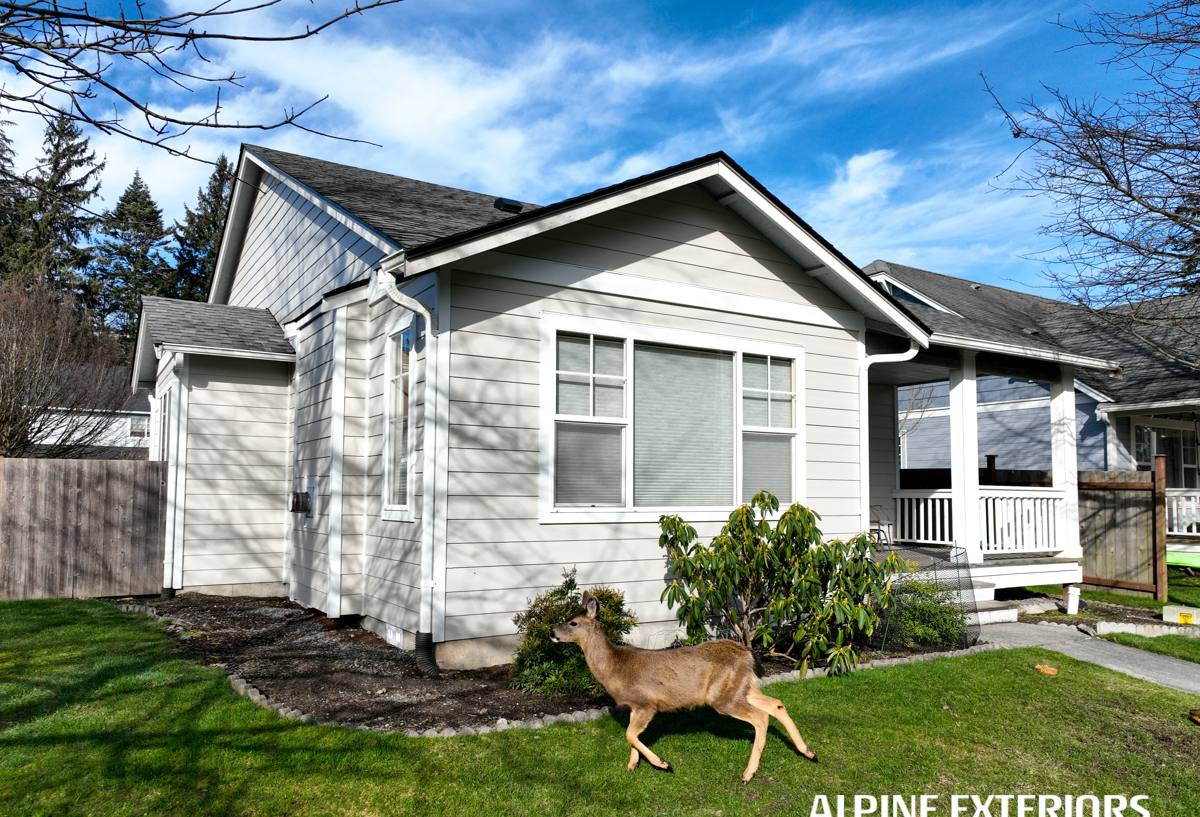
What Bow's Climate Actually Does to a House
Salt Air
Homes closer to Samish Bay and the surrounding tidal flats deal with airborne salt that settles on exterior surfaces. Salt is corrosive to fasteners and metal flashing, and it accelerates the breakdown of coatings and finishes that aren't built to handle it. Over years, a siding product with a weak factory finish will chalk, fade, or start absorbing moisture at a faster rate in a salt-air environment than it would twenty miles inland.
Driving Rain
Western Skagit County gets wind-driven rain, not just straight-down rain. That distinction matters for siding performance. Wind-driven rain gets pushed sideways and upward under laps, around trim, and into any gap in the water-management system. A siding product and installation detail that only handles vertical rainfall will eventually let water in during a real Bow storm.
Moss and Shade
A lot of Bow properties are wooded or bordered by trees, which means long stretches of north- and east-facing wall area that rarely see direct sun. Combined with our wet season, that shade creates ideal conditions for moss, algae, and mildew growth on exterior surfaces. Materials that hold moisture — or that need to breathe and dry out between rain events — struggle in these shaded, damp microclimates. Siding that can't dry properly stays wet longer, and wood-based products in particular are vulnerable to rot when moss and moisture sit against the surface for extended periods.
Why We Standardized on James Hardie
We used to get asked to install a wider range of siding products. We don't anymore, and it's worth explaining why, honestly, rather than just stating a policy.
What Other Products Get Right — and Where They Fall Short Here
Vinyl siding is inexpensive and low-maintenance in mild climates, but it's a petroleum-based product that expands and contracts significantly with temperature swings, and in driving rain it relies heavily on a perfect water-resistive barrier behind it since the panels themselves aren't a true water seal. Engineered wood products like LP SmartSide use a wood-strand core with a resin coating, which performs reasonably in dry climates but is more sensitive to sustained moisture exposure — exactly the condition Bow's shaded, damp walls create. Primed spruce and cedar are attractive, traditional choices, but they're organic materials that require diligent, ongoing maintenance — recoating, caulking, moisture monitoring — to hold up against moss growth and salt air, and even then they're more prone to rot than a fiber cement product.
None of these are "bad" products in every context. They're just not the product we're willing to put our name behind in a climate that combines salt exposure, wind-driven rain, and heavy shade the way Bow's does.
Why James Hardie Fits This Climate
James Hardie fiber cement is non-combustible, dimensionally stable across temperature and moisture swings, and doesn't rot or absorb water the way wood-based siding can. Its ColorPlus factory-baked finish is engineered to resist fading and chipping better than field-applied paint, which matters in a salt-air environment where coatings take a beating. Hardie's HZ5 product line is specifically engineered for climates with harsher moisture and temperature cycling — the kind of engineering that's relevant for a coastal-influenced area like Bow. It also carries a strong, transferable limited warranty, which gives homeowners real protection rather than a marketing claim.
None of that means Hardie siding is maintenance-free or installation-proof. Fiber cement still depends entirely on correct installation — proper clearances, flashing, and fastening — to perform the way it's engineered to. That's the other half of the equation, and it's where a local, experienced crew matters as much as the product itself.
Siding Material Comparison for a Bow, WA Property
| Material | Moisture/Salt Air Performance | Maintenance Need | Typical Lifespan |
|---|---|---|---|
| James Hardie Fiber Cement | Strong — non-combustible, dimensionally stable, factory finish resists fading | Low — occasional wash, no repainting cycle with ColorPlus | Decades with correct install and upkeep |
| Vinyl | Moderate — relies on barrier behind panels; can warp with heat/cold cycling | Low, but limited repair options if damaged | Variable; sun and impact sensitive |
| Engineered Wood (e.g., LP SmartSide) | Moderate — more moisture-sensitive than fiber cement in shaded, damp conditions | Moderate — coating and edge maintenance | Shorter in high-moisture microclimates |
| Primed Spruce / Cedar | Weaker in sustained shade/moisture — prone to rot and moss retention | High — regular recoating, caulking, inspection | Shortest without diligent upkeep |
How We Approach Installation for Bow Conditions
Product choice is half the equation; installation detail is the other half, and it's where a lot of exterior work quietly fails in this region even with good materials.
- Proper rain-screen or drainage gap behind siding so water that gets past the surface has a way to drain and the wall can dry
- Correct flashing at windows, doors, and roof-to-wall transitions — the places wind-driven rain actually finds its way in
- Fastener spacing and clearance details that follow James Hardie's published installation requirements, which is what keeps the manufacturer's warranty intact
- Ground and roofline clearances to reduce moisture wicking and keep siding out of standing water or splash-back zones
- Attention to shaded, north-facing walls where moss and algae growth is most likely, including surface prep that supports better long-term drying
These aren't exotic techniques — they're standard best practice. But they take longer to do correctly, and they're the details that separate siding that performs for decades from siding that starts showing problems in five years.
Roofing, Windows, and Decks: The Full Exterior Picture
Siding doesn't work in isolation. A roof with failing flashing will send water down behind siding no matter how well the siding itself is installed. Windows with degraded seals let moisture into wall cavities from the inside out. Decks in a shaded, damp Bow lot face the same moss and rot pressures as siding, often more acutely because the surface is horizontal and holds water longer.
We work on all four systems — siding, roofing, windows, and decks — because they share the same job: keeping water out of the structure. When one system is neglected, it tends to undermine the others. A homeowner planning siding work in Bow is often better served by having a contractor look at the whole exterior envelope at once, rather than treating each component as a separate project with separate blind spots.
What to Check on Your Own Home
- Moss or dark streaking concentrated on shaded, north- or east-facing walls
- Soft spots, bubbling, or visible warping around window trim and butt joints
- Paint or finish that's chalking, peeling, or fading unevenly, especially on walls facing prevailing wind
- Gaps or cracked caulking where siding meets windows, doors, or trim
- Siding sitting too close to grade, mulch beds, or deck surfaces with little clearance
- Rust staining near fasteners or metal flashing, a sign of corrosion from salt air exposure
Any one of these on its own isn't necessarily an emergency, but a pattern of several is usually a sign that moisture is getting past the surface, and that's worth having looked at before it turns into structural repair.
Why Local Experience Matters in Bow
Skagit County's mix of coastal exposure, rural tree cover, and marine-layer weather isn't identical to conditions twenty or thirty miles inland, and it isn't identical to a fully coastal town either. A crew that works this specific area regularly understands where moss tends to concentrate, which wall orientations take the worst of the wind-driven rain, and how salt air factors into fastener and flashing choices. That local pattern recognition, paired with a single manufacturer we know inside and out, is what lets us install siding that's actually built for what a Bow property faces year after year — not a generic install pulled from a national playbook.
If you're weighing a siding project in Bow — or want a straight opinion on whether your current siding is holding up the way it should — we're happy to take a look. Reach out for a free, no-pressure estimate and we'll walk the property with you and tell you what we actually see.