 Burlington
 Exterior Work for Stanwood-Area Homes
Stanwood sits along the I-5 corridor between Skagit and Snohomish counties, in the kind of low-lying, water-adjacent landscape that's common across northwest Washington. Homes out here take a different kind of beating than homes twenty miles inland. Between the salt air coming off Puget Sound, the steady rain that settles in for months at a time, and the moss and algae that thrive in the shade and damp, an exterior has to work hard just to stay looking decent, let alone hold up structurally. We serve Stanwood as part of our regular coverage area out of Burlington, and we bring the same standards here that we hold to on every job: siding, roofing, windows, and decks installed to last in this specific climate, not a generic one.
This page is about siding specifically, but it's worth saying up front that siding rarely fails in isolation. Water gets in through a roof, a window flashing, or a deck ledger just as often as it gets in through a wall. When we look at a Stanwood home, we're looking at the whole envelope, because that's how water actually behaves.
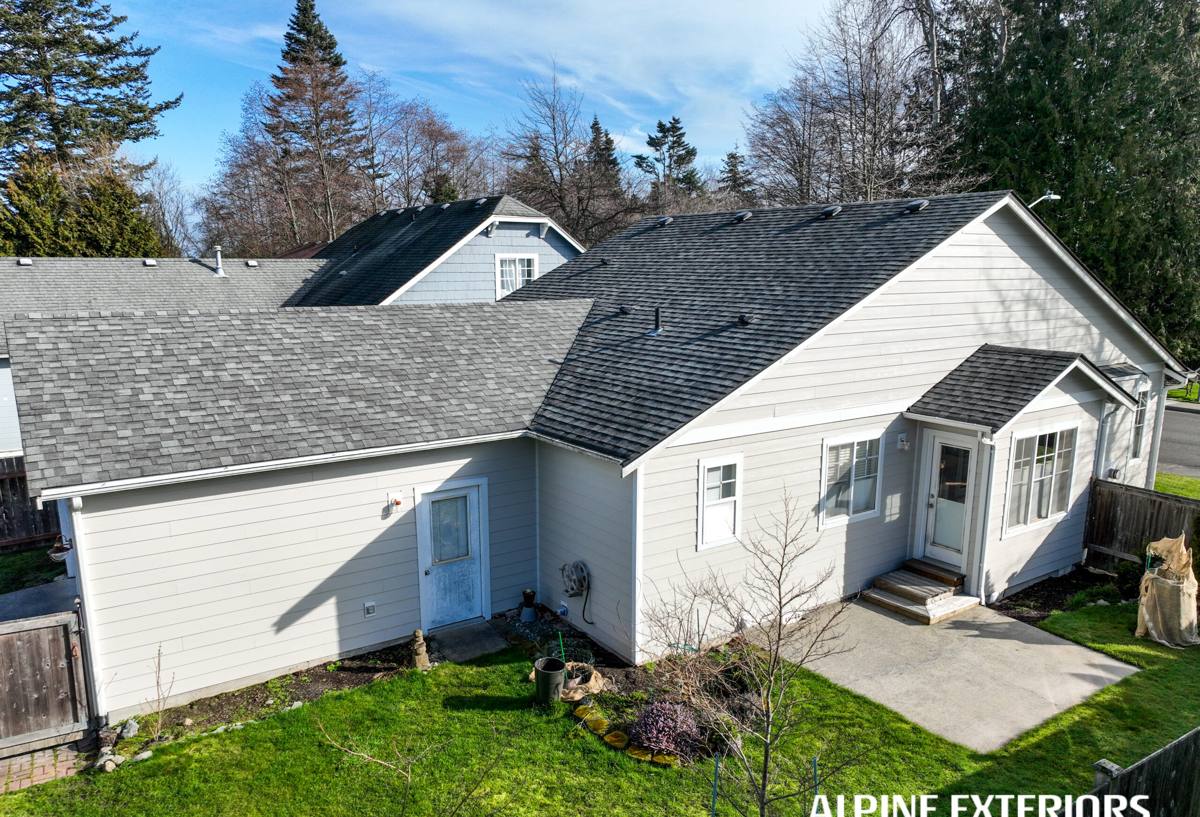
What the Local Climate Does to a House
Salt Air
Proximity to saltwater accelerates corrosion on anything metal — fasteners, flashing, hardware, HVAC components — and it also degrades cheaper paint and coating systems faster than inland exposure does. Homes closer to the water tend to show chalking, fading, and coating breakdown years ahead of similar homes further from the Sound. It's not dramatic, it's just steady wear that adds up.
Driving Rain
Northwest Washington doesn't get hard downpours as often as it gets long, wind-driven rain that comes in sideways for days. That kind of weather finds every weak seam, every under-caulked joint, every spot where flashing was an afterthought. It's less about volume and more about duration and wind-driven penetration, which is why installation detail matters more here than in drier climates.
Moss and Algae
Shaded, damp, north-facing walls and anything under tree cover are prone to moss, algae, and mildew growth almost year-round. This is mostly a cosmetic issue on siding, but it's a real one — some materials hold moisture against the surface and feed the growth, while others shed water and stay cleaner longer. Roofs face the same issue, often worse, since moss on a roof can lift shingles and hold water against the deck.
Why We Install Only James Hardie Fiber Cement
We get asked fairly often why we don't offer vinyl, LP SmartSide, or a primed wood option alongside Hardie. The honest answer is that we made a call, years ago, to standardize on one product system we trust completely rather than carry several and let the customer sort out the trade-offs. James Hardie fiber cement is non-combustible, it's engineered specifically for wet Pacific Northwest conditions in its HZ5 product line, and it carries a factory-applied ColorPlus finish that's baked on rather than field-painted — which matters a lot in a climate that's hard on paint.
We're not going to tell you vinyl or wood siding can't be installed well, because they can. But vinyl expands and contracts with temperature swings and can warp or crack over time, wood requires a maintenance commitment most homeowners underestimate (recoating, caulking, watching for rot), and engineered wood products like LP SmartSide rely on their outer coating staying intact to keep moisture out of the wood-based core. Fiber cement doesn't have that same vulnerability — moisture doesn't cause it to swell, rot, or delaminate the way it can with wood-based products. In a climate like Stanwood's, where damp conditions are the rule rather than the exception for much of the year, that difference in how the base material handles water is the whole reason we standardized on it.
How Hardie Is Engineered for This Climate
James Hardie makes different formulations of its siding for different climate zones across the country, and the HZ5 line is built for regions like ours — freeze-thaw cycles, high humidity, and sustained moisture exposure. The fiber cement itself is a mix of cement, sand, and cellulose fiber, which makes it dense, stable, and resistant to the swelling and cracking that plague less climate-specific products.
The ColorPlus finish is a separate piece of that engineering. It's a multi-coat, baked-on finish applied at the factory under controlled conditions, not brushed or sprayed on-site. That process gives it better fade resistance and adhesion than field-applied paint typically achieves, which is a real advantage in an environment where UV, salt, and moisture all work against a coating over time. It also comes backed by its own finish warranty, separate from the substrate warranty on the siding itself.
Comparing Siding Materials for a Coastal-Influenced Climate
| Factor | James Hardie Fiber Cement | Vinyl | LP SmartSide / Wood-Based | Cedar / Primed Wood |
|---|---|---|---|---|
| Moisture tolerance | High — cement-based, doesn't rot | High, but seams can trap moisture | Moderate — relies on intact coating | Low without diligent upkeep |
| Salt air resistance | Strong with factory finish | Can chalk/fade near saltwater | Coating wears, exposing substrate | Finish breaks down faster near salt |
| Moss/algae resistance | Sheds water, holds finish well | Sheds water but can look dated fast | Prone if coating fails | Prone, especially in shade |
| Fire resistance | Non-combustible | Combustible | Combustible | Combustible |
| Maintenance | Occasional wash, no repainting for years | Low, but limited repair options | Regular coating inspection needed | Recoat/caulk every few years |
This table reflects general product characteristics, not a claim about any specific competitor's installation quality — a well-installed product in any category will outperform a poorly installed one. But material behavior under sustained moisture and salt exposure is a fair, honest basis for comparison, and it's the basis we used when we decided what to put our name behind.
Roofing, Windows, and Decks Alongside Siding
Because we handle the full exterior, a Stanwood siding project often turns into a broader conversation. A few things come up regularly:
- Roofing that's showing moss buildup or granule loss gets flagged during a siding estimate, since a compromised roof edge can undermine new siding at the trim line.
- Windows with failed seals or old aluminum frames are a common source of the drafts and moisture staining homeowners blame on siding.
- Decks built from untreated or aging lumber take the same rain exposure as the siding and often need ledger flashing corrected at the same time siding is opened up.
- Trim, fascia, and flashing details around all of the above are where most real-world leaks actually start.
You don't have to replace everything at once. But if you're already planning siding work, it's worth having someone look at the whole envelope rather than treating each component as a separate problem.
What to Expect From the Process
A typical siding project for a Stanwood-area home starts with an on-site look at the existing siding, sheathing condition where accessible, and any trouble spots — usually around windows, roof lines, and low-clearance areas near grade where moisture sits longest. From there we walk through Hardie product lines and ColorPlus color options, put together a scope and estimate, and schedule around weather windows that work for fiber cement installation.
Installation itself follows manufacturer specifications closely — proper fastener spacing, correct clearances from grade and roofing, and flashing details at every penetration. This is where a lot of the long-term performance difference actually comes from. Fiber cement installed loosely, with the wrong fasteners, or without proper flashing will underperform no matter how good the material is. It's also why we don't treat installation as a generic skill that transfers automatically from other siding types.
Questions Worth Asking Any Contractor Before You Hire
- Are they factory-trained or certified specifically on the product they're proposing to install?
- Will they show you the manufacturer's installation instructions for your specific climate zone?
- What's covered under the manufacturer's warranty versus their own workmanship warranty, and for how long?
- Do they carry current liability insurance and workers' comp coverage you can verify?
- Will they put the material, fastener schedule, and flashing details in writing before work starts?
Why a Local Crew Matters
A crew that works this area regularly knows what north Puget Sound weather does to an exterior over a full year, not just what a spec sheet says. That means knowing which wall orientations tend to grow moss first, which details matter most against wind-driven rain, and how to sequence a job around the region's wet season rather than fighting it. It also means being reachable after the job is done — for warranty questions, for a color-match on a future addition, or just to look at something that's bothering you five years down the line. That kind of accountability is hard to get from a crew that isn't local.
Get an Estimate
If you're weighing siding options for a home in the Stanwood area — or thinking about roofing, windows, or a deck alongside it — we're happy to take a look and talk through what actually makes sense for your house and your budget. There's no pressure and no obligation. Use the form below to request a free estimate.