 Burlington
 Sedro-Woolley's Climate Is Harder on Siding Than It Looks
Sedro-Woolley sits in the Skagit Valley, tucked between farmland, river bottom, and the foothills of the North Cascades. It's a beautiful place to own a home, but the same conditions that make it green year-round are the conditions that wear out exterior siding faster than most homeowners expect. Marine air moves inland off the Sound and up the valley, bringing long stretches of driving rain, heavy morning fog, and humidity that lingers under tree cover and in low-lying yards. Add a moss season that can run eight months or longer in shaded, north-facing spots, and you've got a climate that's constantly testing whatever material is on the outside of your house.
None of this is unique to one street or neighborhood — it's a Skagit County-wide reality, and it's the reason we think about siding differently than a contractor working in a drier part of the state. A product that performs fine in Eastern Washington's dry heat can behave very differently after a decade of Skagit Valley winters.
What Local Homes Actually Face
Driving Rain and Wind-Driven Moisture
Storms coming off the water don't just fall straight down — wind pushes rain sideways into wall assemblies, especially on the windward side of a house. Over time, that means more water finds its way into seams, laps, and trim joints than a homeowner might assume from just watching rain fall in the yard.
Moss, Algae, and Shade
Sedro-Woolley's tree cover and valley humidity are ideal for moss and algae growth, particularly on shaded walls, under eaves, and anywhere air doesn't move much. Moss holds moisture directly against a siding surface for months at a time, which is a much bigger problem for materials that absorb water than for materials that don't.
Freeze-Thaw Swings
Skagit County doesn't get brutal winters, but it does get cold snaps and hard frosts sandwiched between wet, mild stretches. Any siding material that's already holding moisture when a freeze hits is at risk of that moisture expanding and doing damage from the inside out.
Sun Exposure on the Open Side
Where the valley opens up and homes get more direct afternoon sun, siding faces the opposite problem — UV breakdown, fading, and coatings that chalk or peel years before the material itself is worn out.
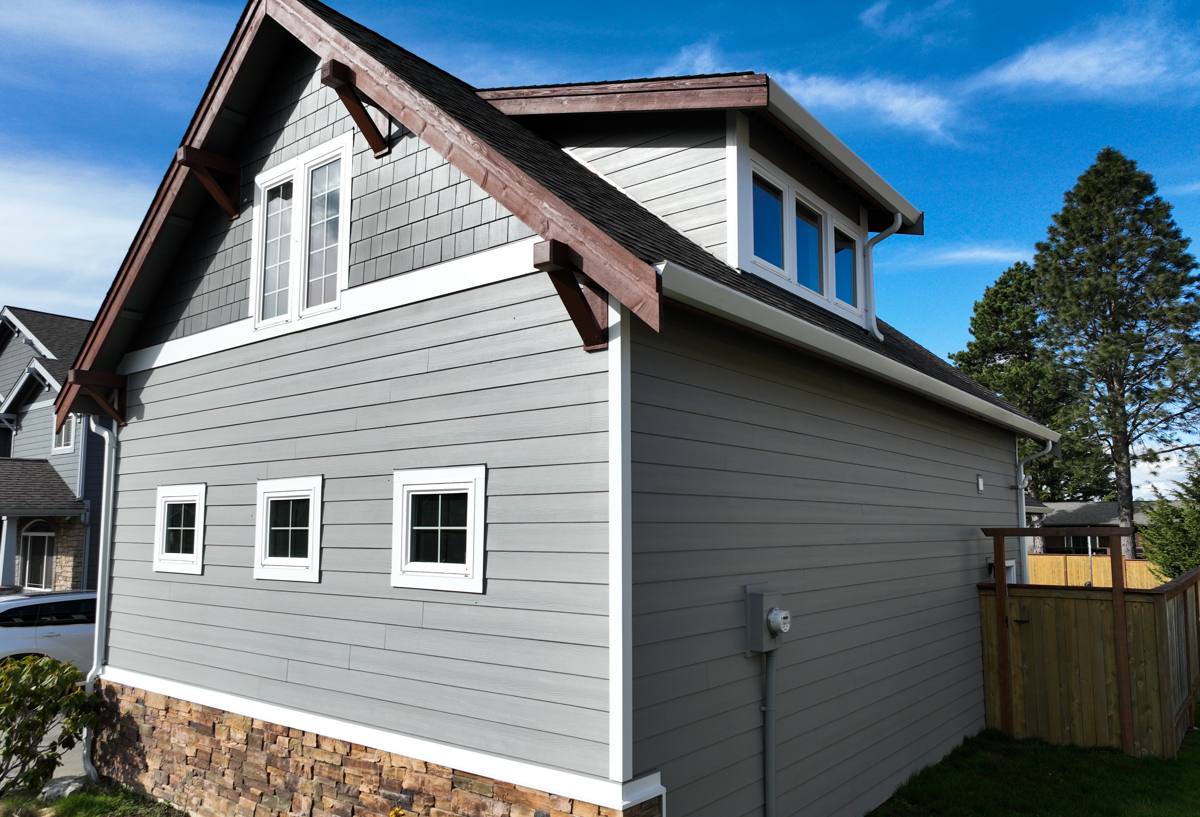
Why We Install Only James Hardie Fiber Cement
We get asked why we don't offer vinyl, LP SmartSide, cedar, or other fiber cement brands. The honest answer is that we've made a professional call, based on years of exterior work in this climate, that James Hardie fiber cement holds up better here than the alternatives — and we'd rather stand behind one product we trust completely than offer several we have reservations about.
- Non-combustible core: Hardie siding is fiber cement, not wood or wood-based, which matters as more Skagit County homes sit closer to wildland areas in the foothills.
- Engineered for wet-climate performance: Hardie's HZ5 product line is formulated for regions with the kind of moisture cycling and freeze-thaw we get here.
- Factory-applied ColorPlus finish: baked-on color resists fading and chipping far better than field-applied paint, and it's backed by its own finish warranty.
- Dimensionally stable: it doesn't swell, cup, or rot the way wood-based products can when they take on moisture repeatedly over years.
- Strong, transferable warranty: when installed to spec, Hardie's product warranty is one of the strongest in the industry and can transfer to a new owner if you sell.
That said, no material is perfect, and we don't pretend otherwise. Fiber cement is heavier to work with than vinyl, it has to be cut and installed correctly to perform as designed, and it costs more up front than lower-tier options. We think that trade-off is worth it for a house that has to survive Skagit Valley weather for decades, not just look good on installation day.
Where We Draw the Line on Other Products
Vinyl Siding
Vinyl is inexpensive and low-maintenance in mild, dry climates, but it can warp or become brittle with repeated wide temperature swings, and it doesn't offer the same fire-resistance or impact durability as fiber cement. We simply don't think it's the right long-term investment for this area.
LP SmartSide
LP SmartSide is an engineered wood product with real strengths — it's lighter than fiber cement and easier to install in some respects. But it's still wood-based, which means it's more vulnerable to moisture intrusion at cut edges and seams than fiber cement, and in a climate with Sedro-Woolley's humidity and moss exposure, that's a maintenance burden we'd rather our customers not carry.
Cedar and Primed Spruce
Natural wood siding can look excellent, but it demands ongoing maintenance — refinishing, caulking, and vigilance against rot — that most homeowners underestimate until they're a few years in. In a climate this wet, that upkeep schedule only gets more demanding.
Siding Options at a Glance
| Material | Moisture Resistance Here | Maintenance Burden | Fire Rating | Typical Lifespan |
|---|---|---|---|---|
| James Hardie Fiber Cement | Strong — engineered for wet climates | Low — factory finish, occasional wash | Non-combustible | 30+ years |
| Vinyl | Fair — can warp with temperature swings | Low, but limited repair options | Combustible | 20-30 years |
| LP SmartSide | Moderate — vulnerable at cut edges | Moderate — sealing and inspection needed | Combustible (treated) | 15-30 years |
| Cedar / Primed Spruce | Weak without diligent upkeep | High — regular refinishing | Combustible | 15-25 years with upkeep |
More Than Siding: Roofing, Windows, and Decks
Siding doesn't work in isolation — it's one piece of a home's exterior envelope, and in a climate like Skagit County's, the pieces need to work together. We also handle roofing, windows, and decks, which matters for a few practical reasons:
- Roof flashing and siding trim have to be integrated correctly at the roofline, or water finds the gap between two contractors' work.
- Window flanges and siding need to be flashed and sequenced properly so wind-driven rain doesn't track behind the window frame.
- Deck ledger boards attach directly to the house structure, and that connection needs the same moisture management attention as siding does.
Having one crew that understands how all four systems interact means fewer gaps in the plan and one point of accountability if something needs attention down the road.
What Correct Installation Looks Like in This Climate
Hardie siding performs the way it's engineered to only when it's installed to manufacturer spec — and in a high-moisture area like Sedro-Woolley, the details matter more than in drier climates.
- A properly lapped weather-resistant barrier behind the siding, with no gaps or shortcuts at seams.
- Correct fastener placement and spacing — fiber cement is unforgiving of guesswork here.
- Proper clearance between siding and grade, decks, and roof lines so water has somewhere to go.
- Flashing at every window, door, and penetration, integrated with the barrier rather than just caulked over.
- Factory-cut and factory-primed edges used wherever possible, since field cuts need to be sealed to maintain the warranty.
What Drives Cost on a Sedro-Woolley Project
| Factor | Why It Matters Here |
|---|---|
| Home size and wall complexity | More corners, gables, and cutouts mean more labor and material waste |
| Existing siding removal | Tear-off and disposal of old material, especially if moisture damage is found underneath |
| Sheathing repair | Rot found during tear-off has to be addressed before new siding goes on — common in older homes here |
| Product line and profile | Lap width, texture, and trim details affect material cost |
| Access and site conditions | Sloped lots, tree cover, and setback distances affect staging and labor time |
Choosing a Contractor: What to Check
- Washington State contractor license and current insurance
- Manufacturer training or certification specific to fiber cement installation
- A written estimate that specifies product line, fastener type, and flashing details — not just a lump sum
- Willingness to explain how they'll handle any rot or moisture damage found once old siding comes off
- Local references or completed work you can actually see in person
- A clear warranty explanation covering both material and labor
Why a Local Crew Matters
A crew that works Skagit County regularly knows which walls in the area tend to hold moss, how the valley's fog patterns affect drying time between install stages, and what kind of moisture damage typically shows up under older siding in this region. That's not something you get from a crew passing through on a one-off job. It also means someone is nearby if a question comes up after the project wraps — not a call center two states away.
If you're weighing your options for a siding, roofing, window, or deck project in Sedro-Woolley, we're happy to take a look and walk you through what we'd recommend for your specific home. Reach out for a free, no-pressure estimate using the form below.