 Burlington
 Homeowners in Burlington and across Skagit County ask us about LP SmartSide often enough that we think it deserves a straight answer instead of a sales pitch. It's a legitimate product with real fans, and plenty of licensed contractors install it well. We're not one of them. This page explains what LP SmartSide is, what it does right, and why our crews only install James Hardie fiber cement siding on the homes we work on.
What LP SmartSide Actually Is
LP SmartSide is an engineered wood siding product. It starts as wood strand material — similar in concept to oriented strand board — that's treated with zinc borate for insect and fungal resistance, then bonded with resins and coated with a factory primer or finish. It's manufactured in lap, panel, and trim profiles, and it's noticeably lighter and easier to cut and nail than fiber cement, which is part of why some crews prefer working with it.
LP has improved the product significantly since the OSB siding failures of the 1980s and 90s that gave engineered wood siding a bad name industry-wide. The current SmartSide line carries a 5/50-year limited warranty and performs reasonably well when it's installed exactly to spec and maintained on schedule. That's the key phrase: exactly to spec, and maintained on schedule.
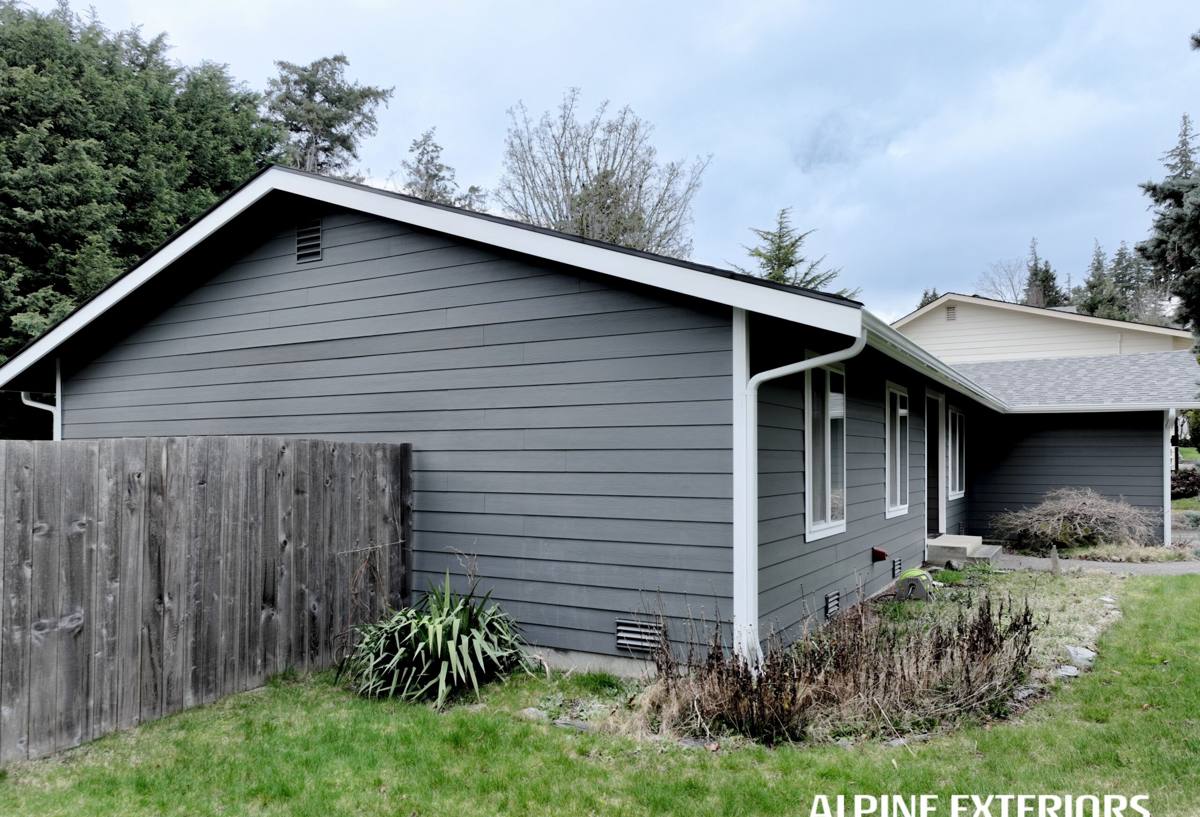
Where It Genuinely Performs Well
- Workability — lighter weight means faster installation and less crew fatigue, which can translate into lower labor cost.
- Impact resistance — wood strand composition holds up to impacts (ladders, hail, stray baseballs) better than vinyl and comparably to fiber cement in many cases.
- Cost — it typically installs for less than premium fiber cement, which matters on a budget-driven project.
- Appearance — the factory finishes and grain textures look good going up, and match well with modern and craftsman-style homes common in the Skagit Valley.
We say this plainly because an honest "why not" page has to acknowledge what the other product does well. If we told you SmartSide was junk, we'd be lying to you, and that's not how we run a business.
The Trade-Off That Matters Here: Moisture and Wood Fiber
Engineered wood siding is still, at its core, a wood product. Wood strand siding is treated to resist moisture and insects, but it is not immune to either — it's resistant, not immune, and resistance depends entirely on the finish layer staying intact and the field-cut edges being sealed correctly every single time.
That distinction is exactly where Skagit County's climate becomes the deciding factor for us. Burlington sits close enough to Puget Sound and the Skagit River delta that salt air, driving rain off the water, and a long moss season — roughly eight to nine months a year of damp, low-sun conditions — are just part of the deal. Any siding product that depends on an intact protective coating to keep water out of a wood substrate is under more stress here than it would be in a drier inland climate.
Why Field Cuts Are the Weak Point
Every corner, window opening, and utility penetration on a real house requires field cuts. Manufacturers specify that cut edges be primed or sealed with an approved sealant before installation. In practice, on a job site, in the rain, with a crew trying to keep pace, that step is the first one that gets rushed or skipped — not out of carelessness, but because it's tedious and weather doesn't wait. An unsealed or under-sealed cut edge is a direct path for moisture into the wood strand core, and once moisture gets in, swelling and delamination follow — sometimes years later, hidden behind a coat of paint that still looks fine from the ground.
Fiber cement doesn't carry that risk because there's no wood fiber to swell. A cut edge on Hardie board is inert cementitious material — it doesn't need the same sealing discipline to hold up over decades.
Maintenance Burden Over the Life of the Siding
SmartSide's warranty and long-term performance depend on repainting or recoating on a schedule the manufacturer sets — typically every 5 to 7 years, sometimes sooner in harsh exposures. Skip that maintenance window and you're not just risking a faded look; you're risking the moisture barrier that protects the wood substrate underneath.
In a climate with this much sustained moisture and moss growth, that maintenance schedule is not a suggestion you can quietly stretch out. We've refinished enough homes in this county to know how easy it is for a repaint to slip from "next spring" to "in a few years" — life gets busy, and by the time it happens, the siding may already be past the point where a fresh coat solves the problem.
| Factor | LP SmartSide | James Hardie Fiber Cement |
|---|---|---|
| Core material | Wood strand composite | Cement, sand, cellulose fiber |
| Moisture vulnerability | Resistant if coating stays intact | Not a moisture-driven failure mode |
| Field-cut sensitivity | High — edges must be sealed correctly | Low — inert material |
| Combustibility | Combustible (wood-based) | Non-combustible |
| Recoat interval | Roughly every 5-7 years | ColorPlus finish rated 15 years before repaint typically needed |
| Typical installed cost | Moderate | Moderate to higher |
| Manufacturer warranty | 5/50-year limited | Non-prorated limited warranty, transferable |
Fire Exposure Is Part of Our Decision Too
Skagit County isn't the Cascade foothills, but wildfire smoke and ember exposure during dry summer stretches have become a real regional concern across Western Washington, and insurance underwriters have taken notice. Fiber cement is non-combustible by composition. Engineered wood siding, even with borate treatment, is still a wood-based product and carries a combustible classification. For us, standardizing on a non-combustible product across every job removes that variable entirely rather than evaluating it house by house.
Why We Draw the Line Here as a Company
We could install LP SmartSide. We know how, and we could do it correctly. The reason we don't is that "correctly" for engineered wood siding means every field cut sealed without exception, every recoat cycle honored on schedule, and a homeowner who stays on top of a maintenance calendar for decades. We can control our own installation quality. We can't control what happens to a paint film 12 years from now, and we don't want to sell a product whose long-term success depends on someone else's future follow-through in a climate that doesn't forgive shortcuts.
James Hardie fiber cement removes that dependency. The core material doesn't rot, doesn't need edge sealant to stay structurally sound, and the ColorPlus factory finish is engineered specifically to hold up under UV and moisture cycling without a repaint every few years. That's a product we can stand behind for the life of the house, not just the life of the installation.
What We Install Instead
Every job we take on uses James Hardie's HZ5 product line, engineered for the Pacific Northwest's moisture and freeze-thaw pattern. It comes in lap siding, panel, and shingle profiles, factory-finished through the ColorPlus system so the color coat is baked on before it ever reaches your house — not brushed on in the field where weather and technique introduce variables. It's non-combustible, backed by a strong transferable warranty, and it holds its look through a full Skagit Valley winter without demanding a maintenance schedule you have to track on a calendar.
Questions Worth Asking Any Siding Contractor
- What warranty coverage does the product carry, and is it prorated or non-prorated?
- What's the manufacturer-specified maintenance schedule, and who's responsible for tracking it?
- How are field cuts and edges treated during installation?
- Is the product rated non-combustible, and does that affect insurance premiums?
- Does the contractor's installation warranty match the manufacturer's material warranty?
The Bottom Line for Burlington Homeowners
LP SmartSide isn't a bad product — it's a product that asks a lot of the homeowner and the climate, and this particular climate doesn't leave much room for that. Salt air, driving rain, and eight-plus months of moss season are exactly the conditions where a moisture-dependent siding system is tested hardest. We'd rather install one product, do it right every time, and stand behind it for decades than offer a menu of options and hope every homeowner keeps up with a recoat schedule for the next 30 years.
If you're weighing your siding options for a home in Burlington or anywhere in Skagit County, we're happy to walk your property, look at your current siding condition, and give you a straightforward, no-pressure estimate for a James Hardie installation — no obligation, no upsell.