 Burlington
 Why Bow Homes Wear Out Siding Faster Than You'd Expect
Bow sits close enough to Samish Bay and Padilla Bay that homes here deal with a mix of weather most siding products were never engineered for: salt-laden air rolling off the water, long stretches of driving rain pushed by wind off the bay, and a moss season that can run from late fall clear through spring. Any one of those on its own is manageable. Together, year after year, they're what actually shortens the life of a siding job.
Salt air is corrosive to exposed fasteners and hard on paint film, which is why chalking, fading, and rust streaking show up faster on Bow-area homes than on similar houses twenty miles inland. Driving rain doesn't just wet the surface of your siding — wind-driven moisture gets forced sideways into laps, seams, and butt joints, which is exactly where a marginal installation fails first. And moss doesn't just grow on your roof. It colonizes the north and west sides of houses, holds moisture against the siding face, and keeps that surface damp far longer than sun-exposed walls ever get to dry.
None of this means siding in Bow is a lost cause. It means the material and the installation both have to be matched to the climate, not just to a budget or a catalog photo.
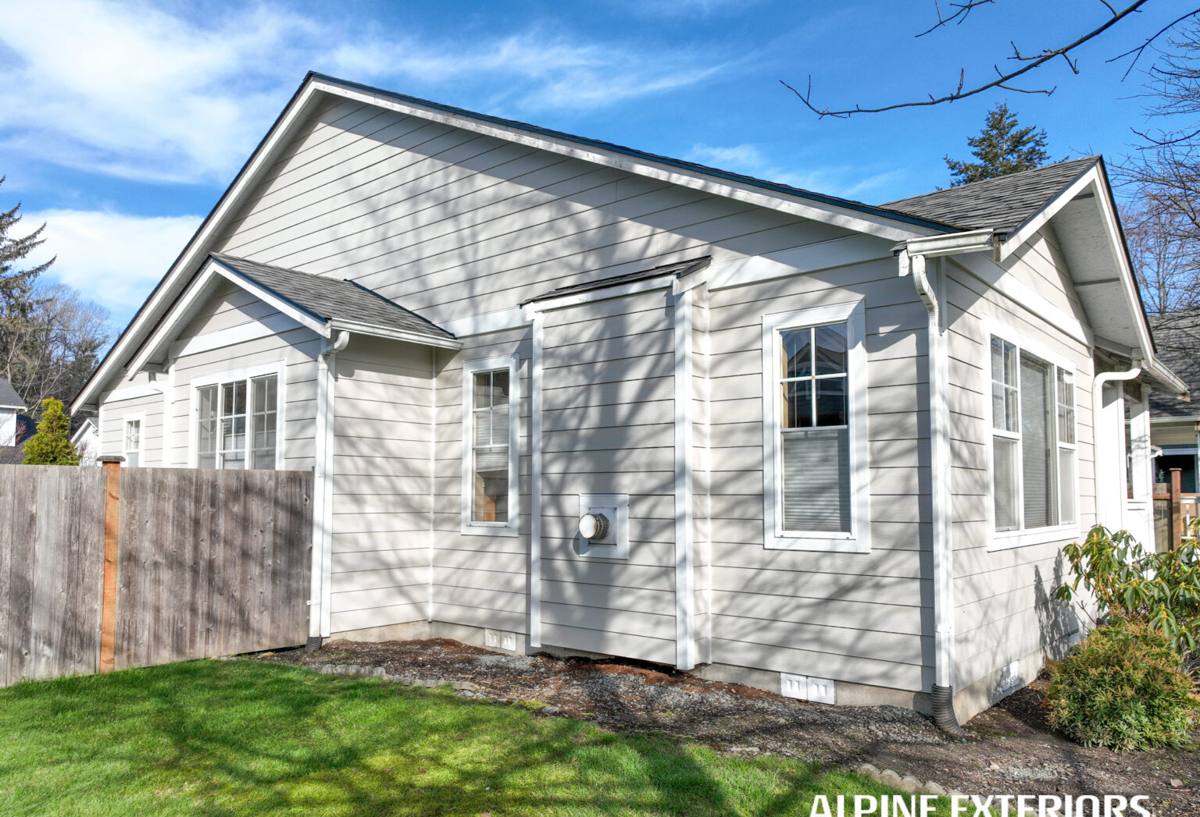
Signs a Bow Home Actually Needs Siding Replacement
Not every siding problem calls for a full tear-off. But there's a point where patching stops making sense and replacement becomes the honest recommendation. On a free estimate, this is what we're actually looking for:
- Soft or spongy spots when you press on the siding, especially near the bottom courses and around windows
- Visible buckling, warping, or cupping boards — often a sign moisture is trapped behind the material, not just on it
- Paint that's failing in patches rather than evenly, which usually means the substrate underneath is already compromised
- Persistent moss or dark staining on the same wall sections every year, even after cleaning
- Gaps opening up at seams, corners, or trim where caulk has failed and hasn't been maintained
- Rising utility bills alongside drafts near exterior walls, which can point to a failing water-resistive barrier behind the siding
- Visible rot at the bottom edge of siding boards, near ground contact, or below leaking gutters
If you're only seeing one or two of these on an otherwise sound wall, targeted repair may still be reasonable. When several show up together, or when they're concentrated on the rain- and wind-exposed sides of the house, that's usually a sign the underlying assembly — not just the surface — needs to be rebuilt correctly.
What a Correct Siding Replacement Actually Involves
Tear-Off and What's Underneath
Replacing siding isn't just swapping old boards for new ones. Once the old material comes off, we're looking at the sheathing underneath for soft spots, delamination, or rot — problems that are invisible until the siding is gone. Any damaged sheathing gets replaced before anything new goes back on. Skipping this step is one of the most common shortcuts in the trade, and it's the reason a siding job can look fine for a year or two and then fail from the inside out.
The Water-Resistive Barrier
Behind the siding, a correctly installed weather-resistive barrier — lapped properly, taped at seams, and integrated with window and door flashing — is what actually keeps driving rain out of your wall assembly. Given how much wind-driven moisture Bow homes see off the bay, this layer matters as much as the siding itself. A good barrier installed under bad siding will outlast bad siding installed over a good barrier, but neither is what you're paying for. You want both done right.
Flashing and Detail Work
Most siding failures don't start in the middle of a wall — they start at the details: window heads, kick-out flashing above roof lines, deck ledger connections, and outside corners. Every one of those transitions needs proper flashing and correct lap sequencing so water is always directed out and down, never trapped or pushed backward into the wall.
Installation to Manufacturer Spec
Fiber cement siding has specific requirements for fastener type, fastener placement, minimum clearances above grade, roof lines, and decks, and joint treatment. These aren't suggestions — installing outside of spec is one of the fastest ways to void a manufacturer warranty, and it's also how you end up with the exact moisture problems the product was designed to prevent.
Why We Install Only James Hardie Fiber Cement
We don't carry vinyl, LP SmartSide, primed spruce, cedar, or other fiber cement brands, and that's a deliberate standard, not a lack of options. In a climate like Skagit County's, the trade-offs of those products tend to show up early: vinyl can warp and become brittle with age and doesn't hold up well to the kind of impact and thermal cycling this region sees; engineered wood products are more sensitive to sustained moisture exposure at cut edges and butt joints than fiber cement is; and untreated or primed wood siding demands a maintenance schedule most homeowners don't realize they're signing up for until the moss and rain start working on it.
James Hardie fiber cement is non-combustible, dimensionally stable in wet-dry cycling, and its ColorPlus factory finish is baked on under controlled conditions rather than field-applied — which matters a lot in a place where you can't always count on a dry week to paint. Hardie's HZ5 product line is specifically engineered for wet, cold-weather climates like ours, and the backed warranty is transferable, which protects resale value as much as it protects the house. It's not the cheapest material on the market. It's the one we're willing to put our name behind on Bow homes.
Comparing Siding Materials for This Climate
| Factor | James Hardie Fiber Cement | Vinyl | Engineered Wood / Primed Spruce |
|---|---|---|---|
| Moisture resistance | Excellent — dimensionally stable, resists swelling and rot | Water-resistant but can trap moisture behind panels if installed loosely | Vulnerable at cut edges and joints if not sealed and maintained |
| Salt air / coastal exposure | Holds up well; factory finish resists chalking and fade | Can become brittle and discolor over time near salt air | Finish and substrate both degrade faster in salt-laden, damp air |
| Fire resistance | Non-combustible | Combustible, can melt or deform near heat sources | Combustible |
| Maintenance burden | Low — factory finish, occasional wash | Low, but repairs and color-matching aging panels can be difficult | Higher — repainting and edge-sealing on a recurring schedule |
| Typical lifespan when installed to spec | Decades, with a transferable warranty | Long, but with visible wear well before failure | Shorter, especially in wet climates without diligent upkeep |
None of this means the alternatives are unusable products everywhere — they're common for a reason, and in drier climates some of these trade-offs matter less. But for a wall that's going to face Skagit County rain and salt air for the next thirty years, the math favors fiber cement, and specifically the version of it engineered for this exact climate.
Our Process, Start to Finish
- Free on-site estimate. We walk the exterior with you, check the worst-exposed walls first, and give you an honest read on whether you're looking at repair or full replacement.
- Written scope and pricing. You get a clear breakdown of what's being replaced, what products are being used, and what's included — no vague allowances.
- Tear-off and sheathing inspection. Old material comes off, and any compromised sheathing is identified and replaced before we move forward.
- Water-resistive barrier and flashing installation. This is the layer that does the real work keeping water out, and it goes in before a single piece of siding.
- Hardie siding installation to manufacturer spec. Correct fastener placement, clearances, and joint treatment, done by a crew that installs this product regularly.
- Final walkthrough. We go over the finished job with you before we consider it done, not before we've been paid.
Cost Factors for a Bow Siding Replacement
| Factor | Why It Affects Cost |
|---|---|
| Extent of sheathing damage found during tear-off | Rotted or delaminated sheathing has to be replaced before new siding goes on |
| Home size and wall complexity | More corners, dormers, and trim details mean more labor and material waste |
| Siding profile chosen | Lap width, shingle-style panels, and board-and-batten each have different material and labor costs |
| Trim and accessory scope | Replacing fascia, window trim, and corner boards alongside siding affects total project cost |
| Access and site conditions | Steep grades, tight lot lines, or limited equipment access can add labor time |
We don't quote broad averages on this page because they'd be meaningless without seeing the house — a small single-story home with simple walls and a larger two-story home with multiple rooflines and dormers are different jobs. What we can tell you is that every estimate breaks these factors out so you know exactly what you're paying for and why.
Why a Crew That Already Works Bow Matters
Siding work in Bow isn't identical to siding work on the dry side of the state, and it's not identical to siding work in downtown Burlington either. A crew that's worked this specific area knows which wall orientations take the worst of the wind off the bay, understands how moss behaves on shaded north-facing walls here, and isn't guessing at how Skagit County's permitting and inspection process works for exterior replacement projects. That local familiarity shows up in small decisions — where extra flashing attention is worth it, which details tend to fail first on homes like yours — that don't show up on a generic estimate.
It also means we're not a crew that shows up once and disappears. If a warranty question or a maintenance question comes up two or five years down the road, we're still working in Bow and still reachable.
Maintenance After Installation
Correctly installed Hardie siding is low-maintenance, not no-maintenance. A rinse-down once or twice a year removes the moss spores and organic buildup that Skagit County's damp winters encourage before they can take hold. It's worth walking the exterior after major windstorms to check for any displaced trim or open caulk joints, particularly around windows and roof intersections, since catching a small gap early is a lot cheaper than dealing with the water damage it can cause if it's ignored for a season or two. Keeping gutters clear also matters more here than in drier climates — overflowing gutters are a direct source of the concentrated water exposure that ages siding fastest at rooflines and corners.
If your Bow home is showing any of the wear signs above, or you're just planning ahead, we're happy to take a look and give you a straight answer — no pressure, no upsell. Fill out the form below for a free estimate.