 Burlington
 Allura Is a Legitimate Fiber Cement Product — Let's Start There
We get this question a lot, usually from homeowners who've already gotten a quote from another contractor pushing Allura: "Is it a bad product?" No. Allura is genuine Portland cement-based fiber cement siding, made with the same basic recipe as every reputable fiber cement product on the market — cement, sand, and cellulose fiber, cured and pressed into planks and panels. It's non-combustible, it doesn't rot, and termites don't eat it. Compared to vinyl or primed wood, it's a real upgrade, and we're not going to stand here and tell you otherwise.
So why don't we install it? Not because it's junk, but because after years of putting siding on homes in Burlington and across Skagit County, we standardized on one manufacturer and one system — James Hardie — and we've found the differences between that system and everything else matter more here than they do in drier, milder climates. This page is about those differences, not about tearing down a competitor's product line.
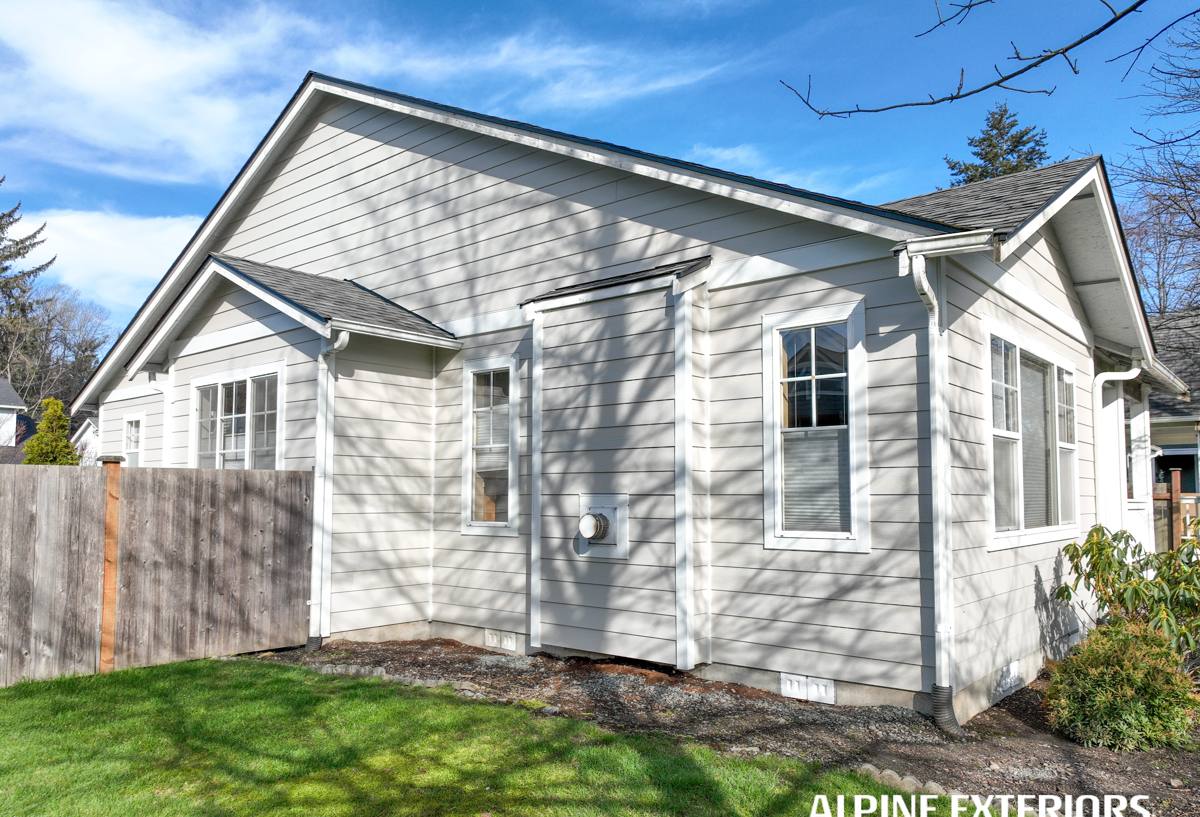
Why Skagit County's Climate Makes the Fine Print Matter
Burlington sits close enough to Puget Sound and Padilla Bay that salt-laden air is a real factor on fasteners, flashing, and any exposed metal trim. Add in driving rain off the Sound, a wet season that stretches from fall through spring, and a moss and algae season that can run most of the year on north-facing walls and shaded elevations, and you've got a climate that's genuinely harder on exterior cladding than most of the country deals with.
In a climate like this, the questions that actually matter aren't "is it fiber cement" — most of what's sold today is. The questions are: how does the coating hold up to years of moisture cycling, how well-engineered is the product for a wet marine climate specifically, who backs the finish warranty and for how long, and can you actually get a matching replacement plank fifteen years from now if a piece gets damaged. Those are the areas where we saw real, practical differences.
Moss and Algae Growth
Anything installed on a shaded north wall or under mature trees in this county will see moss and algae pressure eventually — that's true no matter whose siding is on the wall. What varies is how the factory finish resists staining and how easily it cleans without stripping the coating. This is one of the areas where finish quality and warranty terms end up mattering more than the base material.
Factory Finish: The Part Most Homeowners Never Ask About
Every fiber cement plank needs some kind of finish — paint, primer, or a factory-applied coating system. This is where products diverge more than people expect.
James Hardie's ColorPlus finish is baked on in a controlled factory environment, in multiple coats, with a warranty that covers fading and peeling on the finish itself, separate from the substrate warranty. Allura also offers factory-finished options, and to be fair, factory finishes across the industry have improved a lot over the past decade. But the depth of color options, the consistency of touch-up products available years later, and the length and clarity of the finish-specific warranty are where we saw the real gap when we compared products side by side for our own installs.
If a plank gets scuffed during a move-in or a tree branch scrapes a wall five years down the road, you want a touch-up product that actually matches — not a close guess. That's a small thing until it's your house.
Regional Engineering: One-Size-Fits-All vs Climate-Specific
James Hardie engineers different product lines for different climate zones — its HZ5 line, for example, is built and rated specifically for regions with prolonged moisture exposure and freeze-thaw cycling, which describes western Washington reasonably well. That's not marketing fluff; it affects how the board is formulated and how it's expected to perform over decades of wet winters.
We didn't find the same depth of climate-specific product segmentation from Allura's lineup when we did our comparison. That doesn't make it a bad product for a lot of the country — but for a coastal Pacific Northwest install, we'd rather put a climate-engineered product on a home than a general-purpose one.
Availability and Long-Term Repairs
This is the trade-off that doesn't show up until years after installation. James Hardie has a deep, established distributor network throughout western Washington, which means color-matched replacement planks, trim, and touch-up paint are realistically available a decade or more after your original install. That matters when a delivery truck backs into a wall or a storm cracks a single board — you want a repair that blends in, not a patchwork of near-matches.
Allura is a smaller player in this region. That's not a knock on the manufacturer — it's a straightforward supply chain reality that affects how easy it is for any contractor, us included, to source an exact match years down the road. We factor that into every material decision we make, because we're the ones fielding the call when a homeowner needs a repair five or ten years after the original job.
Warranty Structure: Read Who's Actually Backing It
Every fiber cement manufacturer offers a warranty, and on paper the numbers can look similar. What actually matters is what's covered (substrate versus finish versus labor), whether it's transferable to a new owner if you sell the home, and how established the manufacturer is regionally to actually honor a claim years down the line.
| Factor | What to Ask About | Why It Matters in Skagit County |
|---|---|---|
| Finish warranty | Is fading/peeling covered separately from the board itself? | UV, salt air, and moisture cycling stress the finish first |
| Substrate warranty length | Years covered and what voids it | Long wet seasons mean moisture exposure adds up fast |
| Transferability | Does it transfer to a new owner if you sell? | Protects resale value on a coastal home |
| Regional distributor network | Can a matching plank be sourced in 10+ years? | Repairs are inevitable near driving rain and salt exposure |
| Climate-specific engineering | Is there a product line built for wet marine climates? | Not all fiber cement is formulated the same for moisture cycling |
Installation Sensitivity: The Product Isn't the Whole Story
We want to be honest about something else: fiber cement siding of any brand fails the same way when it's installed wrong. Improper fastener spacing, missing flashing at butt joints, caulk used where a gap should breathe, siding installed too close to grade or a roofline — these installation errors cause more callbacks and premature failures than any difference between manufacturers. A well-installed Allura product will outperform a poorly installed Hardie product every time.
That said, standardizing on one manufacturer lets our crews specialize. Every install detail, every flashing sequence, every fastener spec is dialed in for one system instead of switched between products job to job. In a climate where driving rain finds every gap, that consistency is worth something.
Questions to Ask Any Fiber Cement Contractor
- Is the finish factory-applied or field-painted, and what's covered under warranty?
- Is the product engineered for a wet marine climate, or is it a general-purpose line?
- Can you realistically source a matching replacement plank in 10-15 years?
- What's the flashing and joint-sealing detail at butt seams and window trim?
- Is the crew certified or trained specifically on the product being installed?
- Does the warranty transfer to a new owner if the home is sold?
Cost: Where the Numbers Actually Land
Allura and James Hardie both sit in a similar mid-to-upper range compared to vinyl on the low end and natural wood siding on the high end — fiber cement in general costs more upfront than vinyl but less than most cedar installations, with the payoff being durability and lower long-term maintenance. Material price differences between fiber cement brands tend to be modest; the bigger cost swings come from board profile (lap, panel, shingle-style), trim complexity, and the amount of tear-off and prep work your home needs. We're not going to quote a number here that isn't specific to your home — that's what the estimate is for.
Why James Hardie Is What We Put on Homes
After weighing finish warranties, climate-specific engineering, regional parts availability, and our own installation consistency, James Hardie is the fiber cement system we chose to build our business around. It's not that other fiber cement products are unfit for a home — it's that for a coastal Skagit County climate with salt air, driving rain, and a long moss season, we wanted the product with the deepest regional track record, the strongest factory finish backing, and the best long-term repair support behind it. Standardizing on one manufacturer also means our crews aren't relearning install details from job to job — they're getting better at one system, every single day.
If you're comparing quotes and one of them includes a different fiber cement brand, that's worth asking about directly — not as a red flag, but as a legitimate question about finish warranty, climate rating, and long-term parts availability for your specific home.
If you'd like to talk through your siding options for a Burlington home, we're happy to walk your property, look at sun and moisture exposure on each elevation, and put together a free, no-pressure estimate — no obligation, just straight answers.