 Burlington
 One Product, One Standard
Walk into most siding companies and you'll get a menu: vinyl if you're on a budget, LP SmartSide if you want something in between, fiber cement if you want the best. We don't work that way. Every siding job we take on in Burlington and the rest of Skagit County goes on with James Hardie fiber cement, full stop. No vinyl, no engineered wood, no other fiber cement brand.
That's not a marketing angle. It's a decision we made after years of watching which products actually hold up here and which ones create callbacks. Burlington sits close enough to the Salish Sea and the Skagit River delta that homes deal with salt-laden air, long stretches of driving rain off Puget Sound, and a moss and mildew season that can run eight or nine months out of the year. That combination is unforgiving on the wrong siding material. It's manageable, even easy, on the right one.
This page explains what "the right one" means in practical terms — what James Hardie actually is, why we stopped installing the alternatives, and what correct installation looks like so you know what to expect and what to ask for.
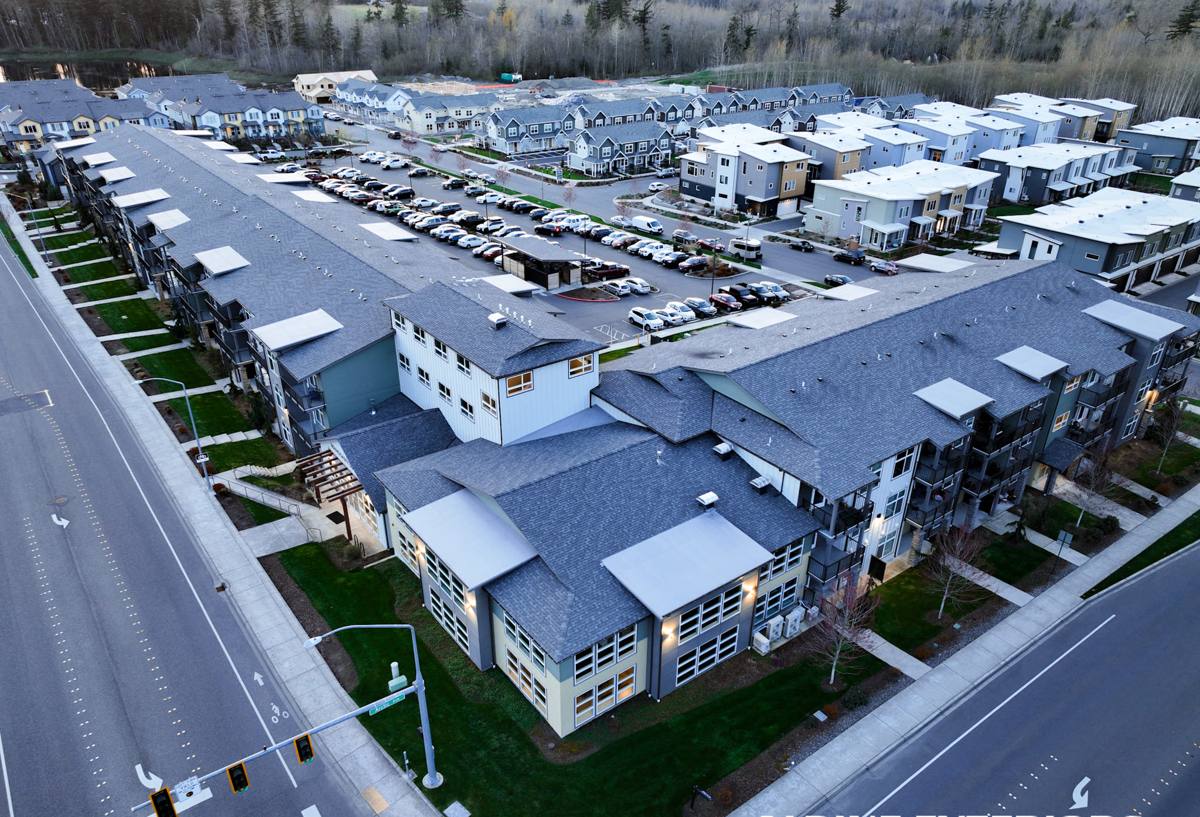
What James Hardie Fiber Cement Actually Is
James Hardie siding is fiber cement: a mix of Portland cement, sand, and cellulose fiber, cured into rigid boards and panels. It's not plastic (vinyl), it's not wood (cedar or primed spruce), and it's not a wood composite (LP SmartSide). That distinction matters more than most homeowners realize when they start comparing products, because fiber cement behaves differently than all three in the ways that matter most in a wet coastal climate.
- It doesn't rot. There's no organic wood fiber for moisture to break down over time.
- It doesn't feed insects. Carpenter ants and moisture-loving pests have nothing to eat.
- It's non-combustible. Fiber cement carries a Class A fire rating, which some insurers and homeowners weigh heavily.
- It holds paint and factory finish far longer than wood-based products because it doesn't expand and contract with moisture the way wood does.
- It resists moss and mildew growth on the surface better than porous or absorbent siding materials, though nothing is immune to Western Washington's growing season without occasional cleaning.
None of this makes fiber cement magic. It has to be installed correctly — proper flashing, proper clearances, factory-cut and factory-primed edges sealed the right way — or you lose most of these advantages. We'll get into that later, because installation quality matters as much as the product itself.
Why We Don't Install Vinyl
Vinyl siding is affordable, low-maintenance in the sense that it never needs painting, and it's genuinely fine for a lot of climates. In Burlington's climate, we see three recurring problems.
First, vinyl is a thin plastic skin, typically 0.040 to 0.046 inches thick, installed to "hang" rather than fasten rigidly, which lets it move with temperature swings. That looseness is by design, but it also means it dents, cracks in cold snaps, and warps if anything reflective (a neighbor's window, a dark-colored surface) concentrates heat on it. Skagit County doesn't get brutal heat, but we do get enough freeze-thaw cycling in winter to make brittle, cold-weather cracking a real issue on older or lower-grade vinyl.
Second, vinyl doesn't stop water — it sheds it, assuming the water-resistive barrier and flashing underneath are done right. Any siding relies on what's behind it, but vinyl gives you zero backup if a seam opens or a panel loosens, because the material itself has no structural rigidity to resist wind-driven rain finding a gap. In a location that gets sustained horizontal rain off the Sound, that's a real vulnerability.
Third, and this is the trade-off homeowners care about most at resale: vinyl reads as a budget material. It can look fine from the street, but it doesn't add the same perceived value or curb appeal as a factory-finished fiber cement product, and it's usually the first thing buyers' inspectors flag if it's had a hard life.
Why We Don't Install LP SmartSide
LP SmartSide is engineered wood strand siding — wood fiber treated with resins and waxes, then coated with a resin-saturated overlay. It's a legitimate step up from raw wood in terms of engineered consistency, and it costs less than fiber cement, which is why it's popular with builders working to a budget.
The problem is what happens at the cut edges and seams over time in a wet climate. SmartSide is still wood at its core. If the factory seal at a cut edge is compromised — a common installation-sensitivity issue — moisture can wick into the strand board and cause swelling or delamination at that point, even though the face of the panel is well protected. In a climate with Burlington's rainfall and humidity, cut-edge sealing has to be perfect on every single piece, every time, for the life of the product, or you're looking at localized failure points years down the road.
We're not saying SmartSide is a bad product when installed to spec by a crew that's meticulous about edge sealing. We're saying we'd rather install a material where that specific failure mode doesn't exist at all, because a Portland-cement-based board doesn't have wood fiber to swell in the first place.
Why We Don't Install Cemplank or Allura
Cemplank and Allura are also fiber cement, and structurally they compete with Hardie on paper. Where we see the gap is in the finish system, the product engineering for regional climates, and the warranty backing.
| Factor | James Hardie | Other fiber cement brands |
|---|---|---|
| Factory finish | ColorPlus baked-on finish, engineered for UV and moisture resistance | Varies by brand; some rely more on field-applied paint |
| Climate engineering | HZ5 product line specifically engineered for Pacific Northwest freeze-thaw and moisture exposure | Typically one general-purpose formulation |
| Warranty structure | Long-term, transferable limited warranty backed by a company with decades in fiber cement | Warranties exist but vary widely in length and transferability |
| Regional supply and support | Established distribution and installer training network in Western Washington | Less consistent regional support in this market |
We install one fiber cement brand for the same reason we don't juggle three different flashing details or three different caulk systems: consistency is what keeps a crew sharp. Hardie's HZ5 formulation was engineered for exactly the kind of high-moisture, moderate-freeze climate Skagit County sits in, and that's a meaningful edge over a general-purpose formulation.
Why We Don't Install Primed Spruce or Cedar
Real wood siding has a look that some homeowners genuinely prefer, and we understand the appeal. But primed spruce and cedar both require an ongoing maintenance commitment — recaulking, repainting or restaining on a multi-year cycle, and vigilance about any spot where the finish has worn through — that most homeowners underestimate when they choose it. In a climate with Burlington's rainfall totals and moss pressure, an unmaintained wood surface starts showing rot and moss growth faster than most other materials, and the repair, once rot sets in, usually means replacing boards rather than patching them.
Cedar in particular is a beautiful material in the right hands with the right maintenance budget. We just don't think it's the right fit for a standard residential install where most homeowners want to set siding and not think about it again for 30 years.
What Correct James Hardie Installation Involves
Buying the right product doesn't guarantee the right result. Fiber cement's durability depends heavily on installation details that are easy to shortcut and hard to inspect after the fact.
The details that matter most
- Proper clearance from grade and roof lines — Hardie specifies minimum clearances (typically 6 inches from grade, 2 inches from roofing) to keep splash-back and roof runoff off the bottom edge of the boards.
- Correct fastener pattern and type — over- or under-driven nails, or the wrong fastener for the substrate, compromise both the water管理 and the warranty.
- Rain-screen or proper water-resistive barrier behind the siding — this is what actually manages bulk water, and it matters more in Skagit County's climate than almost anywhere else in the state.
- Sealed cut edges — any field cut needs factory-matched primer or sealant on the exposed edge before installation.
- Proper joint and butt-seam treatment — gaps sized and caulked (or left open per spec, depending on the detail) exactly as Hardie's installation guide specifies for the region.
Skip any one of these and you can end up with moisture problems on a product that's otherwise engineered to resist them. This is a big part of why we standardized on one product: our crews install the same details, the same way, on every job, instead of relearning a new manufacturer's spec sheet each time.
The James Hardie Product Lines We Work With
Hardie makes several distinct product lines, and picking the right one is part of the job, not an upsell.
- HardiePlank lap siding — the most common choice for full re-sides, available in several textures and exposures.
- HardiePanel vertical siding — often used for accent areas, gables, or a more modern look.
- HardieShingle — a shingle-profile option for homes wanting a more traditional or coastal look without real cedar shingles.
- HardieTrim — matched trim boards so the whole exterior envelope, not just the field siding, is fiber cement.
Most of what we install carries the ColorPlus factory finish — a baked-on, UV-cured color coat applied under controlled conditions, rather than field-painted after installation. Field paint is available on primed Hardie board, but ColorPlus consistently outperforms it for long-term color retention, which matters given how much gray, low-angle daylight this region gets for the panel to hold color true under.
Warranty: What You're Actually Getting
James Hardie backs its fiber cement products with a long-term limited warranty (30 years is standard on most current lap and panel products) and ColorPlus finishes carry their own separate finish warranty. Both are transferable to a subsequent homeowner within the warranty terms, which is a real factor if you plan to sell within the warranty period — it's a selling point buyers' agents recognize.
Warranty coverage is tied to installation per Hardie's published specifications, which is another reason installation quality isn't optional. A warranty claim can be affected by improper clearances or fastening, so the contractor doing the install is effectively part of what you're buying, not just the material.
What This Means for Your Project
If you're planning a re-side in Burlington, Mount Vernon, Sedro-Woolley, or elsewhere in Skagit County, here's what to actually evaluate before you sign anything:
- Ask which specific fiber cement product line and profile is being quoted, not just "Hardie siding."
- Ask whether the quote includes ColorPlus factory finish or field-applied paint over primed board.
- Confirm the contractor is a certified or experienced Hardie installer, not someone installing it for the first time on your house.
- Ask what rain-screen or water-resistive barrier system is being used behind the siding.
- Get the clearance details (grade, roofline, deck) in writing, not just verbally.
We'd rather walk you through these details in person, on your own house, than have you guess at them from a brochure. If you're weighing a re-side or want a straight answer on what your current siding situation actually needs, reach out for a free, no-pressure estimate — we'll look at what you have now and tell you honestly what we'd recommend.