 Burlington
 Cedar Has Real Appeal — Let's Start There
Cedar siding has been used on homes in the Pacific Northwest for well over a century, and it's easy to understand why homeowners in Burlington still ask about it. Real wood grain, a warm natural color that can be stained in dozens of tones, and a material that feels authentic to this region — cedar checks a lot of boxes on looks alone. It's also a renewable resource, and when it's fresh off the mill, few products photograph as well on a custom or craftsman-style home.
We're not going to tell you cedar is a bad product. Old-growth cedar, properly milled, has natural resistance to rot and insects that other softwoods don't have. The issue isn't the wood itself — it's what happens to that wood once it's nailed to a wall in Skagit County and left to face forty-plus years of Pacific Northwest weather with only a paint or stain film standing between it and the elements.
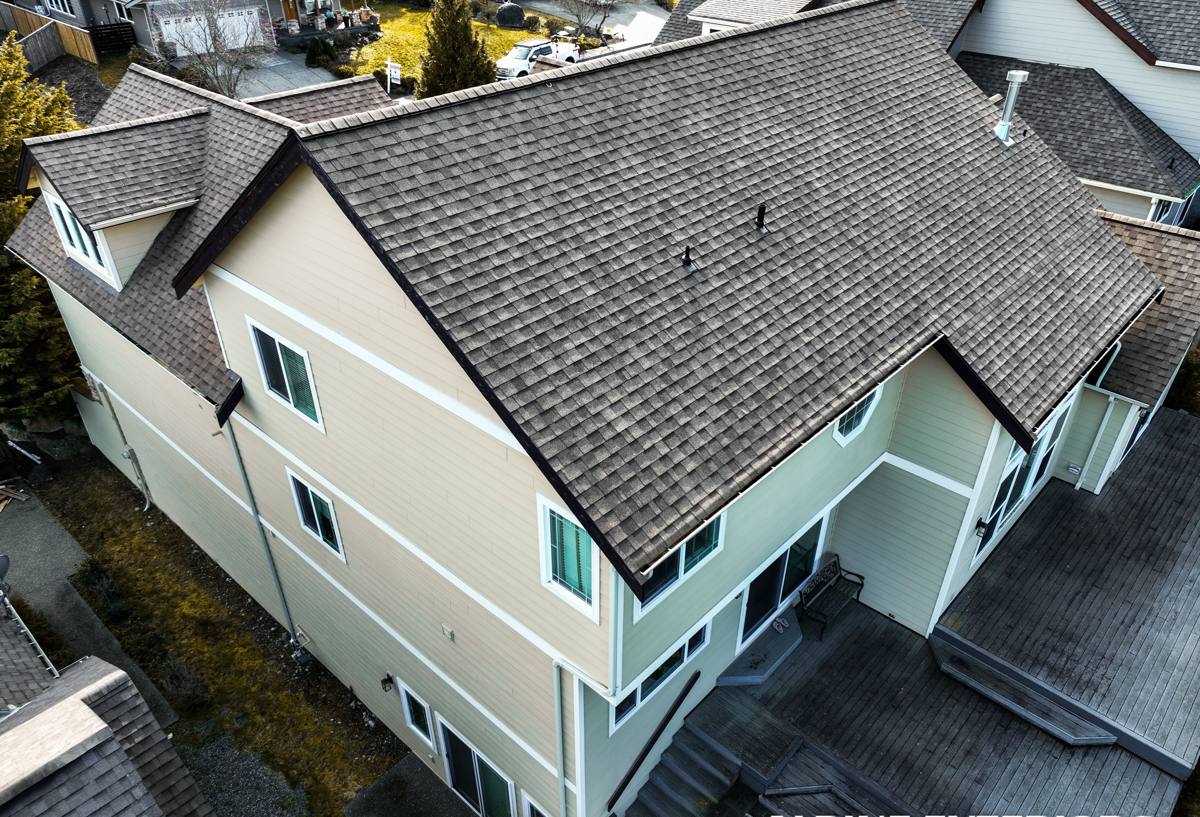
Why Skagit County Is a Tough Environment for Any Wood Product
Burlington sits in a stretch of Western Washington that combines several conditions wood siding handles poorly when combined together:
- Salt-influenced air. Proximity to Padilla Bay and the Puget Sound corridor means airborne moisture carries salt content that accelerates finish breakdown and can contribute to fastener corrosion over time.
- Driving rain. Storms here don't just fall straight down — wind-driven rain off the Sound gets pushed sideways into wall assemblies, finding every seam, end-cut, and nail head that isn't perfectly sealed.
- A long moss and algae season. Skagit County's mild, wet winters and shaded lots (especially under mature fir and cedar trees) create months of ideal growing conditions for moss, algae, and mildew on north- and west-facing walls.
- Short drying windows. Even in summer, morning dew and marine-layer humidity mean wood siding often doesn't fully dry out between rain events, especially on shaded elevations.
None of these conditions are unique to Burlington — they describe most of the I-5 corridor from Bellingham to Olympia. But taken together, they add up to one of the more demanding climates in the country for a siding material that depends on an intact finish to keep water out.
What Cedar Maintenance Actually Looks Like Over Time
The sales pitch for cedar usually focuses on year one, when the wood is fresh and the finish is new. The maintenance reality shows up in years three through fifteen, and it's worth walking through honestly.
Refinishing Is Not Optional — It's Scheduled
Stain and paint on cedar break down under UV exposure and moisture cycling. In our region, that typically means:
- Semi-transparent stain: recoat every 3-5 years, sooner on south and west exposures that take direct sun.
- Solid-body stain or paint: recoat every 5-8 years, with spot touch-ups likely in between.
- Full strip-and-refinish (if the finish has failed badly): a much bigger job that involves sanding or media-blasting the old coating off before recoating.
Skip a cycle, and you're not just risking a faded look — you're letting bare wood soak up moisture unprotected, which is where the real damage starts.
Moss and Algae Cleaning
Shaded walls and north-facing elevations in Burlington routinely grow moss and green algae film within a year or two of a fresh finish. Left alone, moss holds moisture directly against the wood and roots into the grain, which both stains the surface and feeds ongoing decay underneath. Keeping cedar looking clean here usually means annual or biannual soft-washing, and homeowners need to be careful — pressure washing wood siding too aggressively strips the finish and drives water into seams.
End-Cuts, Caulk Joints, and Nail Heads
Every board end, every window and door trim joint, and every fastener is a potential water entry point. Caulk joints on cedar shrink, crack, and need to be inspected and redone periodically. Exposed end-grain — even when factory-primed — is one of the fastest places for rot to start if it isn't field-sealed and kept sealed.
What Happens When Maintenance Slips
We've been in enough attics, crawlspaces, and torn-off wall sections around Skagit County to know what deferred cedar maintenance looks like a decade or two later. It's rarely dramatic — it's usually quiet, progressive rot starting at the bottom of boards, around window trim, or behind trim boards where nobody's looking:
| Warning Sign | What It Usually Means |
|---|---|
| Soft or spongy spots when pressed | Active rot below the surface finish |
| Peeling or alligatored paint/stain | Finish has failed; wood underneath is exposed to moisture cycling |
| Dark staining at board ends or laps | Water is being held at a joint instead of shedding |
| Persistent moss regrowth within months of cleaning | Chronic moisture retention on that wall section |
| Warped or cupped boards | Repeated wet/dry cycling stressing the wood fibers |
Once rot sets in behind cedar siding, the repair isn't cosmetic. It often means removing siding to inspect and replace sheathing or framing, which turns a maintenance item into a structural repair bill.
The Cost Conversation Nobody Has Up Front
Cedar siding's material cost is competitive, and sometimes lower than fiber cement, at the time of install. What's rarely part of that initial conversation is the total cost of ownership over 20-30 years — recoating cycles, cleaning, caulk maintenance, and the real possibility of repair or replacement if a maintenance cycle gets missed during a busy stretch of life. We'd rather have that conversation with you before the siding goes up, not after a wall section needs to come apart.
Why We Standardized on James Hardie Instead
After years of doing tear-offs and repairs on wood siding across Skagit and Whatcom counties, our company made a decision: we only install James Hardie fiber cement siding. Not because cedar is a bad product in the abstract, but because Hardie's engineered fiber cement performs differently in exactly the conditions that give cedar trouble here:
- Non-combustible material that doesn't feed fire the way wood products can.
- ColorPlus factory-baked finish — the color and protective coating are cured at the factory under controlled conditions, not brushed or sprayed on-site, which means far more consistent, long-lasting coverage than field-applied stain.
- HZ5 climate-engineered formulation designed for wet, freeze-prone regions like ours, built to resist moisture-driven damage better than standard-mix fiber cement.
- Dimensionally stable — it doesn't swell, cup, or warp with humidity swings the way solid wood does, which means caulk joints and paint lines stay intact longer.
- A strong transferable warranty backed by the manufacturer, which matters both for your own peace of mind and for resale.
None of that means Hardie is maintenance-free — no exterior product is. It still needs periodic washing and eventually a repaint, and it still has to be installed correctly, with proper flashing, clearances, and fastening, to perform as designed. But the maintenance burden is meaningfully lighter than wood, especially against moss, algae, and finish failure, which are the exact problems this climate creates.
If You Already Have Cedar Siding
If you're a Burlington homeowner with existing cedar siding, this isn't a page telling you to panic or replace it prematurely — well-maintained cedar can last a long time. It's worth knowing what to watch for:
- Walk the exterior twice a year (spring and fall) and press-test any soft-looking boards, especially near grade, decks, and window sills.
- Keep gutters and downspouts clear so roof runoff isn't dumping extra water onto siding.
- Trim back vegetation and tree canopy that's keeping walls shaded and damp.
- Recoat on schedule rather than waiting until the finish visibly fails.
- Address caulk gaps and exposed end-grain promptly — these are the cheapest problems to fix early and the most expensive to fix late.
When cedar does reach the point of major refinishing or repair, that's often the right moment to compare the cost of another full refinish cycle against converting to a fiber cement system that won't need repeating.
Making the Right Call for Your Home
Every siding decision is a trade-off between upfront cost, appearance, and long-term maintenance reality. We install James Hardie because, for the climate we work in — salt air, driving rain, and months of moss pressure every single year — it's the product that has held up best against the problems we see over and over in older Skagit County homes. If you're weighing cedar, Hardie, or trying to figure out what's already on your walls and how much life it has left, we're glad to take a look and give you a straight answer, even if that answer is "your current siding is fine for now." Reach out for a free, no-pressure estimate and we'll walk your home with you.