 Burlington
 Why Sedro-Woolley Roofs Take a Different Kind of Beating
Sedro-Woolley sits where the Skagit Valley's river-bottom moisture meets marine air pushed inland from Puget Sound, and that combination is hard on a roof. Homes here deal with long stretches of driving rain in the fall and winter, a marine layer that keeps humidity high even between storms, and enough shade from surrounding timber and mature trees that moss gets a foothold and never really lets go. Add in a trace of salt carried on the westerly air, and you've got three separate stresses working on the same shingles and flashings year-round.
None of that means a roof here is doomed to fail early. It means the roof has to be built with those specific conditions in mind — not installed the same way you'd build one in a dry inland climate and hope for the best.
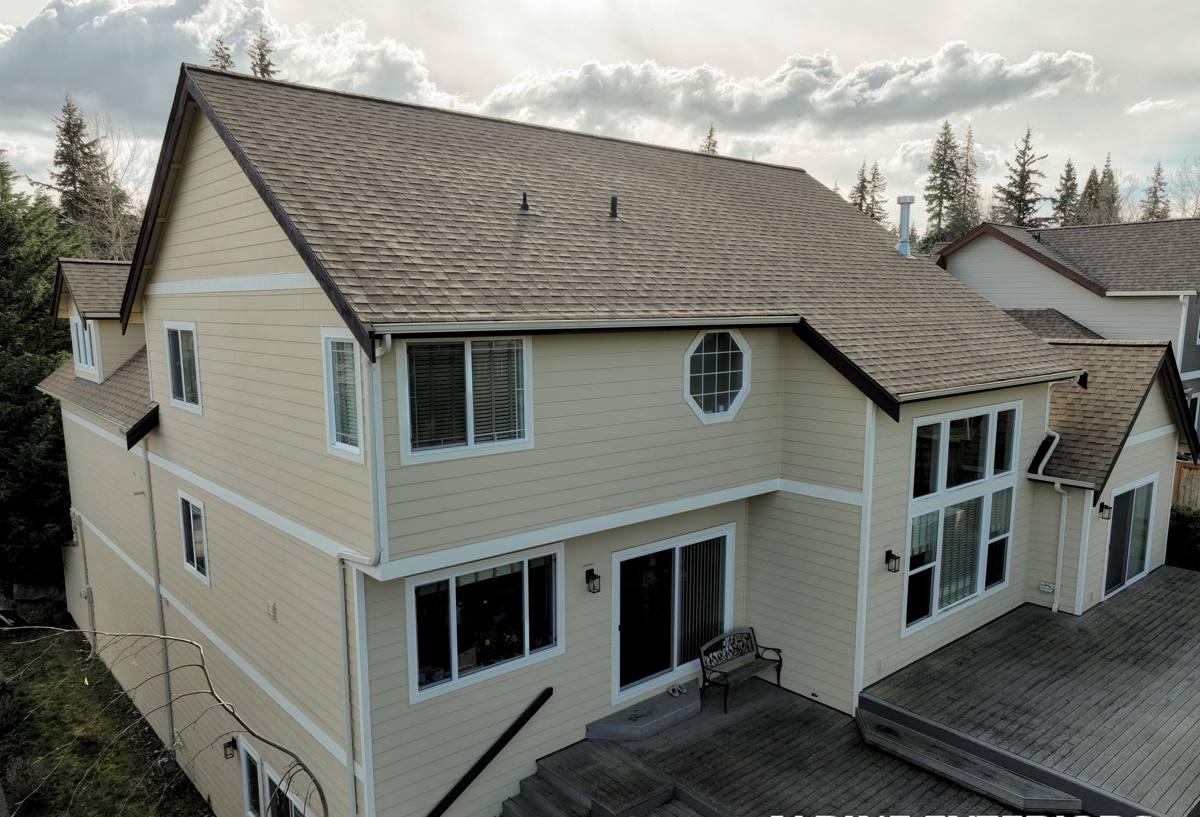
Signs a Sedro-Woolley Home Needs a Full Roof, Not Another Patch
Plenty of roofs get repaired when they should be replaced, which usually just delays a bigger bill. Here's what tells us a full new roof is the honest recommendation rather than another round of patchwork:
- Granules collecting in gutters and downspouts, leaving shingles looking bald or gray in patches
- Moss forming a solid mat rather than scattered spots, especially on north-facing or shaded slopes
- Shingles cupping, curling, or cracking when you look at them from the ground
- Daylight or water staining visible on the attic sheathing
- Soft or spongy spots underfoot when we walk the roof
- Repeated leak calls to the same area of the roof over the past couple of years
- An asphalt shingle roof already past the 20-25 year mark, regardless of appearance
If a roof is only showing one or two of these and the decking underneath is sound, a repair can still make sense. Once several stack up together, patching is just spending money to buy a little more time before the same money gets spent again.
What a Correct New Roof Installation Actually Involves
Tear-Off and Deck Inspection
We remove the old roofing down to bare decking rather than layering over it. That's the only way to actually see the plywood or plank sheathing underneath, which is where years of trapped moisture do their real damage. Any soft, delaminated, or rotted decking gets replaced before anything new goes down — skipping this step is the single most common shortcut that leads to a roof failing well before its warranty runs out.
Underlayment and Water Barrier
Given how much sustained, wind-driven rain this area gets, we don't treat underlayment as an afterthought. A synthetic underlayment goes down across the full deck, with self-adhering ice-and-water membrane at the eaves, valleys, and any low-slope transitions — the places where wind-driven rain is most likely to work its way backward under the shingles.
Flashing Details
Flashing failures cause more leaks than worn-out shingles do. That means proper step flashing at every wall intersection, kick-out flashing where a roof edge meets a wall (a detail that's frequently missed and is a common source of hidden siding rot), and solid metal in the valleys rather than relying on shingles alone to shed water in a high-flow area.
Choosing Materials That Actually Hold Up Here
There's no single "best" roofing material — the right choice depends on how much moss and moisture exposure the specific roof gets, the budget, and how long the homeowner wants to go before thinking about it again.
| Material | Moss & Algae Resistance | Rain/Wind Performance | Typical Lifespan | Maintenance |
|---|---|---|---|---|
| Standard asphalt shingle | Fair without treatment | Good when installed correctly | 18-22 years in this climate | Periodic moss treatment recommended |
| Algae-resistant (AR) architectural shingle | Good — copper/zinc granules resist algae growth | Good to very good | 25-30 years | Lower, but not maintenance-free |
| Standing seam metal | Excellent — moss struggles to grip a smooth metal surface | Excellent | 40-50+ years | Low |
| Synthetic/composite shingle | Good | Very good | 30-40 years | Low to moderate |
For homes with heavy tree cover or a shaded, north-facing roof plane, we usually steer people toward an algae-resistant shingle at minimum, since a standard shingle in that spot will grow moss again within a few seasons no matter how well it's installed. Metal costs more up front but earns that back over decades in a climate like this one.
Ventilation and Moisture Control
A new roof is only as good as the airflow underneath it. Balanced intake at the soffits and exhaust at the ridge keeps the attic space closer to outside temperature and humidity, which does two things: it slows moss regrowth by reducing the moisture the roof deck holds onto, and it prevents the kind of condensation that rots sheathing from the inside — often the real cause of a "roof leak" that turns out to have nothing to do with the shingles at all. On a re-roof, we check existing ventilation and correct it if intake and exhaust aren't balanced, rather than just matching whatever was there before.
Our Installation Process, Start to Finish
- On-site inspection and written estimate — we walk the roof and attic, not just look from the ground, and give you a clear scope in writing.
- Material selection — we go over the honest trade-offs for your specific roof, not just the most expensive option.
- Permitting and scheduling — pulled through the appropriate city or county jurisdiction, with the tear-off timed around a dry weather window whenever possible.
- Tear-off and disposal — old roofing removed and hauled off the same day work starts on that section.
- Deck repair — any compromised sheathing replaced before new materials go down.
- Underlayment, flashing, and new roofing installed — including the ventilation corrections noted during inspection.
- Final walk-through and cleanup — including a magnetic sweep for stray nails and debris removal.
- Warranty paperwork — both workmanship and manufacturer coverage explained plainly, not buried in fine print.
What Affects the Cost of a New Roof in This Area
| Factor | Why It Matters |
|---|---|
| Roof pitch and complexity | Steep or cut-up roofs with multiple valleys and planes take longer and need more flashing work |
| Number of layers to remove | Homes with an existing layer (or two) over the original roof mean more tear-off labor and disposal |
| Decking condition | Hidden rot from years of moisture means sheathing replacement, which isn't known until tear-off |
| Material choice | Standard shingle, algae-resistant shingle, and metal all carry different material and labor costs |
| Roof size and number of squares | The most direct driver of material and labor quantity |
| Accessibility | Steep grades, limited driveway access, or tight lot lines can affect equipment and staging |
We don't give ballpark numbers over the phone for a full replacement — too many of these factors only show up once we're actually on the roof and in the attic. What we can promise is a written estimate that breaks the scope down clearly before any work starts.
Why Hiring a Crew That Already Works Sedro-Woolley Matters
A roofing crew that works this specific area regularly picks up things a crew unfamiliar with Skagit County won't think to check. They know which lots — usually the shaded, tree-lined ones on the north and east sides of a roof — hold moisture and moss the longest, and plan the material and ventilation accordingly. They know how to time a tear-off so a roof isn't left open overnight during an unpredictable rain window, which matters far more here than in a drier climate. They're also familiar with the age and framing common to homes in and around Sedro-Woolley and Burlington, which helps when older decking or non-standard rafter spacing turns up mid-project instead of becoming a surprise change order.
Protecting Your New Roof Once It's Installed
A well-installed roof still needs a little attention over the years, especially in a climate that grows moss on command. A few habits go a long way:
- Keep gutters and downspouts clear so water isn't backing up under the roof edge
- Trim back overhanging branches to cut down on shade, debris, and moss-friendly conditions
- Have moss growth treated before it forms a solid mat, not after
- Watch for granule buildup in gutters as an early sign of shingle wear
- Get the attic ventilation checked every few years, especially after any other exterior work
- Keep your workmanship and manufacturer warranty documents somewhere you can actually find them
If your Sedro-Woolley or Burlington home is showing any of the wear signs above, or you'd just like a straight answer on whether a repair or a full replacement makes more sense, we're happy to take a look. Reach out for a free, no-pressure estimate using the form below.