 Burlington
 Siding Repair in Sedro-Woolley: Catching Damage Before It Spreads
Not every siding problem in Sedro-Woolley calls for a full tear-off. A cracked board near a downspout, a soft patch under a window, a section of trim that's finally given up after one too many wet winters — these are common, fixable problems, and jumping straight to full replacement isn't always the right call or the honest one. At the same time, Sedro-Woolley sits in a part of Skagit County where salt air drifting up the valley, driving rain off Puget Sound weather systems, and a moss season that runs most of the year all combine to turn small, ignorable damage into structural problems faster than homeowners expect. Knowing which siding problems are a quick, targeted repair and which ones are the first visible sign of something bigger underneath is most of what separates a good repair job from a wasted one.
We install and repair James Hardie fiber cement siding exclusively across Skagit County, including Sedro-Woolley. When we're called out for a repair, our first job is an honest read on what's actually happening behind the damaged section — not just patching the visible symptom.
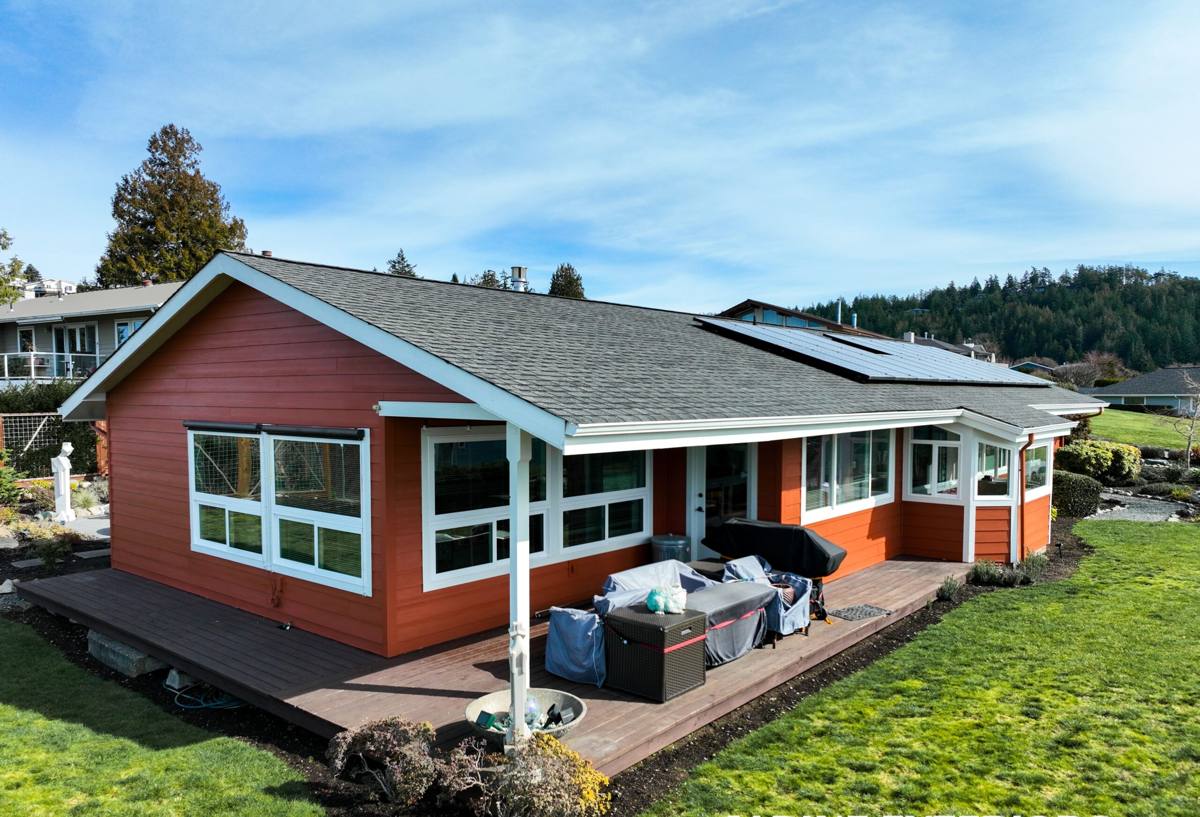
What Sedro-Woolley's Climate Does to Siding, One Season at a Time
Driving Rain Off the Valley
Weather systems moving in from Puget Sound get funneled and intensified as they push up the Skagit Valley, and Sedro-Woolley catches a real share of that driving rain. Wind-driven rain doesn't fall straight down — it's forced sideways into seams, laps, and trim joints, which is exactly where small cracks and gaps turn into moisture intrusion if they sit unrepaired through a few storm cycles. A repair that looks cosmetic in July can be the reason water is tracking behind the wall by the following February.
A Moss Season That Doesn't Really End
Mild temperatures, filtered light from tree cover, and near-constant moisture add up to a moss and mildew season that runs most of the year in this part of Skagit County. Moss doesn't just look bad — it holds water against whatever it's growing on, and on siding with any surface porosity or existing damage, that trapped moisture accelerates rot and finish failure. Repair work in Sedro-Woolley almost always includes checking for moss establishment around and behind the damaged area, not just fixing the crack or gap itself.
Salt Air Reaching Inland
Sedro-Woolley isn't a coastal town, but Skagit County's salt-laden air off Puget Sound still reaches this far up the valley on windier weather patterns. It's a smaller factor here than in towns sitting directly on the water, but it adds a slow corrosion load to fasteners, flashing, and exposed trim over years. A repair that reuses corroded fasteners or skips a compromised flashing detail is a repair that's likely to need doing again.
Freeze-Thaw From the Foothills
Sedro-Woolley's proximity to the foothills of the North Cascades means slightly cooler overnight temperatures and more freeze-thaw cycling than towns closer to the Sound. Materials that have already absorbed moisture and then go through repeated freezing and thawing are prone to cracking and surface breakdown — which is why a damaged section that seems stable in late summer can visibly worsen by the following spring if it isn't addressed before winter.
Repair or Replace? How We Actually Make That Call
We don't default to recommending a full replacement because it's a bigger job. We also don't patch something that's genuinely past the point of a reliable fix. The decision comes down to how contained the damage is, what's causing it, and what condition the substrate and surrounding material are actually in once we get eyes on it.
| Situation | Usually a Repair | Usually Points to Replacement |
|---|---|---|
| Damage extent | Isolated to one board, panel, or small section | Spread across multiple walls or elevations |
| Cause | Impact damage, isolated caulk failure, one bad flashing detail | Systemic moisture intrusion or widespread substrate rot |
| Substrate condition | Sheathing and framing behind the damage are sound | Sheathing is soft, delaminating, or water-stained over a wide area |
| Material match | Existing siding is James Hardie fiber cement, or another product still structurally sound enough to patch | Existing siding is a product we don't install and is already showing widespread failure |
| Age and overall condition | Siding is otherwise performing well for its age | Siding is near or past its realistic service life |
Whenever we're not sure which side of that line a job falls on, we err toward opening things up and looking rather than guessing. A repair that goes back together without checking the substrate underneath isn't a repair — it's covering a problem up for a few more years.
What a Correct Siding Repair Actually Involves
Diagnosing What's Really Wrong
Visible damage is often just the endpoint of a problem that started somewhere else — a flashing detail that's letting water behind the cladding, a caulk joint that failed months earlier, or a moss mat that's been holding moisture against one section of wall. We trace the damage back to its actual cause before deciding on a repair scope, because fixing the symptom without fixing the cause just means we'll be back.
Checking the Substrate Behind the Damage
Once the damaged siding comes off, we check the sheathing and framing underneath before anything goes back up. If there's rot or water damage, it gets repaired — not covered over with new siding on top of a compromised wall. This step is where a lot of low-cost "patch" jobs cut corners, and it's the reason a repair can fail again within a year or two even when the new siding looks fine on the surface.
Matching Material and Finish
James Hardie's factory-applied ColorPlus finish is formulated and cured to a specific standard, which makes matching a repaired section to existing siding more reliable than trying to blend field-applied paint. We match plank profile, exposure, and color line as closely as the product allows so a repaired section reads as part of the wall, not a patch stapled onto it.
Flashing and Sealant Details
Any repair that touches a seam, corner, or penetration gets the same flashing and sealant attention a full installation would get — not a shortcut because it's "just a repair." Given how much of Sedro-Woolley's siding damage traces back to water finding its way behind a wall through a bad seam or joint, this is the step that determines whether a repair actually holds.
Common Repair Calls We Get in Sedro-Woolley
- Cracked or split boards near downspouts, hose bibs, or other concentrated water points
- Soft or spongy siding low on the wall where splash-back and standing moisture collect
- Failed caulk joints at trim, corners, and window and door casings
- Persistent moss or algae staining on shaded or north-facing walls that keeps returning after cleaning
- Impact damage from storm debris, falling branches, or yard equipment
- Gaps or separation at seams that have opened up after years of freeze-thaw cycling
- Discoloration or finish breakdown limited to one wall or elevation rather than the whole exterior
Why We Repair — and Replace — Only With James Hardie Fiber Cement
We used to offer a broader range of siding products, and we stopped. That decision came out of years of service calls, not a sales pitch. Fiber cement's non-combustible core, factory-cured ColorPlus finish, and dimensional stability mean it holds up to patching and repair work more predictably than materials that swell, cup, or fade unevenly once they've taken on years of moisture exposure. Hardie's HZ5 product line is engineered specifically for regions with significant moisture and freeze-thaw exposure, which lines up closely with what Sedro-Woolley homes actually deal with. It also carries a strong transferable warranty when installed and repaired to specification.
We don't install or repair LP SmartSide, vinyl siding, Cemplank, Allura, primed spruce, or cedar. Those products have legitimate use cases and homeowners who are happy with them, and we're not here to tell anyone they made a bad choice. But when a homeowner with one of those products calls us for a repair, we'll give an honest assessment of what's involved and, where it's a better long-term answer, explain why replacing the affected section — or eventually the whole exterior — with fiber cement tends to hold up better against this climate than repeated patching of a product that struggles with sustained moisture exposure.
Our Siding Repair Process, Step by Step
Inspection and Honest Assessment
We start by walking the exterior and looking at the damage in context — not just the spot that's obviously failing, but the surrounding wall, trim, and any nearby penetrations. In Sedro-Woolley, we pay particular attention to shaded and tree-adjacent walls, since that's where moss and slow-drying moisture problems tend to originate first.
Sourcing Matching Material
Once we know the repair scope, we source matching James Hardie material — same profile, exposure, and color line wherever possible — so the finished repair blends into the existing wall rather than standing out as an obvious patch.
The Repair Itself
Damaged material comes out, the substrate underneath gets checked and repaired if needed, and new material goes in following the same nailing pattern, clearance, and flashing standards as a full installation. We don't treat repair work as a lower standard than new installation — the product doesn't know the difference, and neither does the weather.
Final Check and Walkthrough
We walk the finished repair with the homeowner, checking seams and caulk lines, and talk through what caused the original damage and what to watch for going forward — particularly if moss regrowth or a specific wall orientation was part of the problem.
Cost Factors for a Sedro-Woolley Siding Repair
We don't post fixed prices because every repair is different, but the variables that move the number from job to job are consistent:
- How much siding is actually damaged versus how much needs to come off to reach it cleanly
- Whether the substrate underneath is sound or needs its own repair before new siding goes back up
- How easily matching material, profile, and color can be sourced for the existing wall
- Amount of trim, corner board, or flashing work involved at the repair site
- Site access, including tree cover and staging room, which varies a lot on the more rural lots common around Sedro-Woolley
- Whether the repair is standalone or can be bundled with other exterior work already planned
Why Hiring a Crew That Already Works Sedro-Woolley Matters for Repair Work
Repair work rewards local knowledge even more than a full replacement does. A crew that's done repair calls across Sedro-Woolley on a regular basis has a working sense of which wall orientations dry out slowest here, where moss establishes first, and which flashing details tend to be the actual cause behind damage that looks unrelated on the surface. That pattern recognition is what keeps a repair from becoming a return visit six months later.
It also means straightforward accountability. A local company is easy to reach if a repair needs a second look, and has a reputation in the community worth protecting — not a case number in a call center queue somewhere out of state.
Get a Free, No-Pressure Estimate
If you've got a section of siding that's cracked, soft, staining, or otherwise showing damage, we're glad to take a look and give you a straight answer on whether it's a repair, and what that repair actually involves. No pressure, no upsell script — just an honest assessment of what your Sedro-Woolley home needs. Use the form below to schedule a free estimate.