 Burlington
 Sedro-Woolley sits at the edge of the Skagit Valley, close enough to the Sound to catch its damp breath and close enough to the Cascade foothills to catch long stretches of shade, fog, and standing moisture through the fall and winter. Homes here take on a specific kind of weather load: salt-tinged air moving up the valley, driving rain that hits siding sideways during winter storms, and a moss season that can run half the year on north-facing walls and shaded siding. Siding that isn't built or installed for that combination doesn't fail dramatically — it fails slowly, one soft board and one moss-stained panel at a time, until a homeowner is looking at a much bigger repair than they expected.
This page is about one job, done right, in one place: full siding replacement for Sedro-Woolley homes. Not a general overview of siding options, not a sales pitch — a straight explanation of what this climate does to exterior walls, what a correct replacement job actually involves, and why it matters that the crew doing the work already knows this area.
What Sedro-Woolley's Climate Actually Does to Siding
Skagit County doesn't get the harshest weather in the state, but it gets the most persistent. That's the real threat to siding — not one bad storm, but months of low-grade moisture exposure that never fully dries out between rain events.
Moisture that lingers
Between fall and spring, many Sedro-Woolley properties go weeks without a full dry-out period. Wood-based and wood-adjacent siding products absorb that moisture at the seams, at fastener points, and at any spot where the factory coating has been compromised. Once moisture gets behind or inside the siding, it doesn't leave quickly — it sits there, softening material and feeding rot from the inside out.
Moss and organic growth
Shaded walls, tree-lined lots, and north-facing exposures common in and around Sedro-Woolley create ideal conditions for moss, algae, and mildew to take hold on siding surfaces. Beyond the cosmetic issue, sustained organic growth holds moisture directly against the siding surface, which accelerates whatever underlying moisture damage is already happening.
Salt-influenced air
While Sedro-Woolley is further inland than coastal Skagit communities, valley air currents still carry a measure of salt-laden moisture up from the Sound, particularly during wind events. Over years, that exposure contributes to the slow breakdown of paint films, caulking, and unprotected wood fiber — the kind of wear that's easy to dismiss year to year and hard to ignore once it compounds.
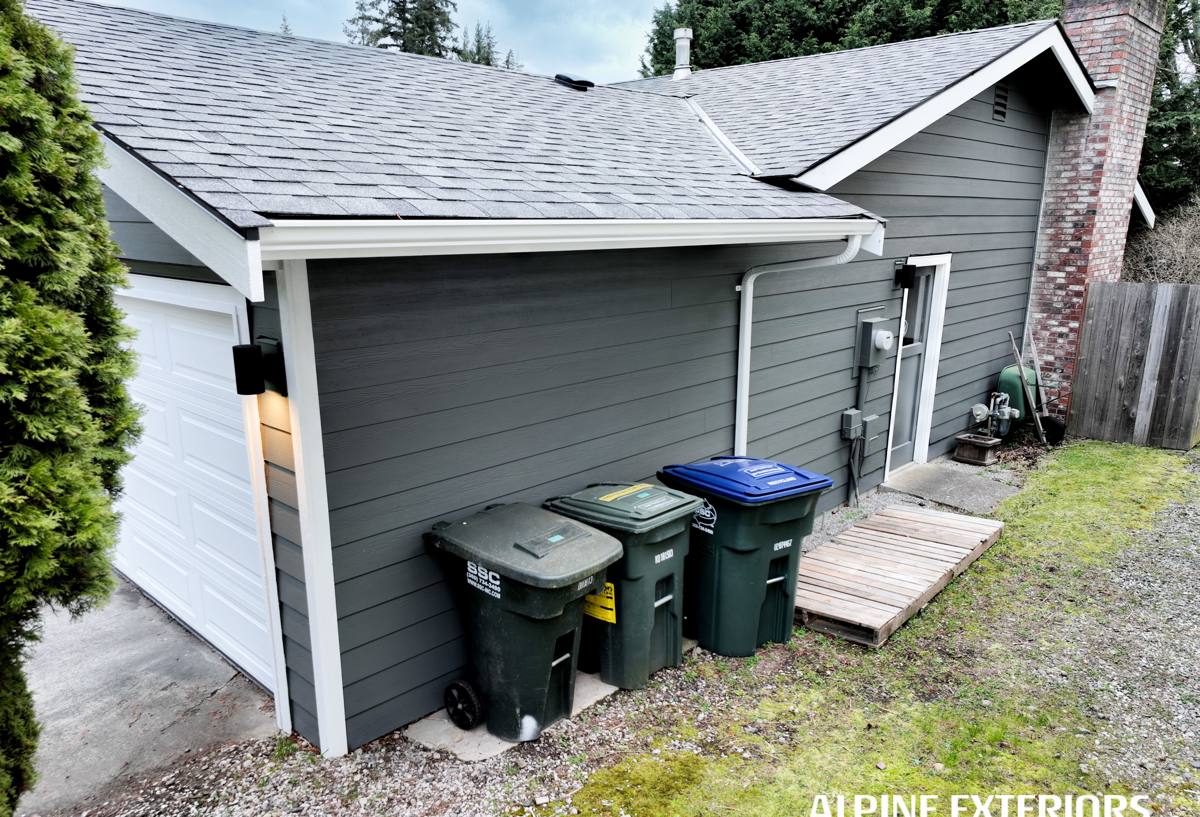
Signs a Sedro-Woolley Home Needs Siding Replacement, Not Another Repair
Not every siding problem calls for a full tear-off. But there's a point where patching stops being the economical choice. Local homeowners should watch for:
- Soft or spongy spots when you press on siding, especially near the bottom courses and around windows
- Visible bubbling, cracking, or peeling paint that keeps returning within a year or two of repainting
- Persistent moss or dark staining that comes back within a season of cleaning
- Gaps, warping, or boards pulling away from the wall line
- Rising energy bills that suggest moisture-compromised insulation behind the siding
- Visible rot at butt joints, corners, or anywhere siding meets trim
Any one of these on its own might be a repair. Several at once, or any sign of rot spreading behind the surface, usually means the siding system as a whole has reached the end of its useful life.
What a Correct Siding Replacement Job Involves
A siding replacement is only as good as what happens underneath it. Skipping steps here is the single biggest reason siding jobs fail early in a climate like this one.
Full tear-off and inspection
Old siding comes off entirely so the wall sheathing underneath can be inspected. In a damp climate, this step matters more than almost anything else — it's the only way to catch hidden rot, compromised sheathing, or prior water intrusion before it gets sealed behind new siding.
Weather-resistive barrier and drainage plane
A proper installation includes a correctly lapped weather-resistive barrier and, where called for, a drainage gap that lets any moisture that does get behind the siding find its way back out instead of sitting against the wall. This is especially important on shaded, moss-prone elevations.
Flashing at every vulnerable point
Windows, doors, roof lines, and butt joints are where water intrusion starts. Correct flashing at each of these points is non-negotiable in a region that sees this much sustained rain.
Manufacturer-spec fastening and clearances
Fastener placement, siding-to-grade clearance, and joint treatment all need to follow the manufacturer's installation requirements — not general habit. This is also what keeps a manufacturer's warranty valid if something does go wrong down the line.
Finish and detail work
Corners, trim, and caulking are finished to shed water rather than trap it, and the job is inspected before it's called complete.
Why This Company Installs Only James Hardie Fiber Cement
We don't install every siding product on the market, and in a climate like Skagit County's, that's a deliberate choice rather than a limitation. Wood-based products — cedar, primed spruce, engineered wood siding like LP SmartSide — can perform well for a while, but they all share the same underlying vulnerability: they're wood fiber at their core, and wood fiber that stays damp for extended periods is wood fiber that eventually softens, swells, or rots, no matter how well it's finished. Vinyl siding avoids the rot issue but brings its own trade-offs in this climate — it can warp or become brittle with temperature swings, and it doesn't offer the same fire performance or long-term color retention.
James Hardie fiber cement siding is engineered specifically to resist the moisture cycling, organic growth, and freeze-thaw stress that define this region's weather. It's non-combustible, dimensionally stable, and available in HZ5 formulations built for climates that see exactly this kind of sustained wet weather. The factory-applied ColorPlus finish resists fading and holds up against the region's moisture and UV exposure far better than field-applied paint, and it comes with a strong transferable warranty backed by a manufacturer with a long track record in the Pacific Northwest. For a home in Sedro-Woolley, that combination — moisture resistance, fire safety, and finish durability — is what actually holds up over time, not just on day one.
Cost Factors for Sedro-Woolley Siding Replacement
Every home is different, so we won't quote a number without seeing the property, but these are the main variables that drive cost on a real project:
| Factor | Why It Matters |
|---|---|
| Home size and wall complexity | More square footage, corners, and roof lines mean more material and labor time |
| Condition of existing sheathing | Rot or moisture damage found during tear-off adds repair scope before new siding goes on |
| Siding profile and accessories | Lap width, trim details, and accent features affect material cost and install time |
| Access and site conditions | Steep lots, mature landscaping, or limited access can add labor time |
| Removal and disposal | Tear-off volume and disposal of old siding materials factor into total cost |
The honest starting point is always an in-person look at the home — quoting sight-unseen tends to miss the details that end up mattering most.
Our Process, Start to Finish
Homeowners in Sedro-Woolley can expect a straightforward process:
- An on-site walkthrough to assess current siding condition, wall structure, and any problem areas
- A written estimate that explains the scope of work, not just a total number
- Scheduling that accounts for the local weather window, since siding work goes best in drier stretches
- Full tear-off with inspection of sheathing before anything new goes up
- Installation of weather barrier, flashing, and James Hardie siding to manufacturer specification
- Final walkthrough with the homeowner before the job is considered complete
Why Hiring a Crew That Already Works Sedro-Woolley Matters
Siding installation isn't just about following a manufacturer's manual — it's about knowing how a specific region's weather interacts with a home over time. A crew that regularly works Skagit County homes already understands where moss tends to build up first, which elevations take the worst of the driving rain, and how to sequence a job around the area's wet stretches so materials and fasteners aren't compromised before the siding is even up. That local pattern recognition is the difference between a crew that installs siding correctly on paper and one that installs it correctly for this specific place. It also means faster, more accurate estimates, since we're not guessing at regional conditions — we're already familiar with them.
Get a Straight Answer About Your Siding
If your Sedro-Woolley home is showing signs of siding wear — soft spots, recurring moss, peeling paint, or just age — we're happy to take a look and give you an honest read on whether you're looking at repair or replacement, no pressure either way. Reach out for a free estimate using the form below.