 Burlington
 Sedro-Woolley's Climate Is Harder on Siding Than It Looks
Sedro-Woolley sits in the Skagit River valley, tucked between farmland and the foothills of the North Cascades. It doesn't get the postcard reputation of the coast, but the climate here is every bit as tough on an exterior wall. The valley traps moisture. Fog settles in low areas on fall and winter mornings and can linger for hours before it burns off. Add in the broader marine influence off the Salish Sea that shapes weather across Skagit County, and you get long stretches where siding simply does not get a chance to fully dry out between storms.
That combination — damp valley air, driving rain off the Cascades' western slopes, and short winter days with weak sun — is exactly the kind of environment that separates siding that holds up for decades from siding that starts failing in five to ten years. Homeowners who've lived here a while already know the signs: green-black streaking on north-facing walls, soft spots near the ground, paint that won't hold past year three or four.
Moss Season Isn't Really a Season Here
In a lot of the country, "moss season" is a couple of months in spring. In Sedro-Woolley, given the shade from mature trees on many lots and the extended damp period from fall through spring, moss and algae growth can be a near year-round maintenance issue on the wrong siding material. Porous or fibrous surfaces give moss something to grab onto and hold moisture against. Once it's established, it's not just cosmetic — trapped moisture behind moss and algae accelerates rot in wood-based products and breaks down cheap paint jobs faster than the sun ever would.
Driving Rain and Wind-Driven Wet
Storms moving up the valley don't always come straight down. Wind-driven rain gets pushed sideways into wall assemblies, working its way behind poorly lapped siding, undersized flashing, and caulk-dependent seams. This is where installation quality matters as much as the material itself — a good product installed wrong will still let water in.
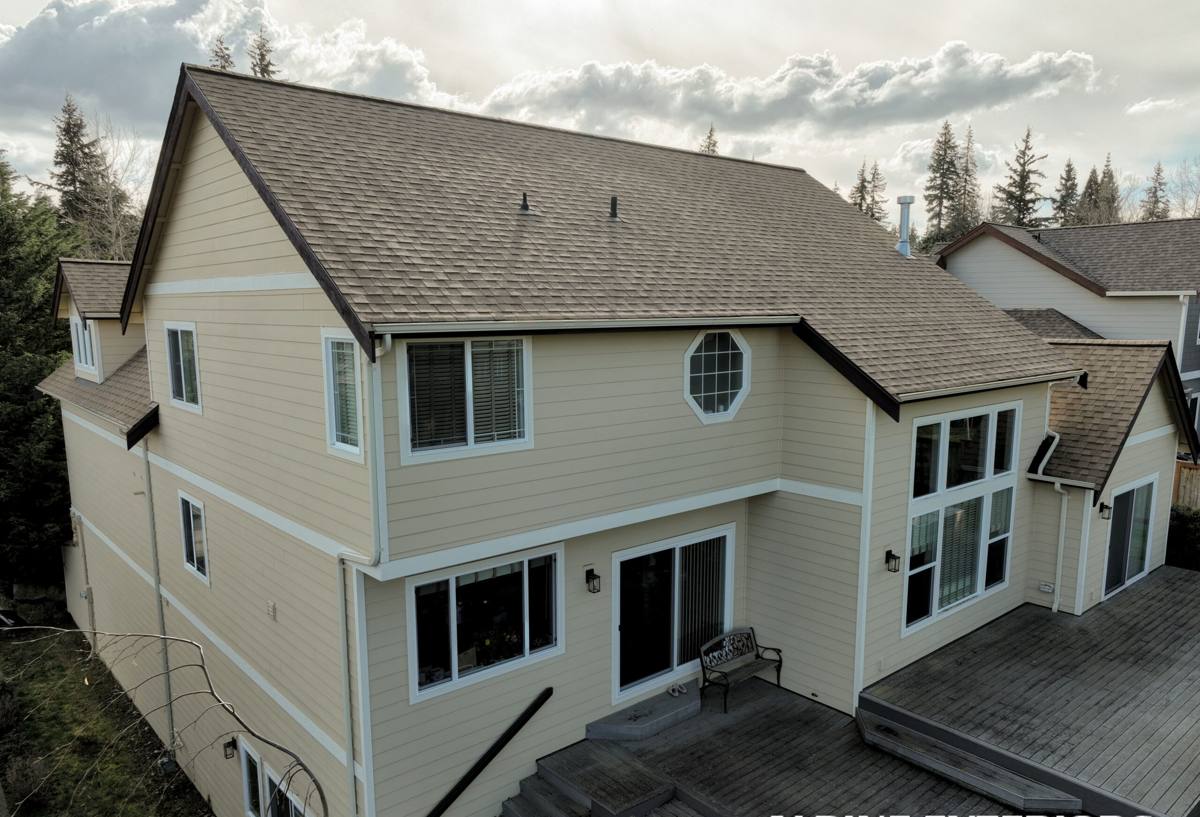
Why We Standardized on James Hardie Fiber Cement
We install James Hardie fiber cement siding exclusively. We don't install vinyl, LP SmartSide, cedar, primed spruce, or other fiber cement brands. That's not a marketing position — it's a decision based on what actually performs, year after year, in exactly the conditions Sedro-Woolley homes deal with.
Fiber cement is a mix of cement, sand, and cellulose fibers, cured into a dense, stable board. It doesn't have the wood grain and structure that gives moisture a path to travel, it doesn't expand and contract with humidity the way vinyl does, and it's non-combustible — a genuine advantage in a region where wildfire smoke and dry summer spells have become a more regular concern even in historically wet areas. James Hardie's HZ5 product line is specifically engineered for the freeze-thaw and moisture cycling common to the Pacific Northwest, which is the version we spec for Sedro-Woolley and the rest of Skagit County.
ColorPlus Finish vs. Field-Applied Paint
Most of the siding failures we get called out to inspect in older homes aren't the substrate — they're the paint. A field-applied paint job is only as good as the prep, the primer, and the weather on the day it was sprayed. James Hardie's ColorPlus finish is baked on at the factory under controlled conditions, resists fading, and carries its own finish warranty separate from the product warranty. In a climate that gives painters a narrow dry-weather window, that factory finish removes a major point of failure.
What a Correct Fiber Cement Installation Involves
Fiber cement siding is only as good as the install behind it. The board itself resists moisture well, but the assembly around it — flashing, gaps, fastening, and the water-resistive barrier underneath — determines whether that resistance actually gets used. A correct install includes:
- A drainage plane (weather-resistive barrier) installed and lapped correctly before any siding goes up
- Proper flashing at windows, doors, and every horizontal penetration — the single most common failure point we find on re-sides
- Manufacturer-specified gaps at butt joints and around trim to allow for seasonal movement
- Fasteners driven to Hardie's specification — not overdriven, not underdriven, in the right location on the board
- Correct starter strip and clearance at the foundation line to keep splash-back and standing moisture off the bottom course
- Factory-primed cut edges sealed in the field, since any cut edge is now exposed material
Skip any one of these and you can end up with a product rated for decades performing far below that — not because the material failed, but because the installation didn't give it a fair chance.
What We See on Sedro-Woolley Homes Specifically
A lot of the housing stock in and around Sedro-Woolley includes older wood siding, T1-11 panel siding, and homes that have already had one or two siding jobs done over their lifetime. The pattern we run into most often:
| What We Find | Why It Happens Here | What Fiber Cement Fixes |
|---|---|---|
| Soft, delaminating panel siding at the base of walls | Splash-back and ground moisture combined with panel seams that were never properly flashed | Dense board with a proper starter strip and clearance eliminates the wicking path |
| Black-green streaking on north and shaded walls | Limited direct sun and tree cover keep those walls damp longer | Fiber cement resists moss/algae adhesion far better than porous wood substrates |
| Peeling paint every 3-5 years | Field-applied paint breaking down under repeated wet-dry cycling | Factory-cured ColorPlus finish is warranted separately and holds color longer |
| Warped or cupped boards | Wood siding absorbing and releasing moisture unevenly across the board | Fiber cement's dimensional stability resists warping under moisture cycling |
Our Process for a Sedro-Woolley Job
Every project starts with an on-site walkthrough, not a phone estimate. We look at the existing siding and sheathing condition, check for hidden moisture damage around windows and at the base of walls, and confirm what's actually underneath before we quote anything. From there:
- Written scope covering tear-off, sheathing repair (if needed), house wrap, flashing detail, and the specific Hardie product and profile
- Material order and scheduling around the drier stretches of the local weather window
- Tear-off and inspection of sheathing — any rot or damage gets addressed before new siding goes up, not covered over
- Installation to Hardie's fastening and clearance specifications, including flashing at every penetration
- Final walkthrough with the homeowner before we consider the job done
Cost Factors for This Job
Every Sedro-Woolley property is different, so we don't publish flat per-square-foot pricing — a walkthrough is the only accurate way to quote. That said, the main cost drivers on a fiber cement re-side here are consistent:
| Factor | Why It Moves the Price |
|---|---|
| Condition of existing sheathing | Hidden rot found during tear-off adds repair scope before new siding can go on |
| Home size and wall complexity | More corners, dormers, and trim details mean more cutting and flashing labor |
| Siding profile chosen | Lap siding, shingle-style panels, and board-and-batten each carry different material and labor costs |
| Access and site conditions | Steep lots, mature landscaping, and limited staging area affect labor time |
| Trim and accessory scope | Fascia, soffit, and trim replacement alongside siding changes total cost |
Why Hiring a Crew That Already Works This Area Matters
We're based out of Burlington, a short drive from Sedro-Woolley, and this valley is part of our regular service area — not a territory we occasionally drive out to. That matters for a few practical reasons. We already know which older subdivisions tend to have panel siding hiding sheathing damage. We know how the local weather windows work for scheduling a tear-off without leaving a house exposed. And if something needs a warranty follow-up down the road, we're not a company that has to be tracked down from three counties over.
Hiring local also means faster response for the walkthrough and estimate, and a crew whose reputation in Skagit County is on the line with every job — not just the one in front of us.
Maintenance After Installation
Fiber cement is genuinely low-maintenance compared to what most Sedro-Woolley homeowners are replacing, but "low-maintenance" isn't "no-maintenance." A simple annual routine keeps a Hardie install performing at its rated lifespan:
- Rinse siding annually with a garden hose and soft brush — avoid high-pressure washing directly at seams and flashing
- Keep gutters clear so overflow doesn't run down wall sections repeatedly
- Trim back vegetation and tree limbs holding shade and moisture against any wall section
- Inspect caulking at trim and penetrations every couple of years and touch up as needed
- Address any impact damage promptly rather than letting a chip sit exposed through a wet season
If you're weighing a siding replacement in Sedro-Woolley and want a straight answer about what your home actually needs, we're happy to walk the property with you. The estimate is free, there's no pressure, and you'll get a written scope you can compare against anyone else's — just fill out the form below to get started.