 Burlington
 Decking Built for Sedro-Woolley's Wet Side of the Mountains
Sedro-Woolley sits where the Skagit Valley starts climbing toward the Cascades, and that location comes with its own version of wet Northwest weather — more rain days than the coastal towns, heavier moss pressure under the tree cover common on Sedro-Woolley lots, and long stretches where a deck simply doesn't get a chance to fully dry out between storms. A deck built here has to handle standing moisture at the board level, not just rain hitting the surface. That's a different problem than a deck built in a drier climate, and it's why the decking choice and the install details matter more here than the brochure makes it sound.
We've built and repaired decks throughout Skagit County, including plenty of jobs in and around Sedro-Woolley, and the failures we get called out to fix almost always trace back to the same two things: a product that wasn't suited to sustained moisture, or an install that trapped water instead of shedding it. Composite decking, installed correctly, solves both — but "installed correctly" is doing a lot of work in that sentence.
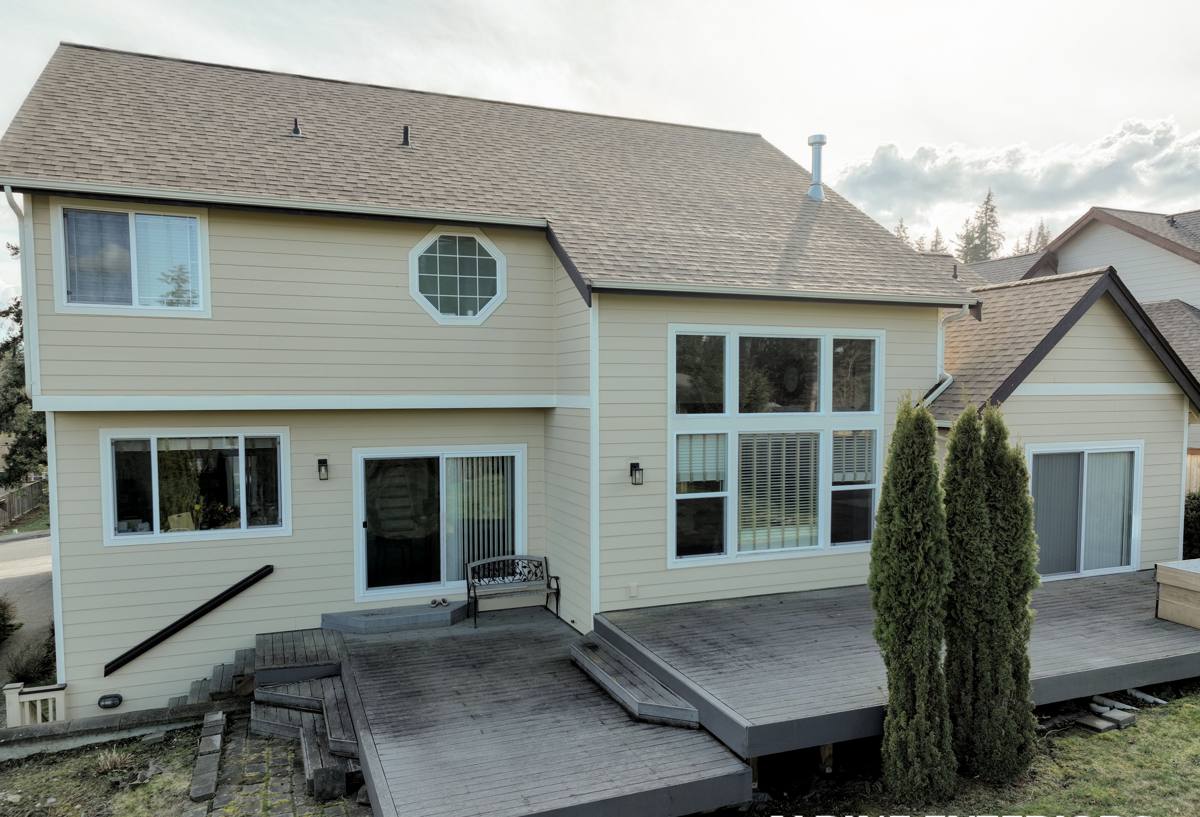
Why Composite Makes Sense in This Climate
Wood decking isn't a bad product — but in a climate with this much sustained dampness and moss growth, it asks a lot of the homeowner. Untreated or even pressure-treated wood needs regular sealing, sanding, and moss treatment to keep water from working into the grain. Skip a season of maintenance in Sedro-Woolley, with its shaded lots and long wet stretches, and moss gets a foothold fast, holding moisture against the board and accelerating rot from the surface down.
Composite decking doesn't eliminate maintenance, but it changes the type of maintenance. There's no sealing schedule, no sanding, and the material itself doesn't absorb water and swell the way wood fibers do. Moss and algae can still grow on the surface — any exterior surface in this climate will get some — but it sits on top of a capped composite board instead of soaking into open wood grain, and it comes off with a deck brush and mild cleaner rather than requiring refinishing.
Where Composite Still Needs Respect
Composite isn't maintenance-free, and any contractor who tells you it is hasn't dealt with a Skagit County winter. The board surface can still get slick with algae film if it's never cleaned, the substructure underneath still needs to be built to drain, and cheaper composite products can hold moisture at the core if the capping isn't done well. The product does most of the work for you — but the install still has to get the water management right, and the composite line still has to be one built for a genuinely wet climate, not a mild one.
What a Correct Composite Deck Install Involves Here
The composite boards get the attention because they're what you see, but most of what determines whether a deck lasts in Sedro-Woolley's climate is underneath them.
- Ledger board flashing: Where the deck attaches to the house is the single most common point of hidden rot on decks we've torn into. It needs proper flashing and a water-tight seal against the siding — not just lag bolts and caulk.
- Joist protection: Composite decking sheds water off the board surface, but the framing underneath is still typically wood. Joist tape or a comparable flashing membrane over the top of each joist keeps rainwater that gets between boards from sitting on bare wood.
- Gap spacing: Composite boards need consistent gapping for drainage and for seasonal expansion. Too tight, and water sits between boards and can't drain; the boards also expand and contract with temperature more than people expect.
- Ventilation underneath: Low decks or decks built close to grade need airflow underneath to keep the substructure from staying damp — a real issue on lots with limited slope or heavy shade, both common around Sedro-Woolley.
- Fastening system: Hidden fastener clips designed for the specific composite line, not generic screws, keep the board surface intact and consistent — face-screwing composite decking is a shortcut that shows and that can compromise the board's warranty.
Skip any one of these and the deck can still look fine for a year or two — moisture problems in this climate are patient. They show up as soft spots, a spongy feel underfoot, or staining around the ledger board once the substructure has already been compromised.
Composite vs. Wood vs. PVC: The Honest Trade-offs
| Factor | Wood | Composite | PVC |
|---|---|---|---|
| Upfront cost | Lowest | Mid-range | Highest |
| Maintenance | Annual sealing/moss treatment | Periodic cleaning, no sealing | Periodic cleaning, no sealing |
| Moisture behavior in this climate | Absorbs water; prone to rot without upkeep | Doesn't absorb, but core quality varies by brand | Fully non-absorbent |
| Surface moss/algae | Grows into grain, harder to remove | Sits on surface, cleans off | Sits on surface, cleans off |
| Typical lifespan here with correct install | 10-15 years with upkeep | 25-30 years | 25-30+ years |
| Appearance | Natural wood grain | Wood-look, wide range of colors | More uniform, some product lines look less natural |
We don't push one product on every homeowner. Composite hits the best balance of cost and low-maintenance durability for most Sedro-Woolley homes we work on. PVC is worth discussing if you want the lowest possible maintenance and the budget supports it. Wood still has a place if you want the natural look and are genuinely willing to keep up the sealing schedule — we'll say so plainly if that's the right fit for your project.
How We Approach a Composite Deck Project in Sedro-Woolley
1. On-Site Assessment
We look at the site itself — slope, drainage, shade cover, proximity to the house — before talking product. A shaded, low-clearance lot needs different ventilation planning than an open, sloped one, and that shapes both the substructure design and which composite line makes sense.
2. Product Selection Based on Real Conditions
We walk through composite lines rated for sustained wet climates, not just the cheapest option on the shelf. Board capping quality, color retention, and slip resistance underfoot all factor in, especially on decks that stay damp for long stretches under tree cover.
3. Substructure First
Framing, flashing, and joist protection get built to the standard above before a single composite board goes down. This is the part that determines whether the deck is still solid in fifteen years, not the part that shows up in a quick estimate.
4. Installation to Manufacturer Spec
Fastening systems, gap spacing, and expansion allowances follow the manufacturer's requirements for the specific product — which also keeps the manufacturer's warranty intact if you ever need it.
5. Walkthrough
We go over basic care — what to do about surface algae, what not to do (pressure washing too aggressively can damage some composite finishes) — so you're not guessing at maintenance after we leave.
Maintaining a Composite Deck in Skagit County's Climate
- Sweep debris off regularly — wet leaves and needles trap moisture against the board surface and feed moss growth.
- Clean the deck surface once or twice a year with a soft-bristle brush and a cleaner rated for composite — avoid harsh chemicals that can dull the cap finish.
- Keep gutters and downspouts near the deck clear so runoff isn't dumping directly onto or under the deck.
- Check the ledger board area and any spots where the deck meets the house once a year for staining or soft wood, even though composite boards themselves won't rot.
- Trim back overhanging branches where possible to cut down on shade and debris buildup, both of which extend how long the deck stays damp after rain.
Why It Matters to Hire a Crew That Works Sedro-Woolley
A lot of deck problems we get called to fix weren't installed by out-of-area crews doing bad work on purpose — they were installed by capable builders working off a generic spec that didn't account for this climate. A deck detail that's fine in a drier region can be exactly the detail that fails here after a few wet winters. Knowing how Sedro-Woolley lots drain, how much shade cover is typical, and how long moss season actually runs isn't something you get from a manufacturer's install manual alone — it comes from having built and repaired decks in this specific area.
We also know what a deck looks like after five or ten Skagit County winters, good and bad, because we've been called back to both kinds. That's the standard we build to on day one.
Get a Straight Answer for Your Property
Every lot in Sedro-Woolley drains differently, sits in different amounts of shade, and has its own quirks worth walking through in person before recommending a product or a plan. If you're weighing composite decking for your home, we're happy to come take a look and give you a straightforward estimate — no pressure, no upsell, just what your deck actually needs.