 Burlington
 Decking Built for Conway's Particular Climate
Conway sits low in the Skagit River delta, close enough to Skagit Bay that homes here deal with a mix most Skagit County properties don't: brackish air drifting in off the water, heavy river-bottom humidity, and long stretches of shade under fir and cottonwood that never quite dry out between rains. A deck built here works harder than one built on higher, drier ground a few miles inland. Wood fibers swell and split faster in that combination of salt-tinged moisture and shade. Fasteners corrode sooner. And moss doesn't just show up in a few shady corners — on a lot of Conway properties it colonizes the whole surface if the board profile and gap spacing weren't chosen with drainage in mind.
Composite decking exists to solve exactly this kind of problem, but only when it's specified and installed correctly for the site. A composite deck installed the same way you'd install one in a dry upland yard in eastern Skagit County will underperform in Conway. The difference is in the details: substructure ventilation, fastener choice, board gapping, and how the framing handles standing water during our wettest months. That's the level we plan at before a single board goes down.
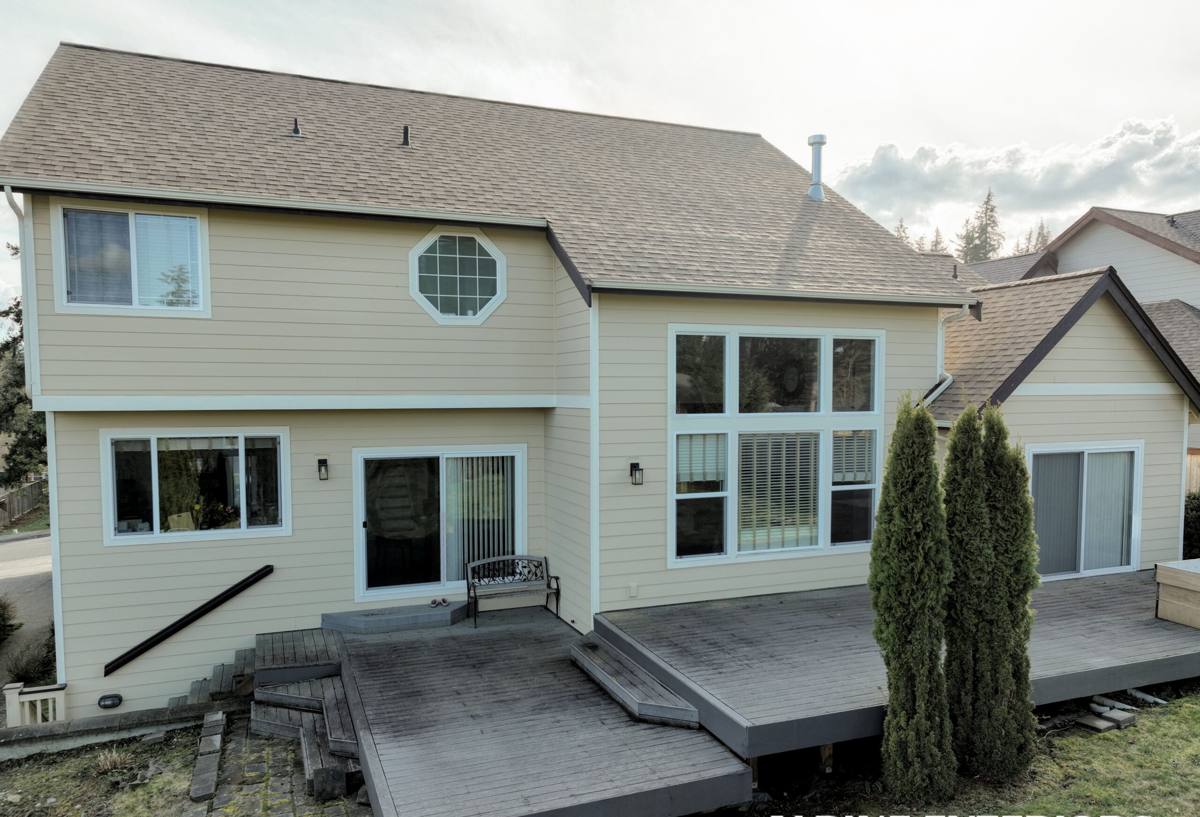
What Conway's Environment Actually Does to a Deck
Salt Air and Moisture Together
Salt-laden air near the delta accelerates corrosion on any exposed metal — screws, joist hangers, flashing. On a wood deck, that shows up as rust streaking and weakening fasteners years before you'd expect. On a composite deck built with the wrong hardware, the same thing happens hidden underneath the boards, where you won't see it until something moves or fails. It matters more here than it does for a deck built ten miles east and inland.
Driving Rain
Western Skagit County gets rain that comes in sideways as often as it falls straight down, especially in the fall and winter storm pattern off the Sound. Driving rain finds gaps in flashing, works its way behind ledger boards, and pools where a deck surface doesn't shed water fast enough. A deck that looks fine in July can be quietly rotting a ledger connection by January if the water management wasn't built in from day one.
The Long Moss Season
Shaded, low-lying yards near the river hold moisture long after a storm passes, and that's exactly what moss needs. Once moss and algae establish on a deck surface, they hold even more moisture against the boards, and on wood that means accelerated rot underneath the green film you can see. Composite boards resist moss anchoring into the surface itself, but they aren't moss-proof — a board with clogged grooves or standing water on it will still grow a film given enough shade and enough of our wet months in a row.
Why Composite Makes Sense for This Location
We don't push composite decking as a universal answer — for a sunny, well-drained lot with good airflow, a well-maintained wood deck can still make sense. But for Conway's specific mix of salt air, shade, and standing moisture, composite has real advantages that matter more here than almost anywhere else in our service area:
- No annual sanding, staining, or sealing — which also means no yearly window where bare, unsealed wood is exposed to a rainstorm
- Consistent density through the board, so it doesn't cup, crown, or splinter the way delta-humidity wood can
- Resists moisture absorption at the board level, reducing (though not eliminating) the conditions moss needs to take hold
- Color and surface texture hold up under damp shade better than most wood finishes, which tend to gray and blotch unevenly in these conditions
The trade-off is upfront cost and the fact that composite is less forgiving of a sloppy install — mistakes in substructure or fastening show up as problems later rather than being something you can just sand and refinish away. That's why the installation details below matter as much as the product choice itself.
What a Correct Installation Looks Like Here
Substructure and Ventilation
The framing underneath a composite deck needs to breathe. In a low, shaded Conway yard, a substructure that traps moisture against the joists is a slow rot problem waiting to happen, even if the decking on top is composite. We build in ventilation gaps and grade the ground beneath the deck to shed water away from the structure rather than letting it pool under the frame.
Fasteners and Hardware
Given the salt air off the delta, we spec corrosion-resistant, coated fasteners and joist hangers rated for coastal or wet-exposure use rather than standard interior-grade hardware. This is a small line-item cost difference and a large difference in how the deck holds up over a decade.
Board Gapping and Drainage
Composite boards need consistent gapping to let water run through rather than sit on the surface. Too tight, and you get standing water and moss film; too loose, and small items and debris fall through and the deck feels less finished underfoot. We set gapping to the manufacturer's spec and adjust slightly tighter or looser depending on how shaded and exposed the specific spot on your property is.
Flashing at the Ledger
Where the deck attaches to the house is the single most common point of hidden rot on any deck in this region, wood or composite. Proper flashing that directs driving rain away from that connection, rather than trusting caulk alone, is non-negotiable on every deck we build.
Comparing Decking Options for a Conway Lot
| Factor | Pressure-Treated Wood | Cedar | Composite |
|---|---|---|---|
| Upfront cost | Lowest | Mid-high | Higher |
| Maintenance in this climate | Annual sealing needed to fight rot | Frequent staining; grays fast in shade/damp | Occasional cleaning only |
| Moss/algae resistance | Low — moisture soaks into fibers | Low-moderate | Higher — surface resists absorption |
| Fastener corrosion risk (salt air) | High if hardware isn't upgraded | High if hardware isn't upgraded | Lower with correct coastal-rated hardware |
| Typical lifespan here with proper install | 10-15 years | 15-20 years | 25+ years |
None of these numbers are guarantees — actual lifespan depends heavily on site drainage, shade, and how well the substructure was built, which is exactly why we walk each Conway property individually rather than quoting off a standard package.
Our Process for a Conway Composite Deck
- Site walk: We look at sun exposure, drainage direction, proximity to shoreline or wetland-influenced ground, and the condition of any existing structure.
- Substructure assessment: If you're replacing an existing deck, we check whether the framing underneath is sound enough to build on or needs replacing — reusing rotten framing under new composite boards just hides the problem, it doesn't fix it.
- Product and layout selection: We talk through board profile, color, and gapping based on how shaded and exposed your specific spot is.
- Build: Framing, ventilation, flashing, and hardware go in first — the parts you won't see are what determine whether the parts you do see last.
- Final walkthrough: We go over basic care — mainly seasonal cleaning to keep moss and algae from getting a foothold — so you know what to expect through a full Skagit County wet season.
Simple Maintenance Checklist for a Composite Deck in This Climate
- Sweep leaves and debris off the surface regularly in fall — trapped organic matter feeds moss growth faster than bare boards
- Rinse or lightly scrub with a soft brush and mild cleaner once or twice a year, more often in heavily shaded spots
- Check that board gaps and drainage channels aren't clogged with debris, especially after storms
- Keep gutters and downspouts near the deck clear so runoff isn't dumping extra water onto or under the structure
- Inspect ledger flashing and visible hardware once a year for early signs of corrosion or gaps
Why a Local Crew Matters for This Job
A deck built to a generic spec sheet doesn't account for the fact that Conway's combination of salt air, delta humidity, and shade is genuinely different from a lot four miles away on higher, drier ground. A crew that already works this specific stretch of Skagit County knows to upgrade hardware for the salt exposure without being asked, knows which corners of a shaded lot need tighter attention to drainage, and has already seen how moss season plays out on decks built well versus decks built to a minimum standard. That local pattern recognition is the difference between a deck that needs real attention in year six and one that's still solid at year twenty.
If you're weighing a new composite deck or replacing an aging wood one in Conway, we're happy to walk the property, look at your specific drainage and shade conditions, and give you a straight, no-pressure estimate — use the form below to get started.