 Burlington
 Why Oak Harbor Homes Need Siding Built for This Climate
Oak Harbor sits right up against Puget Sound, and that location shapes everything about how siding performs there. Homes get a steady dose of salt-laden marine air, wind-driven rain that hits walls at an angle instead of just falling straight down, and a long wet season that gives moss and algae months to take hold on anything that stays damp. None of that is exotic or unusual for this part of Washington — but it does mean siding installed without those conditions in mind tends to fail early, even if it looked fine going up.
Salt air is corrosive to metal fasteners and trim over time, and it accelerates the breakdown of coatings that aren't formulated to resist it. Driving rain finds every gap in flashing, every short lap, every caulk joint that was supposed to be a permanent seal instead of a backup. And moss season — which in this part of the Skagit and Whidbey area can run from fall well into spring — turns any siding that holds moisture into a place for organic growth to establish itself, especially on north-facing walls and under eaves that don't get sun exposure.
We're a Burlington-based crew, and Oak Harbor is one of the coastal communities we regularly drive out to. We're not guessing at what this climate does to a house — we've pulled off enough failed siding jobs in exactly this kind of exposure to know what "installed correctly for the coast" actually has to mean in practice.
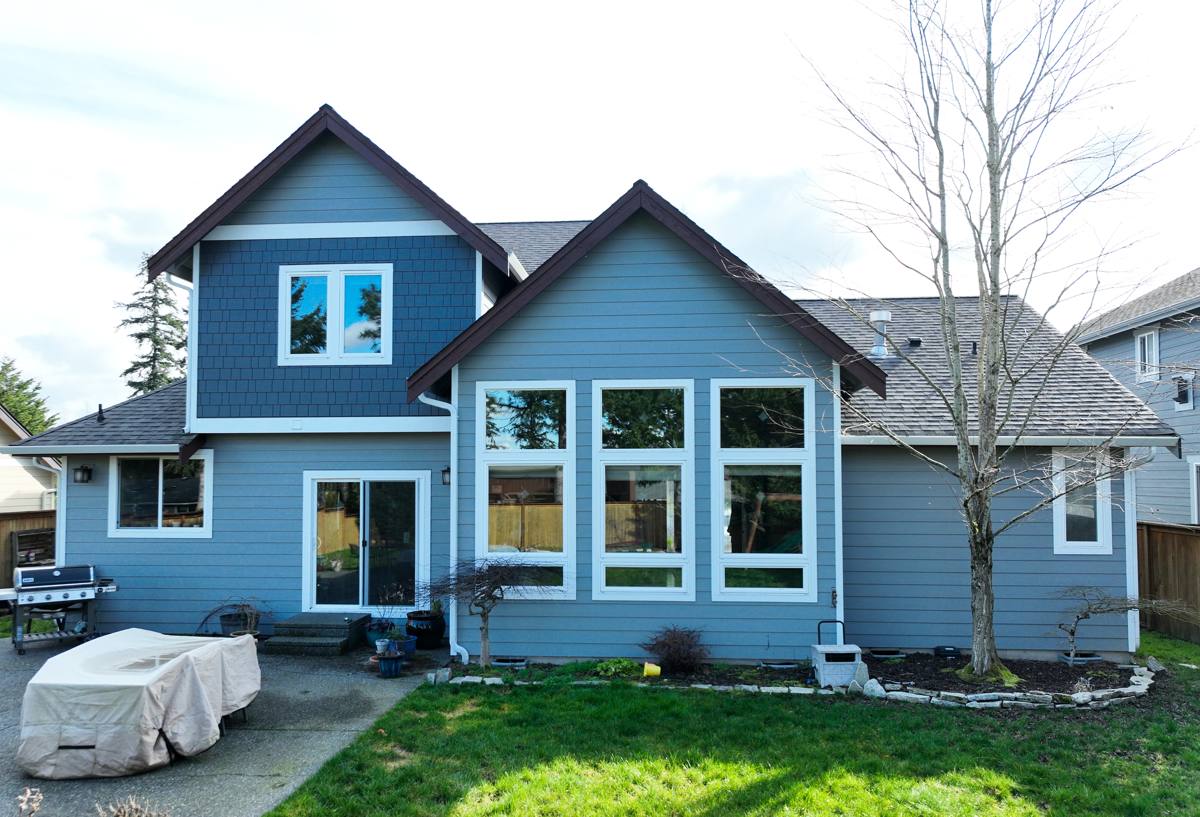
What Correct Siding Installation Actually Involves Here
The Water-Resistive Barrier Comes First
Before a single piece of siding goes up, the wall needs a continuous water-resistive barrier (WRB) properly lapped and sealed at every seam, window, and penetration. This layer is what actually keeps bulk water out of the wall assembly — the siding itself is the first line of defense, but it's not the only one, and skipping or rushing the WRB is one of the most common causes of hidden rot behind siding that looks perfectly good from the driveway.
Flashing at Every Transition
Windows, doors, deck ledgers, roof-to-wall transitions — every place where two building elements meet needs flashing detailed so water sheds outward and downward, never backward into the wall. In a driving-rain climate like Oak Harbor's, flashing shortcuts are the difference between a wall that sheds water for decades and one that's rotting from the inside within a few years.
Fastening and Clearances
Fiber cement siding has specific fastener patterns, penetration depths, and gap requirements at butt joints, corners, and trim. Get those wrong and you either crack the material over time or open small gaps that wick water. We also hold proper clearance between the bottom edge of siding and grade, decks, roofs, and walkways — a detail that's easy to shortcut but critical for keeping splash-back and ground moisture away from the siding's cut edges.
An Airspace Behind the Siding
A drainage gap between the WRB and the back of the siding lets any moisture that does get past the outer layer drain and dry out instead of sitting against the wall. In a marine climate with a long wet season, that airspace is what keeps minor moisture intrusion from turning into a long-term problem.
Why We Only Install James Hardie Fiber Cement
We made a standing decision as a company to install James Hardie fiber cement siding exclusively — not vinyl, not LP SmartSide, not other fiber cement brands like Cemplank or Allura, and not primed wood products like cedar or spruce. That's not a marketing angle; it's a judgment call based on what holds up in exactly the conditions Oak Harbor deals with.
Fiber cement is non-combustible, which matters given how dry Northwest summers have gotten in recent years even in a generally wet region. It doesn't expand and contract with temperature and moisture swings the way vinyl and some wood-based products do, which matters when a wall is regularly wetted by driving rain and then dried by wind off the water. Hardie's ColorPlus factory finish is baked on under controlled conditions rather than field-applied, which gives it more consistent resistance to fading and moisture than site-painted alternatives, and it holds up better against the kind of salt-air exposure that degrades lesser coatings faster than homeowners expect.
Hardie also engineers specific product lines (their HZ5 line, for instance) for cold, wet, and mixed-humidity climates — which is a meaningful difference from a one-size-fits-all siding product. And because Hardie backs its material with a strong transferable warranty when installed to spec, homeowners get a real backstop, not just a manufacturer's brochure claim.
We're not going to tell you other siding products are junk — vinyl is inexpensive and low-maintenance in the right application, and other fiber cement brands have their own merits. But for the coastal exposure Oak Harbor homes deal with, we decided we'd rather install one product correctly and stand behind it than offer a menu of options we can't fully vouch for in this climate.
Our Installation Process
- On-site assessment — we look at your home's current siding, wall condition, sun and wind exposure, and any existing moisture or rot before quoting anything.
- Tear-off and wall inspection — old siding comes off and we inspect sheathing for hidden damage before covering it back up.
- WRB and flashing installation — the water-resistive barrier and flashing details go in first, sealed and lapped correctly at every penetration.
- Furring or rainscreen setup where the wall assembly calls for it, to create drainage airspace behind the siding.
- Hardie installation to manufacturer spec — correct fastener pattern, gaps, clearances, and trim detailing.
- Final inspection and walkthrough — we go over the finished work with you before calling the job done.
Signs Your Oak Harbor Home May Need New Siding
- Visible moss or algae staining that keeps coming back after cleaning, especially on north- or shade-facing walls
- Soft or spongy spots when you press on the siding, which usually signals moisture has reached the substrate
- Cracking, buckling, or warping, particularly near corners and butt joints
- Peeling or bubbling paint that returns quickly after repainting
- Visible gaps or separation at trim, windows, or where siding meets the foundation
- A musty smell or interior wall staining that suggests water is getting past the exterior
Cost Factors for Siding Installation in a Coastal Climate
Every home is different, but these are the main factors that move the price on a job like this:
| Factor | Why It Matters |
|---|---|
| Home size and wall complexity | More linear footage and more corners, gables, and dormers mean more material and labor |
| Current wall condition | Hidden rot or damaged sheathing found during tear-off requires repair before new siding can go on |
| Siding profile and trim detail | Lap width, board-and-batten accents, and trim complexity all affect material and labor cost |
| Existing siding removal | Multiple layers of old siding or difficult removal (e.g., over old cedar) adds labor time |
| Flashing and drainage detailing | Doing this correctly for a marine climate takes more time than a minimal installation, but it's what prevents early failure |
| Access and site conditions | Multi-story sections, tight lot lines, or difficult staging can add labor and equipment cost |
We give firm, itemized quotes after seeing the home in person — we don't work from ballpark numbers pulled off a phone call, because the factors above vary too much house to house.
Why a Crew That Already Works Oak Harbor Matters
Siding installation isn't just about the product — it's about whether the crew installing it understands the specific demands of the site. A crew that regularly works this stretch of Puget Sound knows to pay extra attention to flashing on the windward walls, to check clearances more carefully near ground cover that holds moisture, and to expect moss pressure on shaded elevations that a drier inland job wouldn't need to worry about as much. That's the kind of judgment that only comes from doing the work here repeatedly, not from a one-size-fits-all install checklist.
We're based in Burlington and make the trip out to Oak Harbor and the surrounding Whidbey Island area on a regular basis. That means we're familiar with the ferry and travel logistics that affect scheduling, and we plan around them rather than treating every visit as a special trip.
Keeping New Siding Performing Long-Term
Correct installation is most of the battle, but a little ongoing attention extends the life of any siding in this climate:
- Rinse siding periodically to remove salt residue and organic buildup before it stains
- Keep gutters clear so overflow doesn't wash directly down wall surfaces
- Trim back vegetation and keep mulch or ground cover away from the bottom edge of siding
- Have caulking and trim seals inspected every few years, since sealants wear out well before the siding itself does
- Address any soft spots or staining promptly rather than waiting for it to spread
If your Oak Harbor home's siding is showing its age, or you're planning ahead rather than waiting for a failure, we're happy to take a look and walk you through what we're seeing — no pressure, no obligation. Request a free estimate through the form below and we'll schedule a time to come out.