 Burlington
 Stanwood's Climate Is Harder on Siding Than Most Homeowners Realize
Stanwood sits close enough to Skagit Bay and the Sound that homes here deal with a combination most siding products were never designed for: salt-laden air, long stretches of driving rain off the water, and shaded, damp conditions that keep moss and algae growing for most of the year. Any one of these on its own is manageable. Together, over a few decades, they're what separates a siding job that still looks tight at year 20 from one that's cupping, staining, and rotting at the seams by year 10.
We install siding across the greater Burlington area, and Stanwood properties consistently show a specific failure pattern: moisture getting behind the cladding at butt joints and trim, salt air accelerating corrosion on fasteners and flashing, and moss holding water against the wall assembly in shaded north and west exposures. None of that is unusual for the region — it's just what this climate does to a house over time. The fix isn't a different color or style of siding. It's a product built for wet coastal exposure and an installation that respects how water actually moves down a wall.
Salt Air Accelerates Corrosion You Can't See
Salt-laden air doesn't just affect metal roofing and gutters — it works on fasteners, flashing, and any exposed metal behind the siding. Once corrosion starts at a nail head or a flashing seam, it creates a path for water to follow inward, and that damage is invisible until the siding itself starts to fail. This is one of the reasons fastener choice and flashing detail matter more here than in drier inland areas.
Moss Season Is Longer Here Than People Expect
Shaded, damp exposures in this part of Western Washington can stay wet for weeks at a time in fall and winter. Moss and algae take hold on siding surfaces, gutters, and trim, and once established they hold moisture against the wall long after the rain has stopped. Over years, that constant dampness is hard on paint film, caulking, and any wood-based trim.
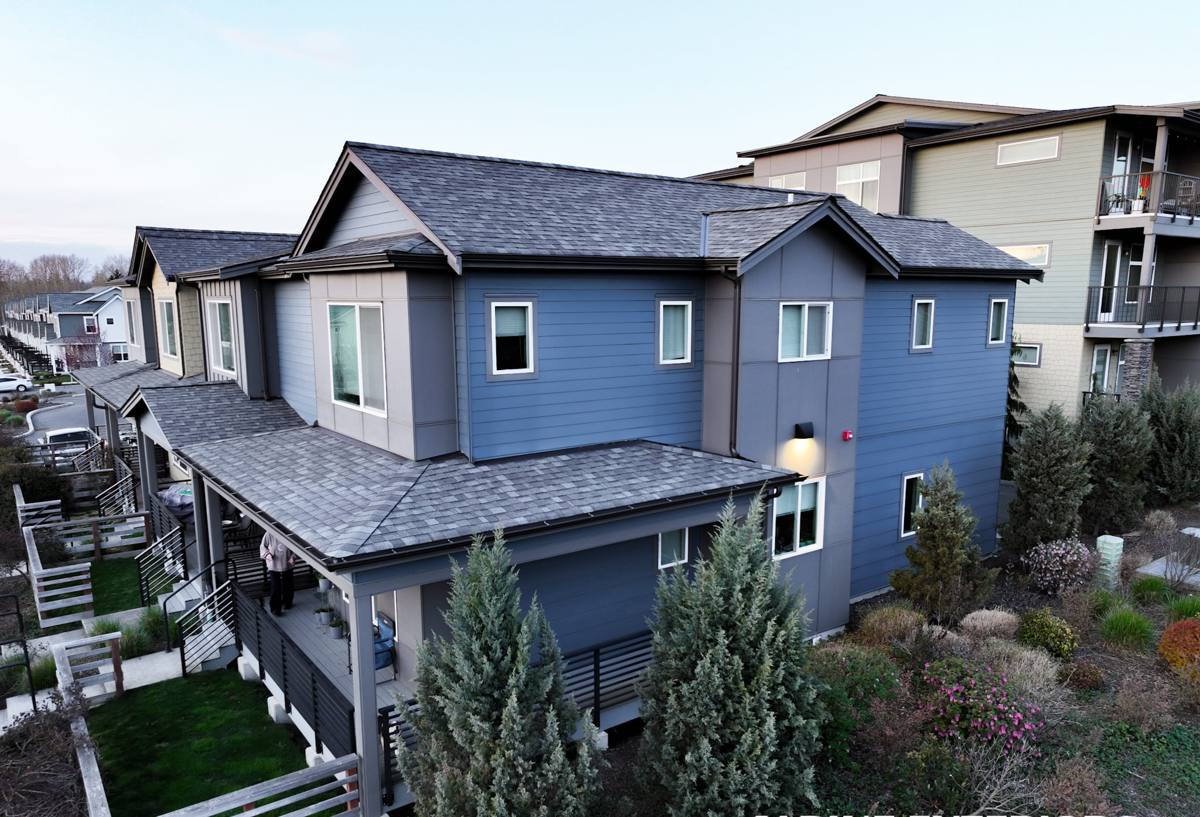
What a Correct Siding Installation Actually Involves
Siding is a water-management system, not just a finish material. A correct installation is judged by what's happening behind the boards, not just how they look from the street. For Stanwood's exposure, three details matter more than usual.
Weather-Resistive Barrier and Flashing
Every wall needs a continuous weather-resistive barrier underneath the siding, with flashing integrated at every window, door, and penetration so water is directed out and down, never trapped behind the cladding. In a high-rain, salt-air environment, sloppy flashing work is the single biggest predictor of early siding failure — it's usually invisible until there's already rot in the sheathing.
Fastening and Clearance to Grade
Fasteners need to be corrosion-resistant and driven to the manufacturer's exact spec — too tight or too loose both cause problems over time. Siding also needs proper clearance from grade, decks, and roof lines so splash-back and standing water don't sit against the bottom course, which is exactly where moss and rot tend to start first.
Joint and Panel Sealing
Butt joints, corners, and trim intersections are where water finds its way in. These need to be detailed with the right sealants and, where called for, factory-mitered or flashed joints rather than caulk alone — caulk is a backup, not a water barrier.
Why We Only Install James Hardie Fiber Cement
We made a decision as a company to install James Hardie fiber cement exclusively, and we don't install LP SmartSide, vinyl, Cemplank, Allura, or primed wood siding. That's not a marketing position — it's a standard we hold because of what we've seen happen to siding in exactly this kind of coastal, wet climate.
Fiber cement is non-combustible, dimensionally stable in wet-dry cycling, and doesn't feed mold or moss growth the way wood-based products can. James Hardie's HZ5 product line is engineered specifically for climates like this one — high humidity, sustained rain exposure, and freeze-thaw swings — with moisture and impact performance built into the substrate itself, not just the paint. The ColorPlus factory finish is baked on under controlled conditions, which holds color and resists the fading and moisture absorption that field-applied paint struggles with over time, especially with the amount of rain Stanwood sees. Hardie also backs the product with a strong, transferable warranty, which matters on a house that may change owners before the siding does.
None of this means every other product is a bad choice for every homeowner. It means that for the way we build and the climate we build in, fiber cement engineered for this exposure is what we're willing to put our name behind.
How Common Siding Materials Hold Up in This Climate
| Material | Salt air / corrosion resistance | Moss and moisture behavior | Long-term maintenance |
|---|---|---|---|
| James Hardie fiber cement | Non-combustible, stable substrate; factory finish resists coastal fading | Doesn't feed mold or rot; sheds water when correctly flashed | Occasional wash; repaint interval is long due to ColorPlus finish |
| Vinyl siding | Can warp or become brittle with temperature swings over time | Moss grows on the surface in shaded, damp exposures | Low upkeep, but panels can't be spot-repainted and fade over years |
| LP SmartSide (engineered wood) | Wood-based substrate is more sensitive to sustained moisture exposure | Prone to swelling and edge damage if water reaches raw edges | Requires diligent caulk and paint maintenance to keep water out |
| Cedar / primed wood | Natural material, sensitive to salt air and constant wet-dry cycling | Highest susceptibility to moss, mildew, and rot in shaded areas | Frequent refinishing and sealing needed to keep ahead of moisture |
Our Installation Process for Stanwood Homes
Our process is the same fundamentals every time, applied with extra attention to the details that matter most for this exposure.
- On-site assessment — we walk the exterior, check existing siding and sheathing condition, and note shaded or moss-prone areas that need extra attention to drainage and clearance.
- Tear-off and sheathing check — old siding comes off and we inspect the sheathing underneath for hidden rot or moisture damage before anything new goes up.
- Weather-resistive barrier and flashing — a continuous barrier goes on first, with flashing detailed at every window, door, and penetration.
- James Hardie panel or plank installation — installed to manufacturer spec for fastening pattern, joint treatment, and clearance to grade, decks, and roofline.
- Trim, caulking, and final detail — corners, trim, and joints are sealed correctly, not just caulked over as an afterthought.
- Final walkthrough — we review the finished job with the homeowner before calling it done.
Signs Your Current Siding Is Already Losing the Fight
- Persistent moss or dark staining that comes back within weeks of cleaning
- Soft or spongy spots when you press on the siding, especially near the bottom courses
- Paint or finish that's peeling, bubbling, or chalking faster than it should
- Visible gaps or separation at butt joints, corners, or trim
- Rust streaks near fasteners or flashing
- Warping, cupping, or panels that no longer sit flat against the wall
Any one of these is worth a closer look before it turns into sheathing damage, which is a bigger and more expensive repair than the siding itself.
Why Hiring a Crew That Already Works in Stanwood Matters
Siding installation isn't generic — a crew that regularly works this stretch near Skagit Bay already knows where moss tends to hold on, which exposures take the worst of the driving rain, and how to detail flashing so it holds up against salt air over decades, not just through the warranty period on paper. That familiarity shows up in the details: clearance heights, joint placement, and where extra flashing attention actually pays off, versus a generic installation that treats every house the same regardless of exposure.
It also matters for follow-through. A local crew is accountable to the same community they're working in, and they're not disappearing after the invoice is paid if a question comes up down the road.
Keeping New Siding Looking Right in a Wet, Shaded Climate
Correctly installed James Hardie siding needs very little upkeep, but a few habits go a long way in this climate. An occasional gentle wash keeps moss and algae from establishing on the surface, especially on shaded north and west walls. Keeping gutters clear prevents overflow from running down the siding face and staining or holding moisture against it. And a yearly visual check — looking for the warning signs listed above — catches small issues while they're still small.
If you're planning a siding project in Stanwood, we're happy to take a look at your home and walk you through what we'd recommend and why. There's no pressure and no cost to get our take — just fill out the form below to schedule a free estimate.