 Burlington
 Why Mount Vernon Homes Wear Out Siding Faster Than the Manual Says
Mount Vernon sits close enough to Puget Sound and the Skagit River delta that homes here deal with a combination most siding products were never engineered for: salt-tinged air moving in off the water, long stretches of driving rain that don't just fall but blow sideways into wall assemblies, and a moss and mildew season that can run eight months out of the year in shaded, north-facing spots. Add in the mature tree canopy common in older Mount Vernon neighborhoods, and you get siding that stays damp longer after every storm than the same product would in a drier part of the state.
None of that is unusual for Skagit County. It's just the reality of building envelopes here, and it's why siding replacement in this area isn't a cosmetic project — it's a moisture-management project with a finish coat on top. When we talk with homeowners about replacing worn siding in Mount Vernon, the conversation starts with what's happening behind the old boards, not just what color goes up next.
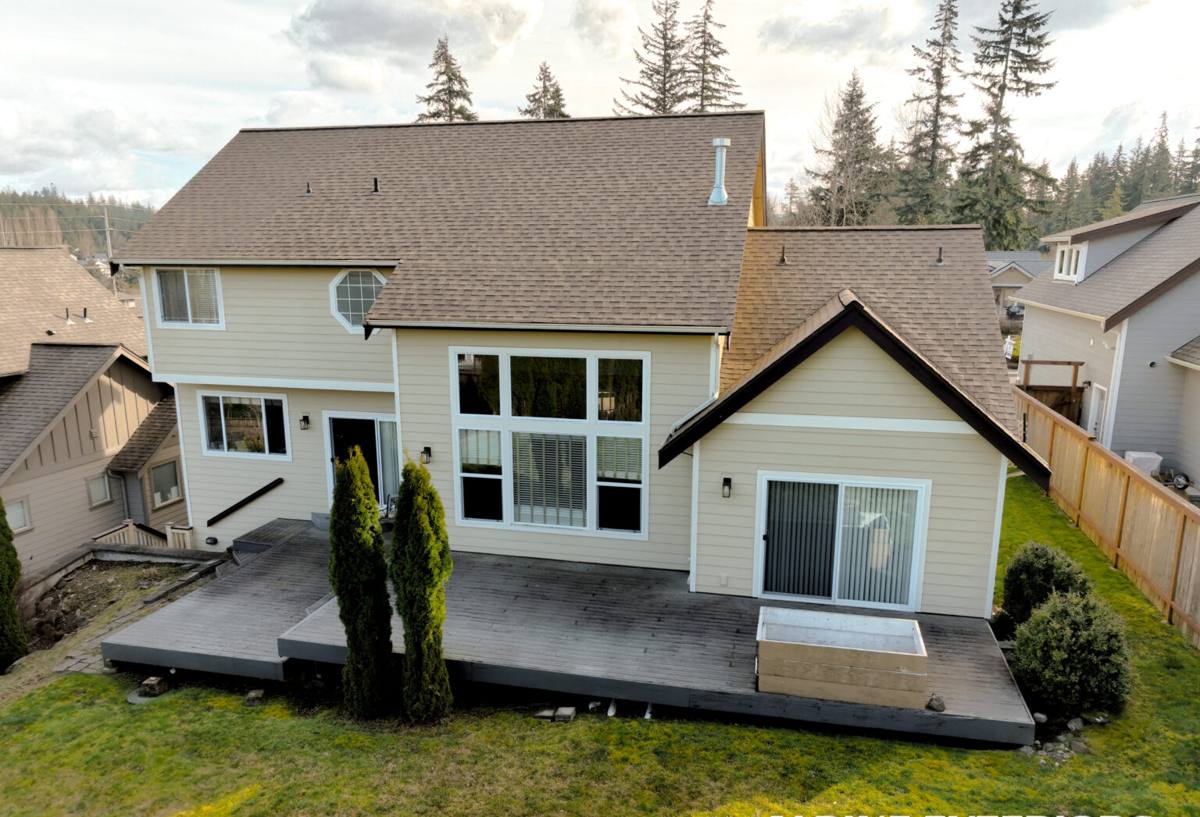
What Salt Air, Rain, and Moss Actually Do to Siding
Salt Air
You don't need to be waterfront to feel it. Airborne salt travels with the marine layer and settles on exterior surfaces, where it accelerates corrosion on fasteners, trim flashing, and any metal components in the wall assembly. Over years, that corrosion can loosen fastening points and let water find its way behind the siding, even on a product that looks fine from the curb.
Driving Rain
Skagit County rain rarely falls straight down. Wind-driven rain pushes water sideways into lap joints, butt seams, and anywhere caulk or flashing has started to fail. A siding system that isn't detailed for wind-driven moisture — proper laps, correct fastener placement, sealed penetrations — will eventually let water track behind the cladding, where it can sit against sheathing for days before it has a chance to dry.
Moss and Sustained Dampness
Shaded walls, especially those facing north or tucked under overhangs and mature trees, stay wet longer after every rain event. That prolonged dampness is exactly what moss, algae, and mildew need to establish themselves. On some materials, that's mostly an appearance issue. On others, it's a durability issue, because sustained moisture contact degrades the material itself over time.
What "Doing It Right" Looks Like on a Mount Vernon Home
A correct siding replacement here isn't just removing old material and nailing up new panels. It's a sequence, and skipping steps is where most premature siding failures start:
- Full removal of old siding and trim to expose the sheathing and framing underneath
- Inspection of sheathing for rot, soft spots, or prior water damage, with repair or replacement before anything new goes up
- Installation of a code-compliant water-resistive barrier, correctly lapped so water sheds outward and downward
- Proper flashing at every window, door, deck ledger, and roof-to-wall intersection — the spots where most leaks actually originate
- Correct fastening schedule and nailing pattern per manufacturer specification, not "close enough"
- Rain screen or drainage gap detailing where appropriate, so any moisture that does get behind the cladding has somewhere to go
- Factory-finished siding installed with the manufacturer's specified clearances from grade, roofing, and hardscape
That last point matters more in Mount Vernon than in drier climates. Siding installed too close to grade, a deck, or a roofline holds moisture against the bottom edge of the material far longer here than it would somewhere with less annual rainfall — and that's often where you'll see the first signs of trouble.
Why We Only Install James Hardie Fiber Cement
We've made a deliberate call as a company: we install James Hardie fiber cement siding, and we don't install vinyl, LP SmartSide, or other engineered wood and composite products. That's not a marketing position — it's based on how these products actually perform under the specific conditions Mount Vernon and the rest of Skagit County deal with year-round.
Vinyl siding is affordable and low-maintenance in the sense that it doesn't need painting, but it's a petroleum-based product that expands and contracts with temperature swings, can warp or crack under impact in colder snaps, and isn't fire-resistant. In a salt-air, high-moisture environment, vinyl's seams and J-channels are also common points where wind-driven rain finds its way behind the material.
Engineered wood products like LP SmartSide use a wood-strand core with a resin coating, which performs reasonably well in moderate climates but is fundamentally a wood product — meaning sustained moisture exposure, if the coating or caulking ever fails, has a real path to rot the core. In an area with our rain totals and moss season, that's a risk we're not willing to put on a homeowner's wall.
James Hardie fiber cement is cement, sand, and cellulose fiber — non-combustible, dimensionally stable, and engineered specifically for moisture resistance. It doesn't rot, and it holds paint and factory finish far longer than wood-based alternatives because it doesn't move the way wood does with humidity swings. Hardie also builds region-specific product lines (their HZ5 formulation is engineered for climates like ours), which is a level of climate-matching most other siding manufacturers simply don't offer.
ColorPlus Finish and Why It Matters in a Moss-Prone Climate
James Hardie's ColorPlus finish is a factory-applied, baked-on finish that's more durable and more UV- and moisture-resistant than field-applied paint. That matters here for two reasons. First, a factory finish resists the kind of moisture intrusion at the coating level that lets mildew and algae get a foothold. Second, when finish does eventually need attention, ColorPlus is backed by its own dedicated finish warranty, separate from the substrate warranty on the siding itself — so you're not relying on a single warranty to cover two very different failure modes.
None of that means Hardie siding is immune to moss or algae staining in a shaded, damp yard. Nothing mounted outdoors in Skagit County is. But a factory-cured finish on a non-organic substrate gives you a much more washable, durable surface to maintain than raw wood or a field-painted product.
Comparing Siding Options for Mount Vernon Conditions
| Factor | Vinyl | Engineered Wood (LP SmartSide) | James Hardie Fiber Cement |
|---|---|---|---|
| Moisture behavior | Water-resistant panels, vulnerable seams | Wood core; failure at coating/caulk lets moisture reach core | Non-organic, doesn't rot from moisture exposure |
| Fire resistance | Combustible | Combustible | Non-combustible |
| Dimensional stability | Expands/contracts with temperature | Moderate movement with humidity | High stability, minimal movement |
| Finish durability | Color molded in, can fade/chalk | Factory or field-applied coating | Factory-baked ColorPlus finish, separate finish warranty |
| Typical lifespan when installed to spec | 20-30 years | 20-30 years | 30-50+ years |
Cost is a real factor too — fiber cement typically carries a higher installed cost than vinyl and is often comparable to or slightly above engineered wood, largely driven by material cost and the labor involved in correct installation. We think that difference is worth it given how much harder Skagit County's climate is on a wall than a national average.
Our Process for a Mount Vernon Siding Replacement
Every project starts with an on-site walkthrough, not a phone estimate. We look at wall orientation (north-facing and shaded walls tell a different story than south-facing ones), existing moisture damage, trim and flashing condition, and any specific trouble spots you've noticed — staining, soft siding, paint that won't hold.
From there, the sequence is straightforward: removal of old material, a real look at what's underneath before anything gets covered back up, repair of any compromised sheathing or framing, correct water-resistive barrier and flashing installation, and then Hardie siding installed to manufacturer spec with proper clearances and fastening. We walk the finished job with you before we consider it done.
Why Local Experience with Mount Vernon Conditions Matters
A crew that mostly works drier inland areas can install siding perfectly well by the book and still miss the details that matter specifically here — how close to grade is too close when your yard floods every winter, which walls need extra attention because they never fully dry out between storms, how flashing details need to account for wind-driven rain coming off the water. A crew that works Burlington, Mount Vernon, and the rest of Skagit County regularly has already seen what goes wrong when those details get missed, on someone else's house, and builds around it on yours.
That local pattern-recognition is hard to substitute for. It's the difference between a technically correct installation and one that's actually built for the specific way weather behaves on your particular lot.
Signs Your Mount Vernon Home May Need Siding Replacement Soon
- Paint that won't hold for more than a couple of years, even after prep and a quality coat
- Soft or spongy spots when you press on siding, especially near the bottom courses or under windows
- Persistent moss or algae staining that comes back within weeks of cleaning
- Visible gaps, warping, or buckling at seams and corners
- Rising energy bills with no other explanation, which can point to a compromised building envelope
- Interior signs like peeling paint or musty smells on exterior-facing walls
If you're seeing more than one of these, it's worth having someone look at what's happening behind the siding, not just at the surface.
If your Mount Vernon home is showing any of these signs, or you're just planning ahead for a siding replacement, we're happy to walk the property with you and give you a straightforward, no-pressure estimate — no obligation, just an honest look at what your home actually needs.