 Burlington
 Fir Island sits out on the flat, low-lying delta ground west of Burlington, where the Skagit River meets the tide flats near Skagit Bay. It's some of the most exposed land in the county — open fields, sloughs on more than one side, and very little standing between a house and whatever the weather is doing that day. A home out here takes a different kind of beating than one tucked into a sheltered lot in town, and when siding on a Fir Island property finally reaches the point where it needs full replacement rather than another round of patching, the material and the installation both need to answer to that exposure. This page covers what a correct full siding replacement looks like for a home in this setting, and why we approach it the way we do.
Why Fir Island's Open Ground Wears Out Siding Faster
Three things compound out here in a way they don't in a more sheltered part of Skagit County. Salt-laden air moves in off Skagit Bay with nothing to slow it down before it reaches a wall — no windbreak of trees or neighboring structures to strip it out of the air first. Driving rain during a fall or winter storm system arrives with real wind behind it, which pushes water sideways into seams and joints instead of letting it run straight down and off. And the same flat, damp ground that makes Fir Island good farmland also means a long moss season, with less of a dry stretch each year for a wall to fully recover between storms.
None of that shows up as a sudden problem. It shows up as paint that fails a season or two earlier than it should, fasteners that corrode faster than the warranty paperwork assumed, and a north or west wall that stays damp for weeks at a time because there's nothing around the property breaking up the wind and moisture coming off the delta.
Wind With Nothing to Slow It Down
A siding system that performs fine on a sheltered, tree-lined lot can still fail on an open Fir Island parcel simply because the wind loading and the angle of the rain are different. Fastening schedules, joint treatment, and flashing details that are adequate in a more protected setting can fall short here, which is exactly why we don't treat every replacement job the same regardless of where the house sits.
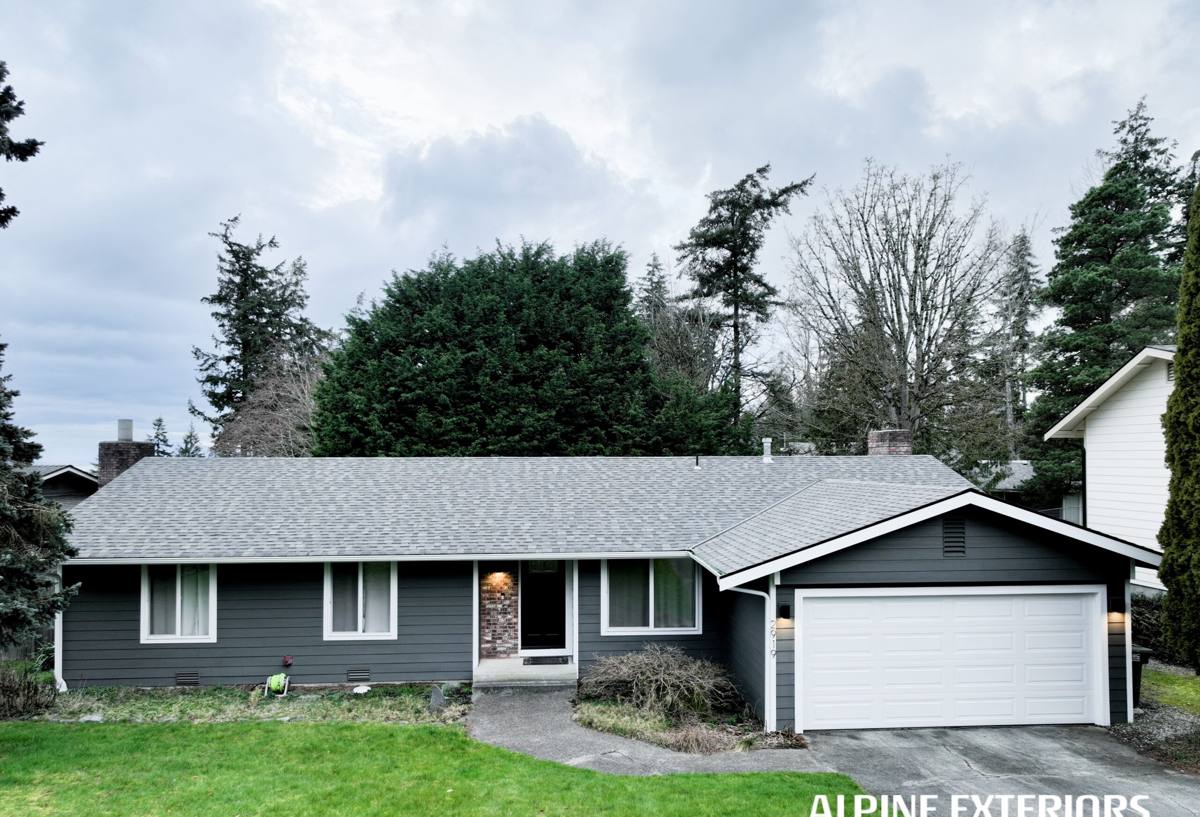
Signs a Fir Island Home Has Reached Full Replacement, Not Just Repair
Not every siding problem calls for tearing the whole wall off. But on an exposed property like this, certain signs mean patch repairs are just delaying the same failure rather than fixing it. Worth checking for before deciding which route to take:
- Siding that feels soft or spongy when pressed, especially near the bottom courses or under windows
- Paint or finish failing across entire wall faces rather than in one isolated spot
- Visible warping, cupping, or bowing across multiple boards on the same wall
- Staining or discoloration low on the wall that suggests moisture has been sitting there a while
- Seams or panels that have pulled loose or separated in more than one location
- A history of repeated repairs to the same section of wall without the underlying problem going away
Why Full Replacement Is the Right Call at That Point
Once moisture problems show up broadly across a wall rather than in one contained spot, patching the visible symptom doesn't fix what's happening underneath. A full tear-off is the only way to actually see the sheathing and weather barrier behind the old siding, confirm whether the framing has taken on hidden moisture damage, and correct whatever let water in to begin with. On a property this exposed, skipping that step and just re-covering the problem tends to mean the same failure reappears a few years later, only now it's hidden behind brand-new siding.
Why We Replace With James Hardie Fiber Cement Only
We install one siding product, on every job, including out here: James Hardie fiber cement. We don't offer vinyl, LP SmartSide, Cemplank, Allura, primed spruce, or cedar. That's a deliberate professional standard, not a limited catalog — each of those alternatives has genuine strengths, but each also carries a moisture or maintenance trade-off we think matters too much on a property that sits this open to salt air and wind-driven rain.
Fiber cement doesn't have an organic substrate for moisture to work into, and it doesn't feed moss growth the way wood-based siding can. That matters more on Fir Island than almost anywhere else nearby, because there's less shelter to reduce how much salt air and rain the walls actually see over a given year.
The HZ5 Product Line and What It's Built For
James Hardie builds different HZ product lines engineered around different climate exposures rather than selling one generic formulation nationwide. For a property this exposed to coastal air and sustained wind-driven moisture, we specify the line built for that kind of exposure rather than defaulting to whatever's standard for a more sheltered inland lot. Paired with a factory-applied ColorPlus finish — cured under controlled conditions instead of painted on-site — it holds up to salt air and sun exposure with less field maintenance than a site-applied finish would need out here.
What a Correct Full Replacement Involves on a Property Like This
The installation matters as much as the product, and on an exposed lot the margin for error is smaller. Correct full replacement means tearing off down to the sheathing rather than covering over what's there, inspecting and repairing any hidden framing or sheathing damage the tear-off reveals, installing a weather-resistive barrier that's properly lapped and sealed, and integrating flashing correctly at every window, door, and penetration before a single piece of new siding goes up. Fastening pattern and spacing need to account for the higher wind exposure a wide-open parcel like this actually sees, not just a generic spacing table written for a sheltered lot.
Tear-Off Is Where Hidden Problems Surface
On an exposed property, tear-off regularly turns up moisture damage that wasn't visible from outside — soft sheathing, rusted fasteners, or a weather barrier that was never lapped correctly the first time the house was sided. Finding that during tear-off, while the wall is open, is the only chance to fix it properly. Covering it back up with new siding without addressing it just resets the clock on the same failure.
Our Replacement Process, Start to Finish
- On-site inspection of the full wall assembly, not just the visible condition of the existing siding
- A written scope specifying the Hardie product line, flashing details, and fastening schedule for this specific property
- Full tear-off to the sheathing, rather than installing over the existing siding
- Repair of any hidden sheathing or framing damage the tear-off uncovers
- Correct installation of the weather-resistive barrier and flashing at every window, door, and penetration
- Hardie installation to manufacturer specification, with fastening and joint treatment sized to this property's actual wind and moisture exposure
- A final walkthrough so you know exactly what was done and what to watch for going forward
Comparing Approaches to Siding Replacement on Fir Island
| Factor | Generic Approach | Approach Built for This Exposure |
|---|---|---|
| Siding material | Whatever's common or cheapest, regardless of exposure | James Hardie HZ line matched to coastal wind and moisture exposure |
| Wall assembly check | New siding installed over the old without opening the wall | Full tear-off to sheathing, hidden damage repaired before re-siding |
| Fastening and flashing | Standard spacing regardless of site conditions | Sized to the wind loading and rain angle of an open, unsheltered lot |
| Finish | Field-applied paint on a recoating schedule | Factory-baked ColorPlus finish, less field maintenance |
| Local exposure judgment | Same spec applied to every property regardless of setting | Adjusted wall by wall based on which faces take the most wind and salt air |
Cost Factors for a Fir Island Siding Replacement
We don't publish blanket pricing, because the real cost drivers depend on the specific house and what tear-off reveals. The factors that consistently move a project's cost are worth understanding before you get quotes.
| Factor | How It Affects Cost |
|---|---|
| Hidden sheathing or framing damage | Found during tear-off; repair adds material and labor before new siding goes on |
| Wind exposure of the specific lot | A more open parcel may call for a heavier fastening schedule and added flashing detail |
| Home size and wall complexity | More corners, gables, and penetrations mean more flashing and labor time |
| Siding profile and trim package | Board-and-batten or heavier trim detail runs higher than standard lap siding |
| Site access | Open, flat lots often stage easier than tight in-town lots, which can offset some labor cost |
Why a Crew That Already Works Fir Island Matters
A crew that regularly works this part of Skagit County already knows how differently an open, wind-exposed wall out here ages compared to a sheltered wall a few miles closer to town, and adjusts the fastening schedule, flashing detail, and product line accordingly instead of applying one generic spec to every job. That judgment comes from doing full tear-offs on properties like this repeatedly, not from a spec sheet written for the average house in the average location. It also means someone local is easy to reach if a warranty question comes up years down the road, rather than tracking down a crew that only passed through once.
If your Fir Island home's siding has reached the point where repair isn't cutting it anymore, we're happy to take a look and give you a straight read on what full replacement would actually involve for your property — no pressure, no generic sales pitch. Reach out for a free estimate and we'll walk the exterior with you and talk through what we find.