 Burlington
 Samish Island's Climate Asks More of Your Siding
Samish Island sits out where Skagit County meets Samish Bay, and that location comes with a trade — one of the best views in the county in exchange for one of the toughest environments for exterior building materials. Homes here take on salt-laden air moving off the water, near-constant winter rain driven sideways by wind with no real windbreak, and long stretches of gray, damp weather that keep siding wet for days at a time. That combination is hard on wood, hard on vinyl, and hard on paint. It is not particularly hard on James Hardie fiber cement, which is why it is the only siding product we install anywhere in our service area, and especially out on the island.
This page is about that one product, in that one location: what Samish Island's climate actually does to a house over the years, what a correct Hardie installation looks like out here, and why hiring a crew that already understands this stretch of Skagit County waterfront is worth more than hiring the cheapest bid.
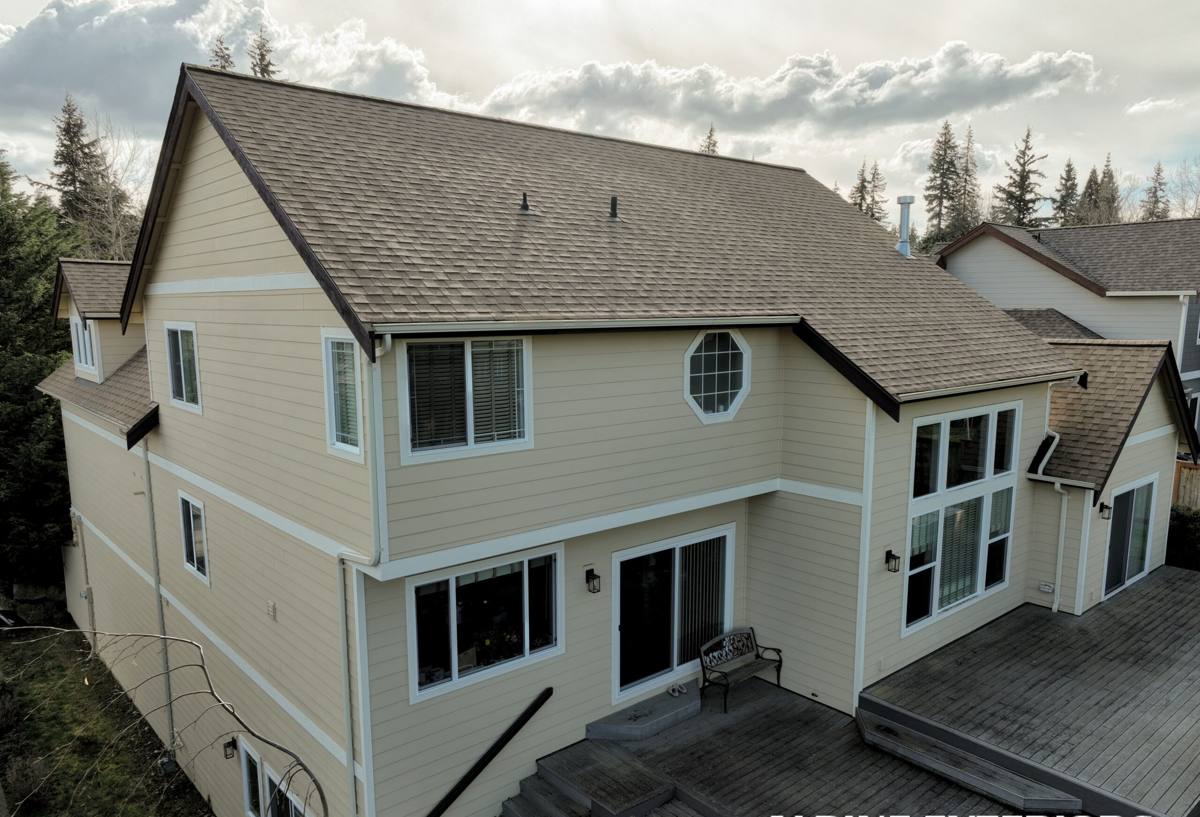
What Salt Air and Driving Rain Actually Do to a House
It helps to be specific about the mechanisms, because "salt air is tough on siding" is true but vague.
Salt Air
Airborne salt is hygroscopic — it pulls moisture out of the air and holds it against whatever surface it lands on. On fasteners and metal trim, that accelerates corrosion. On painted wood, it breaks down the paint film faster than inland exposure would, leading to more frequent repainting and, eventually, wood that stays damp longer between dry spells. On vinyl, salt residue builds up as a chalky film that has to be washed off regularly or it dulls the surface and holds moisture against seams.
Driving Rain
Rain that comes in sideways off open water doesn't just wet the face of the siding — it pushes water up under laps, into seams, and behind trim if those details aren't installed correctly. A siding system's worst enemy usually isn't rain falling straight down; it's wind-driven rain finding a gap, and open water frontage means more of that kind of weather than a house set back in the trees.
Long Moss Season
Skagit County's wet season stretches long, and Samish Island's exposure keeps surfaces damp even longer than most of Burlington. That extended dampness is exactly what moss and algae need to get established on siding, trim, and anything with a north-facing or shaded exposure. Once organic growth takes hold, it holds even more moisture against the surface underneath it — a cycle that gets worse every year it's left alone.
Why James Hardie Fiber Cement Holds Up Here
James Hardie siding is fiber cement — a mix of cement, sand, and cellulose fibers, engineered and cured to be dimensionally stable and non-combustible. For a property like a Samish Island home, three characteristics matter most:
- It doesn't rot. Fiber cement has no wood fiber for moisture to break down, so the repeated wet-dry cycling that eventually rots cedar or primed spruce siding isn't a failure mode for Hardie.
- It doesn't corrode. Unlike some metal siding systems, the board itself has no rust risk from salt exposure — though fasteners and flashing still need to be selected correctly, which we cover below.
- The factory finish resists the elements better than field-applied paint. ColorPlus finish is baked on at the factory under controlled conditions, and it holds color and resists fading, chalking, and salt residue significantly better than paint applied on-site in variable weather.
James Hardie also makes a climate-specific product line — HZ5 — engineered for regions with more moisture and freeze-thaw cycling. We install HZ5 across our whole Skagit County service area, Samish Island included, because there's no reason to install a product engineered for a drier climate when the correct version costs the same to install.
What a Correct Installation Involves — Especially Here
Fiber cement siding performs as well as its installation. A poor installation on a good product will still fail early, and on a wind- and salt-exposed site like Samish Island, the margin for sloppy work is smaller than it is inland. A correct job includes:
Water Management Behind the Siding
Hardie siding is not the primary waterproofing layer — the weather-resistive barrier (house wrap) and flashing behind it are. On a wind-driven-rain site, that drainage plane, the flashing at every window, door, and penetration, and the way the siding laps over it all have to be done right, or water that gets past the face of the siding has nowhere to go but into the wall.
Fastener and Flashing Material
In a salt-air environment, fastener choice matters more than it does a few miles inland. Corrosion-resistant fasteners and compatible flashing metals reduce the streaking and premature corrosion that under-specified hardware causes near open water.
Correct Gaps, Clearances, and Caulking
James Hardie's install specifications call for specific clearances from grade, roof lines, and decks, and specific gapping at butt joints and trim. These aren't arbitrary — they're what keeps water from wicking into end grain or pooling where it can't dry out. Skipping them is one of the most common ways a Hardie installation underperforms.
Fastening Pattern for Wind Exposure
Open, wind-exposed sites benefit from a fastening schedule on the tighter end of Hardie's approved range. It's a small detail that a crew unfamiliar with waterfront sites can easily under-spec.
Product Options for a Samish Island Home
| Product | Best Use | Why It Fits Here |
|---|---|---|
| HardiePlank lap siding | Most homes, traditional look | Widest color range in ColorPlus; proven system for wind and rain exposure |
| HardiePanel vertical siding | Modern facades, accent walls, gable ends | Fewer horizontal laps means fewer water-entry points on exposed elevations |
| HardieTrim boards | Corners, window and door trim, fascia | Matches the fiber cement performance of the field siding — no mismatched wood trim rotting first |
| HardieShingle siding | Accent gables, coastal-style detailing | Delivers a shingle look without the maintenance burden of real cedar shingle near salt air |
Moss, Algae, and Keeping the Finish Clean
No siding is immune to organic growth in a climate this wet, but the ColorPlus finish makes a real difference in how easy it is to keep clean. Because the color is baked into a factory-cured coating rather than absorbed into a porous wood or fiber surface, moss and algae sit on the surface rather than taking hold in it, and a routine soft wash removes them without stripping paint or exposing bare material underneath. Homes with heavy shade or north-facing walls out here will still need that occasional wash — no siding eliminates the need entirely — but the difference between rinsing a factory finish and having to scrape, prime, and repaint a wood surface that's started to fail underneath the growth is significant over a 10- or 15-year span.
What Drives Cost on a Samish Island Job
| Factor | Why It Matters |
|---|---|
| Home size and elevation count | More square footage and more corners, gables, and trim details mean more material and labor |
| Existing siding removal | Tear-off of old wood or vinyl, and any sheathing repair found underneath, adds time before new siding goes on |
| Wall condition underneath | Water-damaged sheathing or framing found during tear-off needs to be repaired before siding — common on older wood-sided homes on wind-exposed sites |
| Trim and detail level | Vertical accent panels, shingle-style gables, and extensive trim add labor beyond a straightforward lap-siding job |
| Access | Waterfront lots, steep grades, or limited staging area can affect scaffolding and material handling |
We give exact numbers after a walk-through, not before — every one of these factors is site-specific, and broad online ranges tend to mislead more than help.
Our Process on Samish Island
We're a Burlington-based crew that already works this part of Skagit County, and Samish Island's wind and salt exposure isn't something we're guessing at project to project. Our process:
- Walk-through and assessment — we look at current siding condition, trim, water damage risk points, and exposure direction specific to the property.
- Written estimate — product selection, colors, and a clear scope, no pressure to decide on the spot.
- Tear-off and inspection — old siding comes off, sheathing gets inspected, and anything damaged gets addressed before new material goes up, not covered over.
- Weather-resistive barrier and flashing — the drainage plane behind the siding gets built correctly, since this is what actually keeps water out.
- Hardie installation to spec — correct fasteners, clearances, gapping, and fastening pattern for the site's wind exposure.
- Final walk-through — we go over the finished work with the homeowner before calling the job done.
A Simple Maintenance Checklist for Salt-Air Sites
- Rinse siding once or twice a year to remove salt residue and organic buildup, more often on shaded or north-facing walls
- Check caulking at trim joints and penetrations annually — caulk is a maintenance item even on a low-maintenance siding system
- Keep gutters and downspouts clear so water isn't overflowing onto siding below the roofline
- Trim back vegetation that keeps siding shaded and damp longer than the rest of the house
- Have any impact damage or corner damage repaired promptly — small gaps are how water gets behind the system
Why Local Experience Matters More Out Here
Samish Island isn't a typical inland Burlington lot, and a crew that mostly installs siding a few miles from Interstate 5 doesn't automatically know how to fastener-spec, flash, and gap a job for open-water wind exposure. We install James Hardie exclusively — no LP SmartSide, no vinyl, no cedar — because it's the product we trust to hold up under this county's weather when it's installed correctly, and installing it correctly on a site like this is a skill set built from doing it here repeatedly, not from a manufacturer's install guide alone.
If you're planning a siding replacement on Samish Island, we're happy to walk the property, look at what your home's specific exposure is dealing with, and put together a straightforward estimate — no pressure, no inflated first number to negotiate down from. Reach out through the form below to get started.