 Burlington
 Roofing for a Wet, Shaded Corner of Skagit County
Big Lake sits in one of the more heavily treed, moisture-heavy pockets around Burlington. Between the lake itself, the surrounding conifers, and the steady parade of fronts that roll in off the Sound through the winter and spring, roofs here deal with a specific combination of problems: near-constant dampness, heavy shade on north- and east-facing slopes, and a moss season that can run eight months or more if nothing is done about it. Add in the broader Skagit County climate — driving rain that comes in sideways during winter storms, and the low-grade salt air that reaches inland from Puget Sound on windier days — and you've got conditions that are genuinely tougher on a shingle roof than what you'd find in a drier part of the state.
None of that means asphalt shingles are the wrong choice for Big Lake. They're still the most practical, cost-effective roofing material for most homes here. It means the installation has to be done with this specific environment in mind, not treated the same way you'd roof a house in eastern Washington.
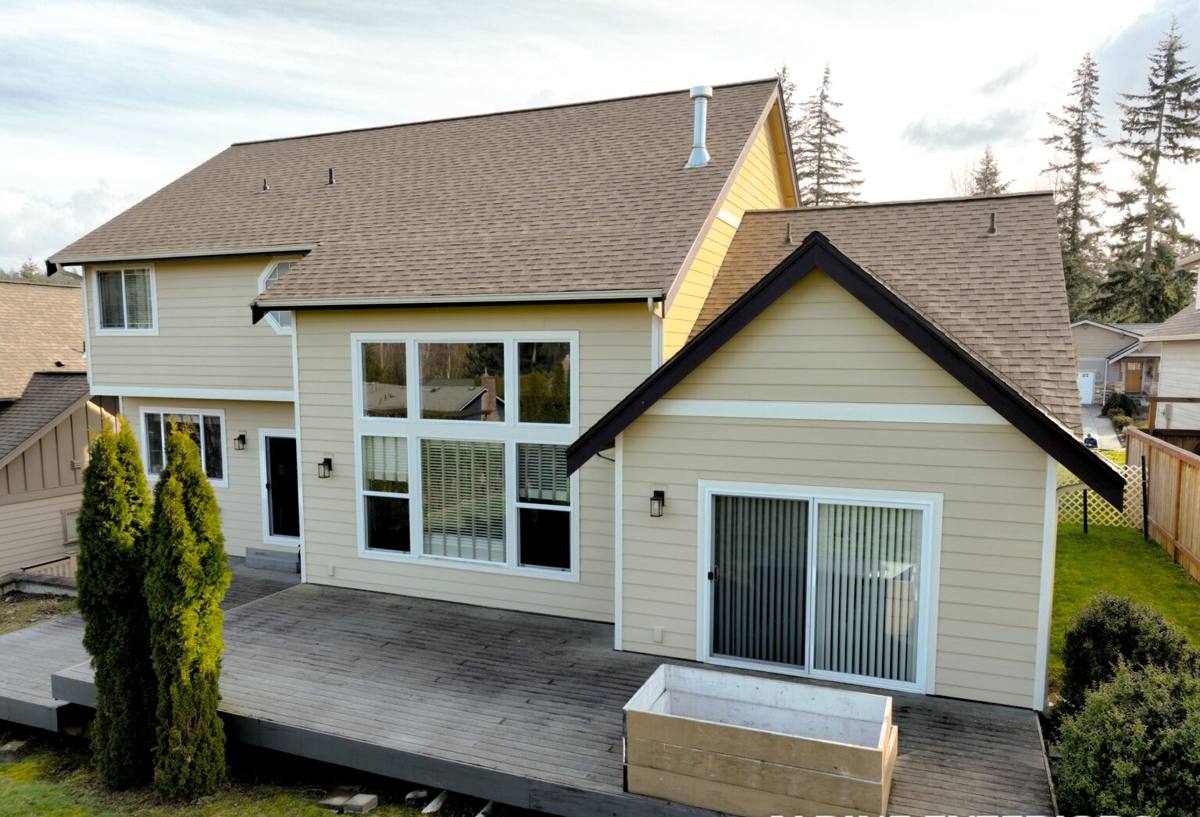
What This Climate Actually Does to a Shingle Roof
Moss and Moss-Related Damage
Moss doesn't just sit on top of shingles looking unsightly — it works its way under the shingle tabs, holds moisture against the granule surface, and gradually lifts edges as it grows. Over a few seasons that trapped moisture accelerates granule loss and can work its way into the underlayment, especially on shaded roof planes that never fully dry out between rain events. Big Lake's tree cover means most homes here have at least one slope that stays damp far longer than a roof in open sun would.
Constant Rain Exposure
It's not just total rainfall — it's how often the roof gets wet and how rarely it gets a real chance to dry. Shingles, flashing, and underlayment all rely on drainage and drying cycles to hold up over time. In a spot like Big Lake, where drizzle and overcast days stack up back-to-back for weeks, poorly lapped flashing or marginal underlayment gets exposed faster than it would in a drier climate.
Wind-Driven Rain
Winter storms in this part of Skagit County don't just drop rain straight down — they push it sideways under wind gusts, which is exactly the condition that exposes weak points at flashing, valleys, and shingle laps that would never leak in a calm rain.
What a Correctly Installed Roof Looks Like Here
A roof built for Big Lake conditions isn't a different product — it's the same asphalt shingle system, installed with extra attention to the details that matter most in a wet, shaded environment:
- Synthetic underlayment (not felt alone) as a second line of defense under the shingles
- Ice-and-water shield or equivalent self-adhered membrane at eaves, valleys, and any low-slope transitions
- Properly lapped, sealed flashing at every roof penetration, chimney, and wall intersection
- Balanced intake and exhaust attic ventilation, so moisture doesn't get trapped from underneath
- Algae-resistant shingles on shaded or north-facing slopes where moss and algae pressure is highest
- Correct nailing pattern and fastener count for wind exposure, not the manufacturer's bare minimum
Skip any one of those and the roof will likely still look fine on install day — the problems show up two, five, or ten years later, usually as a leak, premature moss growth, or shingles that curl and lose granules well before their rated lifespan.
Choosing the Right Shingle for a Big Lake Roof
Architectural vs. 3-Tab
Most homes we work on in this area do better with architectural (dimensional) shingles over standard 3-tab. They're heavier, hold up better to wind, and their layered profile sheds water more effectively — a real advantage on a roof that stays wet as often as one at Big Lake does. 3-tab shingles are still a legitimate, lower-cost option for some budgets and roof types, but they have less margin for error in a demanding climate.
Algae-Resistant Shingles
Most major manufacturers now offer shingles with copper-infused granules designed specifically to resist algae and moss growth. On a heavily shaded roof plane, this is one of the more worthwhile upgrades available — it doesn't make the roof moss-proof, but it slows growth noticeably and buys years between cleanings.
| Shingle Type | Typical Lifespan Here | Moss/Algae Resistance | Best Use |
|---|---|---|---|
| Standard 3-tab | 15-20 years | Low unless treated | Budget-conscious, sun-exposed roofs |
| Architectural, standard | 25-30 years | Low-moderate | Most homes, mixed sun/shade |
| Architectural, algae-resistant | 25-30 years | Higher | Shaded, tree-covered lots like much of Big Lake |
| Impact-resistant architectural | 25-30+ years | Moderate-high (often paired with algae resistance) | Homes wanting extra durability and possible insurance credit |
Actual lifespan depends heavily on ventilation, slope, and how much shade a given roof plane gets — the ranges above assume a correctly installed, properly ventilated roof, not just the shingle itself.
Signs a Big Lake Roof Needs Attention
- Visible moss growth, especially in streaks running down from the ridge on shaded slopes
- Granules collecting in gutters or at downspout outlets
- Shingle tabs that look curled, cupped, or lifted at the edges
- Dark staining or streaking that doesn't wash off with rain
- Soft spots, sagging, or visible daylight in the attic around the roof deck
- Water stains on ceilings or in the attic after a heavy or wind-driven storm
- Flashing that looks rusted, cracked, or pulled away from a wall or chimney
Any one of these on its own isn't necessarily an emergency, but they're worth a real inspection rather than waiting for a leak to show up inside the house.
Our Process for a Big Lake Roof
Inspection and Honest Assessment
We start by getting on the roof, not just looking at it from the ground. That means checking the deck for soft spots, evaluating existing ventilation, and looking closely at flashing and valleys — the places that actually fail first in this climate. If a roof genuinely just needs cleaning, repair, or moss treatment instead of full replacement, we'll tell you that.
Tear-Off and Deck Check
For a full re-roof, we remove the old roofing down to the deck rather than layering over it. That lets us actually see the plywood or sheathing underneath and replace any sections that have taken on moisture damage — something you can't catch or fix with an overlay.
Underlayment and Flashing First
Before a single shingle goes down, the underlayment, ice-and-water membrane, and flashing get installed correctly at every vulnerable point. This is the part of the job that determines whether the roof leaks in year three or holds up for its full lifespan — it matters more than the shingle brand.
Shingle Installation and Ventilation
Shingles go on with the correct nailing pattern and exposure for the manufacturer's wind rating, and we make sure intake and exhaust ventilation are actually balanced, not just present. A ridge vent with blocked or undersized soffit intake doesn't do much good.
Final Walkthrough
We walk the finished roof and the site with you, point out anything worth knowing for future maintenance, and make sure debris and old materials are cleared out.
Moss Prevention and Ongoing Care
Even a well-built roof in this environment benefits from a little ongoing attention, especially on shaded planes:
- Zinc or copper control strips near the ridge, which release trace metal ions that discourage moss regrowth over time
- Periodic soft-washing of moss and algae rather than pressure-washing, which can strip granules and shorten shingle life
- Keeping overhanging branches trimmed back where practical, to cut down on shade and debris buildup
- Clearing gutters and valleys of needles and leaf litter, which hold moisture against the roof edge
None of this is high-maintenance if it's kept up on a normal schedule — it's mostly about not letting moss get a multi-year head start.
Why It Matters Who Installs the Roof
A shingle roof installed by a crew unfamiliar with this specific stretch of Skagit County will often look identical to a well-built one on the day it's finished. The difference shows up years later, in how the flashing holds up to wind-driven rain, how fast moss establishes on the shaded slopes, and whether the attic ventilation was actually sized for the roof rather than copied from a generic spec sheet. We work on homes around Burlington and Big Lake regularly, so we're not guessing at how this climate treats a roof — we're accounting for it in the underlayment, the flashing, the shingle choice, and the ventilation plan from the start.
If your roof is showing moss, wear, or you're just due for a straightforward inspection, we're happy to take a look and give you a clear, honest assessment. Use the form below to request a free, no-pressure estimate.