 Burlington
 Why Fir Island's Siding Takes a Different Approach
Fir Island sits low in the Skagit River delta, close enough to Skagit Bay that salt-laden air is a daily fact of life, not an occasional weather event. Add in the driving rain that comes off Puget Sound through the fall and winter, plus a moss season that can stretch for months in the shade of trees and north-facing walls, and you've got one of the tougher siding environments in Skagit County. Materials that hold up fine in a drier inland town can start showing problems here within a few years — swelling at the edges, paint failure, soft spots, or a green film that never fully goes away between pressure washes.
This isn't a reason to panic about your siding. It's a reason to be specific about what you install and how it's installed. A product that resists moisture intrusion, holds paint under UV and salt exposure, and is fastened and flashed correctly for a wet marine climate will genuinely outperform one that isn't — and the gap shows up faster on Fir Island than it does twenty miles inland.
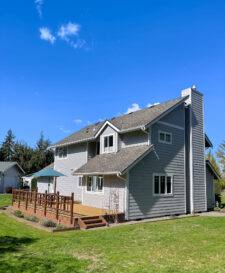
What Salt Air and Driving Rain Actually Do to Siding
It helps to understand the mechanism, not just the symptom. Salt air is hygroscopic — it pulls moisture out of the atmosphere and holds it against surfaces longer than dry air would. On wood-based products, that constant low-grade dampness is what feeds rot at seams, corner boards, and butt joints. On painted surfaces, salt accelerates the breakdown of the paint film, which is why houses closer to the water tend to need repainting more often than the same house set back a few miles.
Driving rain adds a second problem: wind-driven water doesn't just run down a wall, it gets pushed sideways and upward into laps, seams, and any gap in the water-resistive barrier. Siding that isn't installed with the right overlaps, flashing, and drainage gap behind it will eventually let that water find a way in, even if the siding material itself is sound. And once moisture is trapped behind siding in a climate that rarely gets a long dry stretch to let things dry out, it stays trapped — which is where hidden rot and sheathing damage start.
Moss is the visible symptom most homeowners notice first, but it's really just an indicator of a shaded, damp microclimate on that wall. It won't rot fiber cement the way it can compromise wood trim, but left unaddressed it holds moisture against the surface and can stain ColorPlus finishes if it's not rinsed off periodically.
The Three Things Fir Island Siding Has to Get Right
- Moisture management behind the cladding — a proper drainage plane and rainscreen gap so any water that gets past the siding can drain and the wall can dry
- A finish that holds up to salt and UV — factory-applied, not field-painted, so the color and protective layer don't degrade at the seams first
- Fastening and flashing done to spec — correct nail placement, joint treatment, and window/door flashing so wind-driven rain can't work its way behind the boards
Why We Only Install James Hardie Fiber Cement
We standardized on James Hardie for every siding job we do, including on Fir Island, and it's worth explaining why rather than just stating it. Hardie's fiber cement is non-combustible, doesn't provide a food source for the rot and insect damage that wood-based sidings can be vulnerable to, and holds its shape and fastening in wet-dry cycles far better than materials that expand and contract with moisture content. In a delta environment with sustained humidity and salt exposure, that dimensional stability matters more than it does in drier parts of the state.
Hardie also engineers specific product lines by climate zone — HZ5 is the version specified for the Pacific Northwest's wet, temperate conditions, formulated to perform where humidity and rainfall are high year-round. That's a meaningful difference from a one-size-fits-all product, and it's a big part of why we don't substitute in other fiber cement or composite brands: we want the version of the product that's actually engineered for what this climate does to a house.
The ColorPlus factory finish is the other half of the equation. It's baked on under controlled conditions with a coating designed to resist fading and hold adhesion far longer than a field-applied paint job, which matters directly on a salt-air site where paint failure is usually the first visible sign of trouble. Hardie backs its products with a strong transferable limited warranty, which only holds real value when installation follows the manufacturer's specifications — which is the other half of what you're paying a contractor for.
What Correct Installation Involves
Fiber cement siding is only as good as the wall assembly behind it. On every Fir Island job, our process includes:
- Removing the old siding and inspecting the sheathing and framing underneath for existing moisture damage before anything new goes up
- Repairing or replacing any compromised sheathing, trim, or framing — we don't cover over a problem
- Installing a code-compliant water-resistive barrier with correctly lapped and taped seams
- Building in a rainscreen drainage gap so the wall assembly can dry if any moisture does get behind the cladding
- Flashing all windows, doors, and penetrations to shed water outward and downward, never into the wall
- Installing the Hardie boards to manufacturer fastening and clearance specs, including proper gaps at grade and hardscape
- Caulking and finishing joints per Hardie's requirements so the ColorPlus warranty stays intact
Every one of those steps is more important in a marine, salt-air climate than it is in a dry one, because there's less margin for error when the wall assembly rarely gets a long stretch to dry out on its own.
Signs Your Current Siding Is Already Losing the Fight
- Paint that's peeling, bubbling, or chalking faster than it should, especially on the sides of the house that face prevailing weather
- Soft or spongy spots when you press on the siding, particularly near the bottom courses or around window trim
- Persistent moss or dark staining that returns quickly after cleaning
- Visible gaps, warping, or separation at seams and corner boards
- Rising energy bills or drafts that suggest the wall assembly isn't sealing the way it used to
None of these mean you need to replace siding today, but they're worth having looked at before a small moisture problem becomes a sheathing or framing problem.
Cost Factors on a Fir Island Job
| Factor | Why It Matters Here |
|---|---|
| Existing sheathing condition | Salt air and driving rain increase the odds of hidden moisture damage that needs repair before new siding goes on |
| House size and wall complexity | More corners, dormers, and trim details mean more flashing and cutting time |
| Hardie product line and profile | Lap siding, shingle-style panels, and board-and-batten all price differently; HZ5 climate-specific product is what we quote for this area |
| Color and finish selection | Factory ColorPlus finishes carry different pricing tiers than primed-for-paint options |
| Access and site conditions | Fir Island's rural, low-lying layout can affect staging and material delivery on some properties |
Why It Matters That We Already Work This Area
A crew that's done siding work throughout Skagit County, including on Fir Island, isn't guessing at how this environment behaves. We know to plan around the wetter months, we know which wall orientations tend to hold moisture longer, and we know not to cut corners on drainage details that a drier-climate installer might treat as optional. That local familiarity shows up in fewer surprises during the job and a wall assembly that's actually built for the conditions it has to survive.
It also means we're not a stranger if something needs a look down the road. Being based near Burlington and working this part of Skagit County regularly means a real, reachable local business stands behind the installation — not a crew that showed up once from out of the area.
Maintenance That Actually Extends the Life of the Job
- Rinse the exterior annually, focusing on shaded and north-facing walls where moss and grime build up fastest
- Keep gutters clear so water isn't overflowing directly onto siding runs
- Trim back vegetation and tree cover that keeps walls damp and shaded longer than necessary
- Recaulk joints and trim as needed rather than waiting for a gap to become a leak path
- Have a professional look at any soft spots, staining, or paint failure early rather than waiting
Correctly installed Hardie siding is low-maintenance, not no-maintenance — a little attention each year is what keeps a good installation performing for decades instead of one.
If your Fir Island home's siding is showing its age or you're planning ahead of a problem, we're happy to take a look and give you an honest, no-pressure estimate — just fill out the form below.