 Burlington
 Fiber Cement Siding for Conway Homes
Conway sits down in the flats where the Skagit River bends toward Skagit Bay, close enough to open water and tidal marsh that the weather here behaves a little differently than it does even a few miles inland in Burlington. Homes in this stretch of Skagit County take on salt-laden air drifting up off the bay, driving rain that arrives sideways more often than straight down, and a moss season that can run from early fall clear into late spring without much of a real dry-out window in between. That combination is hard on any exterior wall system, and it's especially unforgiving toward siding that wasn't built with a marine-influenced climate in mind.
We install James Hardie fiber cement siding exclusively, and we work Conway regularly as part of our Burlington-area service territory. This page focuses on one thing: what a fiber cement siding job for a Conway home actually needs to get right, given the specific conditions this low-lying, water-adjacent community deals with year after year.
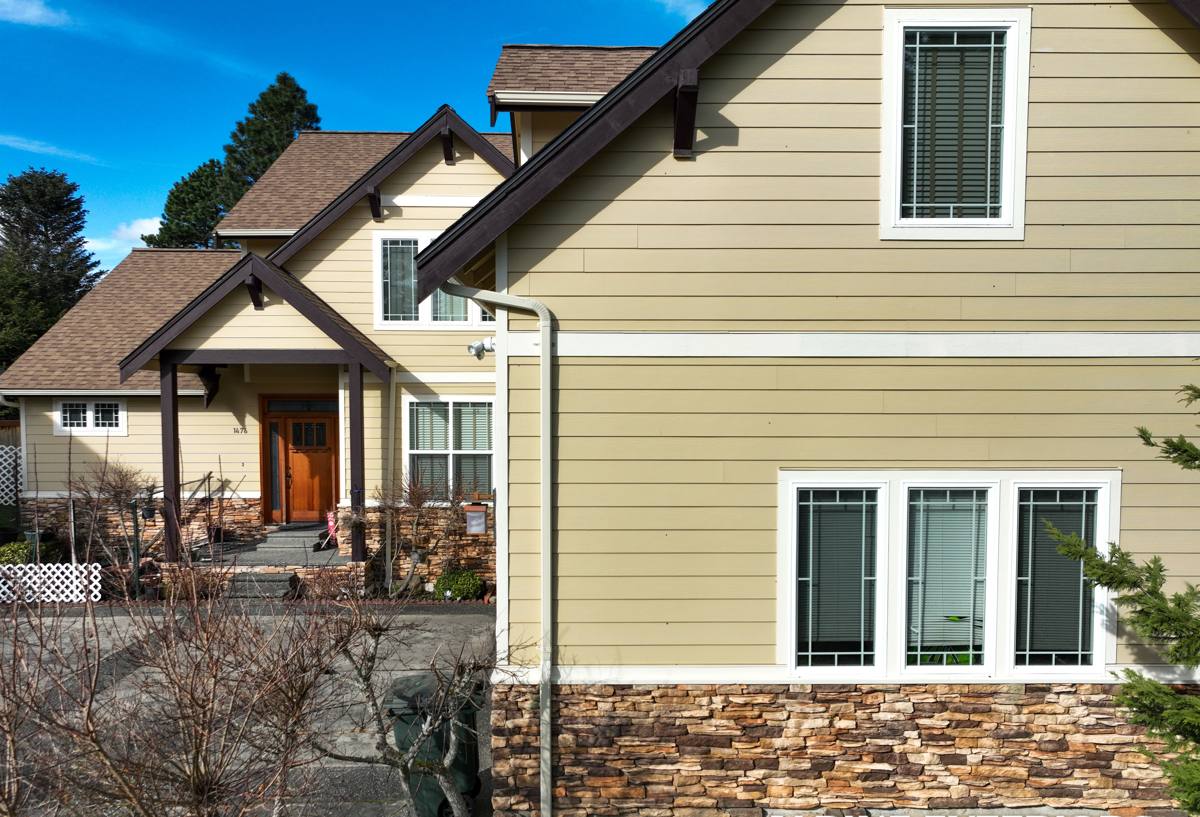
What Conway's Location Does to a House
Conway isn't a hillside town with wind-sheltering terrain — it's low, flat, and close to both the river and the bay, which means there's little to break up wind-driven weather before it reaches a house. That has a few practical effects on siding performance:
- Salt-influenced air corrodes exposed fasteners, trim edges, and any metal flashing that isn't properly protected or detailed
- Wind off the flats pushes rain into seams, laps, and butt joints at an angle, rather than letting it run straight down and off
- Higher ambient humidity near the river and marsh keeps siding surfaces damp longer after a storm, which extends the window moss and algae have to take hold
- Shaded, tree-lined lots common in this area compound the moisture problem on north- and east-facing walls that get less direct sun to dry them out
None of that makes siding a losing proposition in Conway — plenty of homes here have held up fine for decades. It does mean the material and the installation details matter more than they would somewhere drier or more sheltered, and it's the reason a generic siding job tends to show its weak points here faster than it would elsewhere.
Why We Install Only James Hardie in This Area
Homeowners in Conway ask us about vinyl, LP SmartSide, primed wood, and cedar fairly often — they're familiar, and in some cases cheaper up front. We don't install any of them, and it's worth being straight about why.
Where the Alternatives Struggle Here
Vinyl siding depends on the drainage plane behind it staying intact, since the panels themselves aren't a sealed surface — they overlap and rely on a weather-resistant barrier to do the real work. In a spot like Conway where wind-driven rain is routine, that reliance on loose seams and unsealed channels is a real liability. Vinyl also gets brittle with age under sun and salt exposure, so a stray branch or ladder bump can crack a panel in a way that's nearly impossible to color-match years later.
LP SmartSide and other engineered wood products use a wood-strand core with a resin binder. That core performs fine as long as moisture stays out, but any cut edge, fastener hole, or compromised caulk joint gives water a path in, and once moisture reaches the strand core it can swell and delaminate from the inside — damage that's often invisible until the siding is already failing. Primed wood and cedar are honest, attractive materials, but both need a real maintenance commitment — recoating, caulk renewal, moss treatment — and that schedule only gets tighter in a climate with as little drying time as Conway gets.
None of these products are bad everywhere. We just don't think they're the right call for homes sitting this close to Skagit Bay, and we'd rather say so directly than sell something we don't expect to hold up here.
What Hardie Brings Instead
James Hardie fiber cement is made from cement, sand, and cellulose fiber — there's no organic wood core for moisture to work into, and no vinyl substrate to go brittle under UV and salt. It's non-combustible, dimensionally stable across temperature swings, and available in Hardie's HZ5 formulation, which is engineered specifically for regions with heavier moisture exposure like the Pacific Northwest rather than a single generic product sold everywhere. The ColorPlus finish is baked on at the factory under controlled conditions, which holds up to more wet-dry cycling per year than a field-applied paint job typically manages, and it carries a real transferable warranty backed by the manufacturer.
What a Correct Fiber Cement Job Involves
The siding panel itself is only part of the system. In a location like Conway, the details around it are what actually determine whether the job lasts.
Weather-Resistant Barrier and Drainage Plane
Hardie siding is installed over a weather-resistant barrier, and in a wind-driven-rain climate that barrier needs to be lapped correctly — upper courses over lower ones, seams sealed, and penetrations properly flashed — so that any water that does get past the siding face has somewhere to go besides the sheathing. A rainscreen or drainage gap behind the siding gives that moisture a path to drain and the wall assembly a chance to dry, which matters more here than in a drier inland climate.
Fastening and Clearances
Fiber cement needs to be fastened per Hardie's published specs — correct nail or screw type, spacing, and placement relative to panel edges — because under-driven or over-driven fasteners are one of the most common causes of early siding failure. Ground clearance and proper flashing at the base of the wall also matter more in a low-lying, damp area like Conway, where splashback and standing moisture near grade are a bigger factor than they'd be on a well-drained hillside lot.
Joints, Caulking, and Trim
Every butt joint, corner, and trim intersection is a potential entry point for water if it isn't detailed correctly. That means using the right sealant rated for exterior fiber cement, backer rod where joints call for it, and trim details that shed water rather than trap it. Sloppy caulk work is invisible on install day and shows up as a moisture problem two or three years later.
Moss and Algae Resistance
Hardie's factory finish resists staining and biological growth better than field-applied paint, but no siding is immune to moss and algae in a climate this damp. Proper installation — including adequate clearance from overhanging vegetation where possible and correct panel overlap that doesn't trap standing moisture — reduces how much moss gets a foothold in the first place, which cuts down on the cleaning a homeowner has to do down the road.
Cost Factors for a Conway Siding Project
| Factor | Why It Matters in Conway |
|---|---|
| Home size and wall complexity | More corners, gables, and penetrations mean more flashing and trim detail work, which affects both material and labor |
| Existing siding removal and sheathing condition | Homes near the river and bay sometimes have hidden moisture damage behind old siding that needs repair before new siding goes on |
| Hardie product line and profile | Lap, shingle, and panel systems price differently, and HZ5 climate-specific formulations are part of building correctly for this area |
| Trim and accessory package | Corner boards, window and door trim, and fascia detailing all affect both appearance and long-term water management |
| Site access and drainage grading | Low-lying lots near Conway sometimes need attention to grading or flashing at the base of the wall as part of the job |
We give exact numbers only after walking a specific property — anyone quoting a firm price over the phone for a house they haven't seen is guessing.
Our Process for Conway Projects
- A free, no-pressure on-site visit where we look at the existing siding, sheathing condition, and any problem areas specific to the property
- A written estimate that breaks down the Hardie product line, profile, and color, along with the scope of trim and flashing work
- Removal of the old siding and inspection of the sheathing underneath, with any moisture damage addressed before new siding goes up — not covered over
- Installation of the weather-resistant barrier, drainage detailing, and Hardie siding to manufacturer specification
- A final walkthrough so you can see the completed work and ask questions before we consider the job done
Why a Crew That Already Works Conway Matters
Conway is a small community, and it doesn't get the same volume of contractor attention that a bigger town like Burlington or Mount Vernon does. That's exactly why local familiarity matters — a crew that regularly works this stretch of the county knows which walls take the worst of the wind off the bay, how far inland the salt air actually reaches, and which flashing and drainage details are worth extra attention versus which ones are code minimum. That judgment comes from doing the work here repeatedly, not from a general contractor passing through for a one-off job.
Signs Your Conway Home May Need New Siding
- Soft or spongy spots when you press on the siding, especially near the bottom courses or under windows
- Visible warping, buckling, or gaps at seams and corners
- Persistent moss or algae staining that comes back quickly after cleaning
- Peeling or bubbling paint on wood-based siding, or chalky fading on older vinyl
- Rising energy bills that may point to a compromised weather barrier behind the siding
If you're weighing what your Conway home actually needs, we're glad to take a look and give you a straight answer — whether that's a full re-side, a partial repair, or simply confirmation that what you have is holding up fine. Reach out for a free, no-pressure estimate and we'll walk the property with you.