 Burlington
 Why Siding Takes More Punishment in Alger Than Most People Expect
Alger sits in the stretch of Skagit County between Burlington and Bellingham, close enough to Samish Bay and Puget Sound that salt-laden air is a regular part of the weather, not an occasional event. Add the driving, wind-pushed rain that comes through this corridor off the water, and a tree canopy that keeps many walls shaded for much of the year, and you get a climate that is genuinely harder on exterior siding than a typical inland Skagit County property. Moss doesn't take a season off here — on north-facing walls and anything tucked under fir or cedar cover, conditions for moss and algae growth exist nearly year-round.
None of this means siding fails quickly. It means siding that isn't engineered and installed for these specific conditions fails faster than it should, usually starting at the details: caulk joints, butt seams, trim intersections, and anywhere water can sit instead of shed. A siding job in Alger has to be built assuming the wall will stay damp longer than it would a few miles inland, and that salt air will find every unprotected edge of fastener or cut panel.
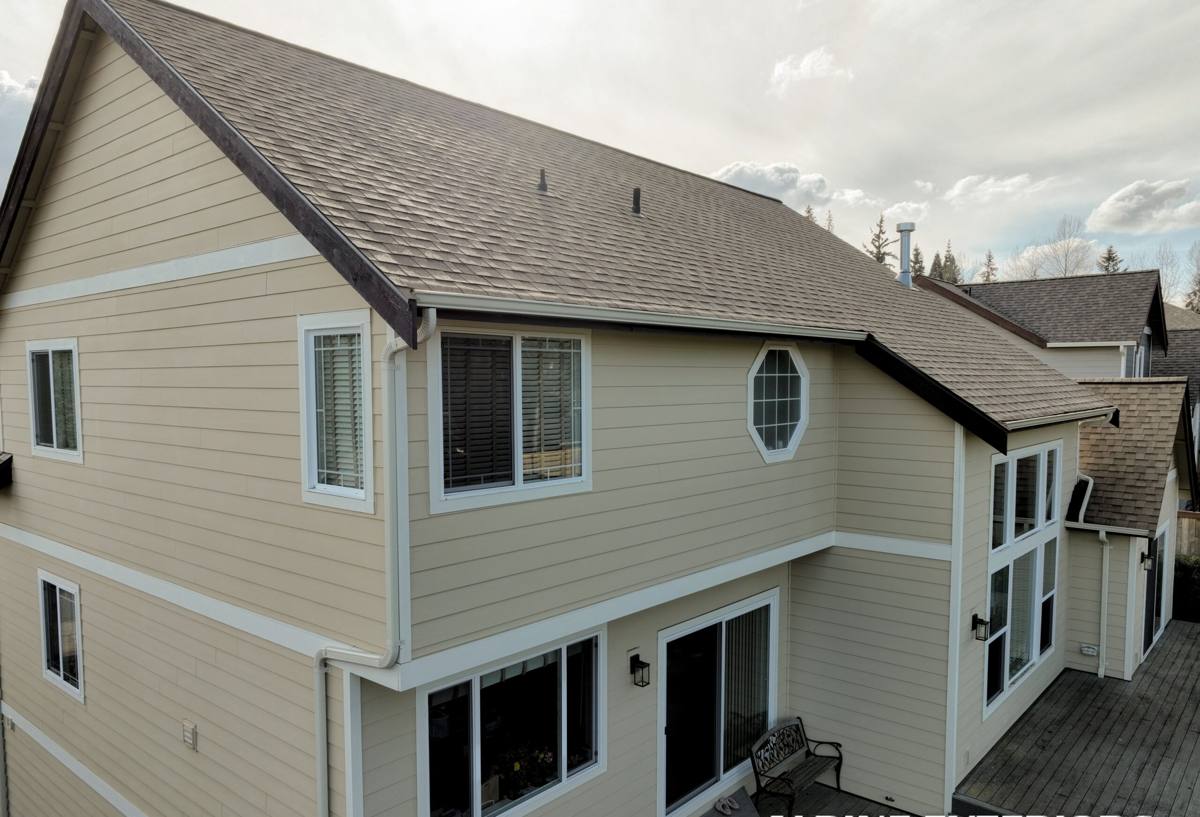
What Correct Fiber Cement Siding Looks Like for This Climate
Climate-Engineered Product, Not Generic Product
James Hardie manufactures its fiber cement lap and panel siding in climate-specific formulations, and for the Pacific Northwest that means the HZ5 line, engineered for moisture cycling, freeze-thaw swings, and sustained damp exposure rather than dry-heat climates. This isn't a marketing distinction — the cement formulation and moisture-resistance testing are genuinely different from siding built for the Southwest or Southeast.
Factory-Applied Finish
ColorPlus finish is baked on at the factory under controlled conditions, which matters more here than in a drier climate. A factory finish resists fading, chalking, and moisture intrusion at the surface far better than field-applied paint, and it holds its seal at cut edges and laps when those edges are properly treated during installation — which is where a lot of the real work happens.
Profile Choice
Most Alger homes do well with a traditional lap profile for water shedding on primary walls, with panel or shingle-style Hardie products reserved for accents where the design calls for it. The profile matters less than the water management behind it, which is the next section.
The Installation Details That Actually Determine How Long Siding Lasts
Fiber cement siding fails prematurely almost never because of the material itself — it fails because of installation shortcuts that don't show up until year three, five, or ten. In a climate with Alger's rain load and moss pressure, these details matter more, not less.
Flashing and Drainage Plane
Every window head, door head, and horizontal trim intersection needs proper flashing integrated with a correctly lapped weather-resistive barrier behind the siding, with a drainage gap that lets any water that does get behind the cladding find its way back out instead of sitting against the sheathing. This is invisible once the job is done, which is exactly why it's the detail most often shortcut on a rushed install.
Clearances and Fastening
Manufacturer clearance requirements from grade, roofing, decks, and horizontal surfaces exist specifically to keep splash-back and standing moisture off the bottom edge of the siding — the first place failure shows up on a damp lot. Fastening pattern and caulk selection at butt joints also matter more in a climate that keeps materials wet longer, since a poor caulk joint stays wet longer before it dries out.
| Detail | Correct approach | Common shortcut |
|---|---|---|
| Clearance from grade/decking | Manufacturer minimum maintained on every elevation | Reduced near patios, walkways, or grading changes |
| Window and door flashing | Integrated pan flashing, properly lapped with barrier | Caulk used as the primary water seal |
| Butt joints | Sealed per manufacturer spec, or flashed and left to drain | Caulked and painted over with no drainage path |
| Cut edges | Sealed with approved product before install | Left raw or sealed after the fact |
What We Commonly See on Older Siding in the Alger Area
On homes we're asked to evaluate in and around Alger, the pattern is consistent: moss and algae staining concentrated on shaded, north- or west-facing walls; caulk joints that have failed at butt seams and trim; and, on the worst cases, soft or discolored sheathing behind the siding where flashing was never properly integrated in the first place. These aren't defects specific to one siding type — we've seen them on wood, engineered wood, and poorly installed fiber cement alike. The common thread is always the same: a wall detail that didn't account for how long this area actually stays wet.
Our Process for a Fiber Cement Project in Alger
- On-site assessment. We walk the property, note shade patterns, moss history, drainage issues, and existing damage before quoting anything.
- Tear-off and sheathing check. Old siding comes off and we inspect the sheathing and framing underneath for moisture damage before anything new goes up.
- Water management repair. Weather-resistive barrier, flashing at every penetration and horizontal transition, and drainage gap are corrected or installed to current standards.
- Fiber cement installation. James Hardie product is installed to manufacturer clearance, fastening, and joint-treatment specifications — no shortcuts on the details that determine longevity.
- Trim and finish. Trim, caulking, and touch-up are completed with products compatible with the ColorPlus finish system.
- Final walkthrough. We review the completed work with the homeowner before calling the job done.
Fiber Cement Versus the Alternatives, for This Specific Climate
We only install James Hardie fiber cement, and the reasons come down to how each material actually performs where salt air, driving rain, and extended moss season are a permanent condition rather than an occasional one.
| Material | Moisture/moss behavior | Maintenance burden | Typical concern in this climate |
|---|---|---|---|
| James Hardie fiber cement | Non-combustible, engineered moisture resistance (HZ5), factory finish | Low — periodic wash, no repainting cycle with ColorPlus | Requires correct installation to realize its full lifespan |
| Vinyl siding | Doesn't rot, but seams and panels can warp or fade under sun/salt exposure | Low, but limited repair options once faded or cracked | Can trap moisture behind panels if house wrap detailing is poor |
| Cedar / primed wood | Absorbs moisture, feeds moss and mildew growth if not maintained | High — regular refinishing, moss treatment, caulk maintenance | Long damp seasons shorten the interval between maintenance cycles |
| Engineered wood (e.g. LP SmartSide) | Treated to resist moisture, but edges remain moisture-sensitive if not sealed and maintained | Moderate — edge sealing and repainting over time | Field-applied finish is more exposure-dependent than a factory finish |
Every one of these products has legitimate uses. Our decision to install only James Hardie is about matching a non-combustible, factory-finished, climate-engineered material to a climate where moisture and moss pressure are constant rather than seasonal — and standing behind a strong transferable warranty on top of it.
Keeping Moss and Moisture From Winning Long-Term
Correctly installed fiber cement needs far less upkeep than wood or engineered wood siding, but "low-maintenance" isn't "no-maintenance" in a climate like this one. A short annual routine keeps moss from ever getting a foothold:
- Rinse shaded and north-facing walls once a year, especially where tree cover keeps siding damp longer
- Keep gutters clear so overflow doesn't run down the wall face
- Trim back vegetation and tree limbs that hold moisture against the siding
- Check caulk joints at trim and butt seams annually for cracking or gaps
- Address any moss growth early with a gentle wash rather than pressure-washing directly into seams
- Watch for staining at the bottom courses, a sign of splash-back or a clearance issue worth having checked
Why It Matters to Hire a Crew That Already Works in Alger
Skagit County's permitting requirements, the practical realities of scheduling around this area's wet stretches, and knowing which wall orientations on a given lot are going to fight moss hardest are all things you learn from doing the work here repeatedly, not from a general contractor's manual. A crew unfamiliar with the Alger microclimate can install a technically correct product and still miss the details — clearance near a shaded foundation planting bed, drainage behind a wall that never gets direct sun — that determine whether it performs for decades or needs attention in a few years.
If you're weighing a siding replacement or new installation in the Alger area, we're happy to walk the property, look at what your walls are actually dealing with, and put together a straightforward, no-pressure estimate. There's a form below to get that started.