 Burlington
 Conway Sits in a Tough Spot for Exterior Siding
Conway doesn't get talked about as much as Mount Vernon or Burlington proper, but the homes here take a specific kind of beating. You've got salt air drifting in off the tidal water near the Skagit River delta, driving rain that comes sideways during winter storms, and enough tree cover and low-lying moisture in some pockets to keep moss and algae growing on north-facing walls for most of the year. None of that is unusual for Skagit County, but Conway gets a concentrated version of it. Siding here isn't just a cosmetic choice — it's the one layer standing between your framing and a climate that never really dries out.
That combination is exactly why we don't install whatever a homeowner asks for. We install James Hardie fiber cement, full stop, because it's the one siding system engineered to actually hold up to salt-laden air, saturated wood trim conditions, and long stretches of shaded dampness without turning into a maintenance project every other year.
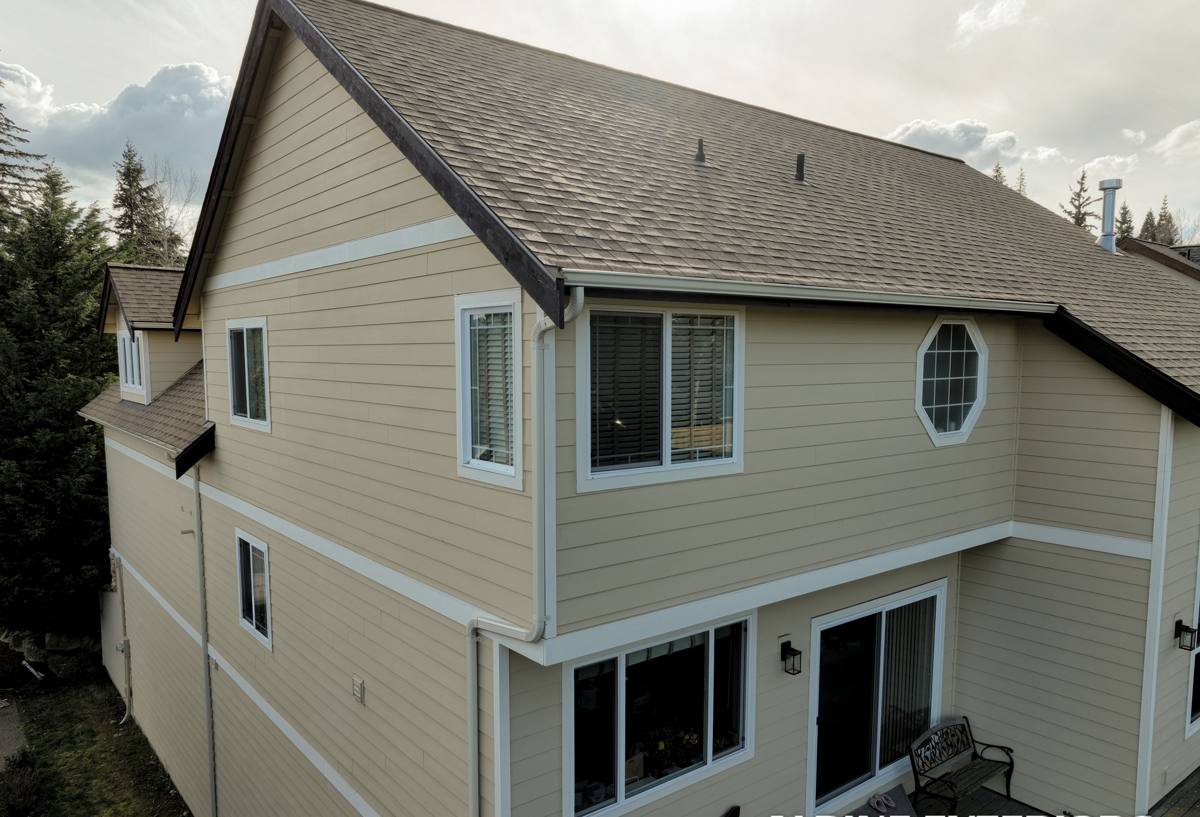
What Salt Air and Driving Rain Actually Do to Siding
Salt air is corrosive to metal fasteners and trim, and it accelerates the breakdown of finishes that aren't built to resist it. Driving rain — rain that's pushed sideways by wind rather than falling straight down — finds every gap, seam, and undersized flashing detail on a wall. On a lot of homes, water doesn't come through the siding material itself; it comes through the joints, the butt seams, the trim intersections, and the places where the installer took a shortcut.
Wood and engineered wood products swell and shrink with this kind of moisture cycling. Vinyl doesn't rot, but it flexes, gaps, and lets wind-driven water get behind it at the J-channels. Fiber cement, installed correctly, doesn't move the same way — it's dimensionally stable wet or dry, which matters enormously in a spot like Conway where the siding rarely gets a long dry stretch to fully recover between storms.
Why Moss Season Runs Long Here
Moss and algae need three things: shade, moisture, and time. Conway's tree cover and the region's overcast winters supply all three for months at a stretch. On siding that isn't factory-finished, that means the paint film breaks down faster, the substrate underneath starts absorbing moisture, and the surface becomes an even better host for growth the following year. It compounds.
Why James Hardie Is the Product We Standardize On
James Hardie fiber cement is non-combustible, dimensionally stable, and — critically for this region — available in an HZ5 formulation specifically engineered for damp, moderate climates like the Pacific Northwest. That's not a marketing detail we repeat because it sounds good; it's the actual reason the product performs differently here than it does in Phoenix.
| Factor | Standard HZ10 Zone | HZ5 (Pacific Northwest) |
|---|---|---|
| Moisture resistance engineering | Built for hot, dry cycling | Built for cool, wet, prolonged-moisture cycling |
| Freeze-thaw performance | Not a primary design factor | Formulated with regional freeze-thaw exposure in mind |
| Finish | ColorPlus or primed | ColorPlus or primed, same color library |
| Fit for Conway/Skagit County | Not recommended | Correct product for this climate zone |
The ColorPlus factory finish matters just as much as the substrate. It's a baked-on, multi-coat finish applied under controlled conditions, and it holds color and resists dirt and mildew adhesion far better than a field-applied paint job on wood or primed products. In a climate where north-facing walls stay damp for weeks at a time, that finish is doing real work.
What a Correct Installation Looks Like in Conway
James Hardie siding is only as good as the installation underneath it. In a high-moisture, salt-air environment, a handful of details separate a 30-year wall assembly from one that starts failing at year eight:
- Proper rainscreen or drainage gap behind the siding so any water that does get past the surface can drain and dry rather than sit against the sheathing
- Correct clearance from grade, decks, and roof lines — Hardie's own installation instructions specify minimum gaps, and skipping them is one of the most common causes of early rot at the bottom course
- Flashing at every window, door, and horizontal trim transition, installed to shed water outward rather than trap it
- Factory-cut and field-cut edges sealed before installation, since raw cut edges are the one part of fiber cement that can absorb moisture if left unsealed
- Stainless or hot-dip galvanized fasteners rated for the coastal-adjacent air, not standard fasteners that will corrode faster here than inland
- Correct fastener spacing and depth — overdriven nails crack the board's fiber cement edge and create a moisture entry point that isn't visible until it's already a problem
None of this is exotic. It's just detail work that takes longer and requires actually following the manufacturer's installation manual instead of treating it like generic lap siding.
Tear-Off vs. Overlay
On a lot of Conway homes, especially older ones, we're not just installing new siding — we're removing whatever's there and checking the sheathing and framing underneath for moisture damage first. Given how long this area holds dampness, siding over a wall that already has hidden rot just locks the problem in behind a new, better-looking surface. We'd rather find that out before the new siding goes up than after.
Cost Factors Specific to a Job Like This
| Factor | Why It Moves the Price |
|---|---|
| Tear-off and disposal of existing siding | Old siding, especially if it's damaged or contains hidden rot repair, adds labor and disposal cost |
| Sheathing or framing repair | Moisture-related damage found during tear-off has to be fixed before new siding goes on |
| Trim and detail complexity | Multiple gables, window returns, and transitions take more time to flash and finish correctly |
| Product profile (lap, shingle, panel) | Different Hardie product lines have different material and labor costs |
| ColorPlus vs. field-primed | Factory finish costs more upfront but eliminates a repaint cycle for years |
| Access and site conditions | Tree cover, tight lot lines, and drainage grading can add setup time on wooded Conway lots |
We don't quote a job without walking the exterior first — moisture-damaged sheathing in particular is impossible to price accurately from a photo or a phone call.
Choosing Between Hardie's Product Lines for This Area
James Hardie makes several siding profiles, and the right one depends on the home's style and exposure, not just preference:
- HardiePlank lap siding — the most common choice, a good fit for most Conway homes needing full replacement
- HardieShingle — works well for accent areas or homes going for a more traditional Northwest look, still with the same moisture-resistant substrate
- HardiePanel — vertical panel option, often used on gables or as an accent alongside lap siding
Color selection matters here too. Lighter ColorPlus finishes show less obvious water-spotting between cleanings, while darker colors can make a shaded, moss-prone wall look dirty faster even when the siding itself is performing fine. We'll walk through the options against your home's actual sun and shade exposure rather than just handing you a color chart.
What to Ask Before Hiring Anyone for This Job
- Do they install to James Hardie's published installation instructions, including clearance and flashing details, or just "however it's always been done"?
- Will they check for and disclose moisture or rot damage during tear-off, in writing, before covering it back up?
- What fastener type are they using, and is it rated for a coastal-adjacent, high-moisture environment?
- Is the crew installing a drainage gap or rainscreen behind the siding, or fastening directly to the sheathing?
- Do they carry manufacturer certification or documented Hardie-specific training, not just general siding experience?
- What does the warranty actually cover — material, labor, or both — and for how long?
Why Local Experience in Conway Specifically Matters
A crew that's worked plenty of jobs in Conway and the rest of Skagit County already knows which walls on a given lot take the worst of the wind-driven rain, how long moss actually takes to establish on a shaded elevation here, and which permitting and inspection details the county expects. That's not something you can fully substitute with general siding experience from a drier region. It shows up in small decisions — where extra flashing goes, which side of the house gets the tighter fastener schedule, how much drainage gap to build in — that add up to whether the siding is still performing correctly in fifteen years or needs rework in five.
If you're weighing a siding replacement or repair on a Conway home, we're happy to take a look and walk you through what your specific house needs — no pressure, no upsell, just a straight assessment and a written estimate.