 Burlington
 Alger Sits in a Tough Spot for Exterior Siding
Alger is a small, heavily wooded community along the I-5 corridor between Burlington and Bellingham, tucked against the hills near Lake Samish and the Chuckanut range. That location is beautiful, but it's rough on a house exterior. Tree cover keeps siding shaded and slow to dry. Elevation and proximity to the hills mean more rainfall than you'll see in flatter parts of Skagit County. And because Alger sits close enough to Samish Bay and the Salish Sea, homes here still pick up salt-laden air on windy days, even without an ocean view.
Put those three things together — shade, rain, and salt air — and you get a siding environment that punishes anything with a paper facing, a foam core, or a paint film that isn't built to handle constant moisture cycling. This page is about one product, in one place: James Hardie fiber cement siding, installed correctly on Alger homes.
What the Local Climate Actually Does to Siding
Moss and Standing Moisture
Alger's tree canopy means a lot of siding surfaces never get direct sun for more than a few hours a day, if that. Moisture sits on the wall longer than it would on an open lot in town. Over a long moss season — which in this part of Skagit County can run most of the year — that trapped moisture feeds algae and moss growth on anything porous, and it slowly breaks down wood-based products from the inside out.
Driving Rain and Wind-Driven Water
Rain in this part of Washington doesn't just fall straight down. Wind off the hills and the nearby water pushes it sideways into wall assemblies, which is why flashing details, caulk joints, and butt seams matter more here than in drier climates. A siding job that would hold up fine in Eastern Washington can fail within a few years in Alger if the water management behind it is sloppy.
Salt Air
Salt exposure is subtler inland than it is right on the water, but it's still real. Salt accelerates corrosion on fasteners and metal flashing, and it can degrade lower-quality paint finishes faster than plain rainwater does. Any siding and fastener system going on an Alger home needs to be rated for that kind of exposure, not just standard interior-grade hardware.
Why James Hardie Fits This Environment
We install James Hardie fiber cement siding exclusively, and Alger is a good example of why. Fiber cement is made from cement, sand, and cellulose fibers — there's no wood pulp or foam core to absorb water and rot, and it's non-combustible, which matters in a wooded community with wildfire seasons that keep getting longer. Hardie's HZ5 product line is engineered specifically for wetter, colder Pacific Northwest climates, with a formulation designed to resist moisture-related damage and cracking in freeze-thaw conditions.
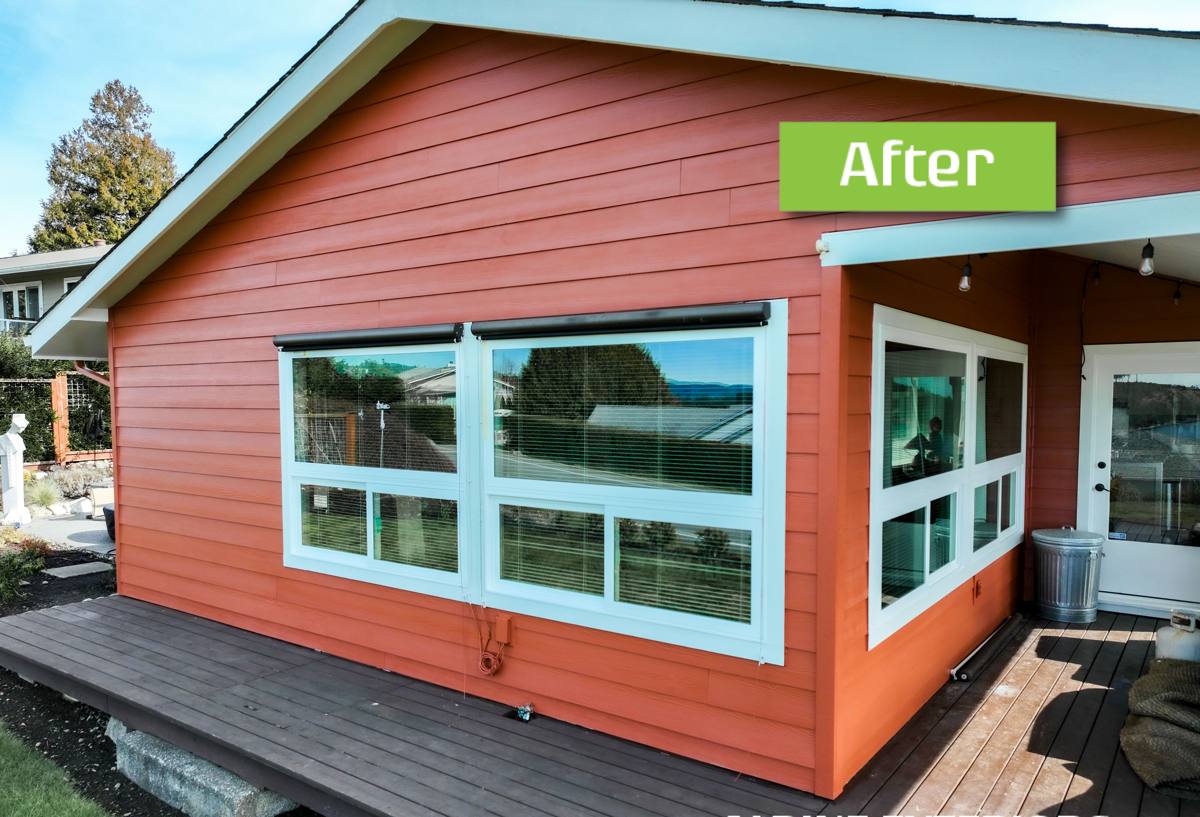
Just as important is the factory-applied ColorPlus finish. Instead of field-painting siding after it's installed — which leaves the cut edges and job-site touch-ups more vulnerable — ColorPlus is baked on in a controlled factory environment with multiple coats, and it's backed by its own finish warranty. In a shaded, damp, salt-touched environment like Alger, that factory finish holds color and resists fading, chalking, and moisture intrusion far better than a field-applied coat.
Why We Don't Install the Alternatives
Vinyl siding is affordable and low-maintenance in mild climates, but it's a poor match for heavy shade and constant moisture — it can warp, and its seams give wind-driven rain more places to work its way behind the panel. LP SmartSide and similar engineered wood products use a wood-strand core that, once moisture gets past a compromised seal or scratch, can swell and deteriorate in ways fiber cement simply doesn't. Primed cedar and spruce siding look great going up, but they demand a repainting and caulking schedule that's hard to keep up with under Alger's tree cover, and untreated cut edges are an open door for rot. We standardized on James Hardie because it removes those failure points, not because the alternatives are worthless products — they just aren't the right call for this specific climate.
What a Correct Installation Involves
Hardie siding is only as good as the installation behind it. The product is engineered to perform, but a rushed or careless install can undo most of that engineering. On every Alger job we run through the same fundamentals:
Water Management Behind the Siding
A weather-resistive barrier goes on first, with all seams properly lapped and taped, and flashing integrated at every window, door, and roof-to-wall intersection. This is the layer that actually keeps a house dry — the siding itself is the second line of defense, not the first.
Correct Fastening
Hardie specifies fastener type, spacing, and placement for a reason — it affects how the boards handle expansion, contraction, and wind load. We use corrosion-resistant fasteners appropriate for a coastal-influenced climate, driven to the manufacturer's specified depth, not overdriven or underdriven.
Clearances and Gaps
Hardie siding needs proper clearance from rooflines, decks, and grade, and small gaps at trim and butt joints to allow for material movement. Skipping these clearances is one of the most common ways a technically "Hardie" job ends up trapping moisture anyway.
Caulking and Sealing
We use sealants rated for the joint type and exposure, applied at manufacturer-specified points — not everywhere, since over-caulking can trap moisture just as badly as under-caulking.
Our Process, Start to Finish
- On-site assessment — we look at your home's exposure, existing siding condition, trim and flashing details, and any moss, staining, or soft spots that point to underlying moisture damage.
- Written estimate — a clear scope covering tear-off or overlay, water-resistive barrier work, trim, and the specific Hardie products and colors involved.
- Prep and tear-off — removing old siding down to the sheathing when needed, and repairing any rot or damage found underneath before anything new goes on.
- Barrier and flashing installation — the water-management layer that does the real work over the life of the siding.
- Hardie siding installation — to manufacturer spec on fastening, clearance, and joint treatment.
- Trim, caulking, and final walk-through — finishing details and a review with you before we call the job done.
ColorPlus Options for a Shaded, Wooded Lot
Color choice matters more in a wooded setting like Alger than it does on an open lot, since a home surrounded by evergreens reads differently in the available light than one in full sun. Darker, richer tones tend to hold up visually well against a green backdrop, while lighter tones can help a home stand out and feel brighter under tree cover. Because ColorPlus is a factory finish, the color is consistent across every board and holds up to years of shade and moisture exposure without the fading that field-painted siding often shows first on sun-facing walls and around trim.
Cost Factors on an Alger Job
Every home is different, so we don't quote a per-square-foot number without seeing the house, but the factors below are what actually move the price on a typical Alger project.
| Factor | Why It Matters |
|---|---|
| Tear-off vs. overlay | Removing old siding and repairing sheathing/rot underneath adds labor but is often necessary on older homes with moisture damage |
| Home size and wall complexity | More corners, gables, and dormers mean more cutting, flashing, and trim work |
| Siding profile | Lap siding, shingle-style panels, and vertical board-and-batten each have different material and labor costs |
| Trim and accent work | Window and door trim, fascia, and soffit detailing add material and installation time |
| Site access | Trees, slopes, and driveway access common in Alger's wooded lots can affect staging and scaffolding time |
| Existing moisture damage | Rot repair discovered during tear-off is billed separately since it can't be accurately scoped until the old siding is off |
Maintenance: What Alger Homeowners Should Actually Watch For
Hardie siding is low-maintenance compared to wood, but "low-maintenance" doesn't mean "no maintenance," especially under Alger's tree cover. A short seasonal check goes a long way:
- Look for moss or algae buildup on shaded walls, especially the north side and anywhere near tree cover, and rinse it off before it spreads
- Check caulking at trim, windows, and butt joints annually for cracking or gaps
- Keep gutters clear so overflow doesn't run down the siding face
- Trim back branches and vegetation touching the siding to improve airflow and drying time
- Watch for any soft spots, staining, or bubbling paint, which can signal a flashing or sealant failure underneath
- Have fastener heads and trim seams inspected every few years, since coastal-influenced air accelerates corrosion faster than it would further inland
Why a Crew That Already Works Alger Matters
Alger isn't downtown Burlington — it's a rural, wooded community with its own access challenges, tree cover, and microclimate, and it's easy for a contractor who mostly works in-town jobs to underestimate what that means for water management and site logistics. A crew that already knows the area knows to plan for slower drying times, to size up moss and moisture damage on tear-off correctly, and to account for tree-heavy lot access when scheduling material delivery and staging. That familiarity shows up in fewer surprises mid-project and a install that's actually built for the conditions your home sits in, not a generic spec sheet.
If you're weighing a siding replacement or repair in Alger, we'd rather walk your property and give you a straight answer than guess over the phone. We install James Hardie exclusively because we've seen what holds up in this climate and what doesn't, and we're glad to explain that reasoning in person. Reach out for a free, no-pressure estimate using the form below.