 Burlington
 Why Decks in Mount Vernon Take More Than a Nice Design
A deck in Mount Vernon has to survive a different set of conditions than a deck in a dry inland climate. Skagit County sits under a marine-influenced weather pattern — long stretches of driving rain, heavy humidity off the water and river valley, and a moss and algae season that can run most of the year in shaded or north-facing spots. None of that is a problem you can design your way around with a nice railing pattern or a popular decking color. It's a problem you solve with flashing, fastener choice, drainage detailing, and material selection — the parts of a deck that aren't visible once the project is finished but determine whether it's still solid in twelve years or soft and green in four.
We build and repair decks throughout the Burlington and Mount Vernon area, so we see both ends of this: decks that were built to shed water and have aged well, and decks that were built to look good on install day and started failing at the ledger board or the post bases within a few wet seasons. The difference almost always comes down to a handful of details covered below.
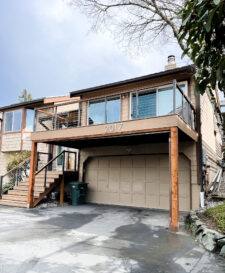
What a Correctly Built Deck Requires in This Climate
Ledger Board Flashing
Where an attached deck meets the house is the single most common failure point we see in this region, and it's almost always a flashing problem rather than a decking problem. If water is allowed to sit or wick behind the ledger board where it bolts to the house framing, that wood — and the framing behind it — starts to rot from the inside, often long before there's any visible sign on the surface. A correct ledger detail uses proper flashing, a water-resistant barrier behind it, and the right fastening pattern so water is directed out and away rather than trapped against the house. This is not optional in a climate that gets as much sustained rain as ours, and it's one of the first things we check on any repair or re-deck call.
Footings and Post Bases
Footings need to be sized and set to local frost depth and soil conditions, not just poured to "whatever's worked before." Post bases should hold the post up off the concrete rather than letting it sit in standing water, since a wood post base in constant contact with wet concrete is one of the fastest ways to rot a structural post from the bottom up. We also grade and slope around footings so water doesn't pool against them season after season.
Fasteners and Hardware
In a humid, wet climate, the wrong fastener corrodes, stains the decking around it, and eventually loses its grip. We use fasteners and structural hardware rated for exterior, high-moisture use — hot-dip galvanized or stainless, depending on the application — and we match hardware to the wood or composite it's fastening so there's no reaction between dissimilar metals and treated lumber chemicals. Cheap fasteners are one of the least visible ways a deck gets built to fail early, because the problem doesn't show up until the fasteners have already been corroding for a couple of winters.
Choosing a Decking Material for Skagit County Weather
There's no single "right" material for every project — it depends on budget, how much upkeep you want to take on, and how much sun or shade the deck gets. Here's how the common options actually perform in a wet, moss-prone climate like this one:
| Material | Upfront Cost | Maintenance | Moss/Mildew Resistance | Typical Lifespan |
|---|---|---|---|---|
| Pressure-treated lumber | Low | High — needs regular cleaning, periodic sealing/staining | Low without upkeep; moss and algae take hold quickly in shade | 10–20 years with consistent maintenance |
| Cedar | Medium | Medium-High — needs sealing to hold color and resist moisture | Naturally more rot-resistant than pine, but still needs cleaning | 15–25 years with maintenance |
| Composite (capped) | Medium-High | Low — periodic washing, no sealing or staining | Higher resistance; surface doesn't absorb moisture the way wood does, but mildew can still grow on the surface film if never cleaned | 25–30+ years |
| PVC decking | High | Low | High — fully synthetic, doesn't absorb water | 25–30+ years |
We're honest with clients about the trade-offs here rather than pushing whatever has the best margin. Pressure-treated lumber is a legitimate choice for a lot of budgets and still performs fine if it's cleaned and sealed on a schedule — the issue is that "on a schedule" often doesn't happen, and that's when moss and soft spots creep in. Composite and PVC cost more up front but remove most of the maintenance burden that this climate otherwise demands. Cedar sits in between: it looks and smells great when new, but it's more sensitive to installation and sealing than people expect, and it will silver and take on moss in shaded areas if it isn't maintained.
Design Choices That Matter Here, Not Just Elsewhere
Drainage and Slope
Every deck surface should have a slight slope away from the house so water doesn't pool on the boards or find its way back toward the ledger. On multi-level or covered decks we also pay attention to how water moves off the structure entirely — where it drains, whether it's directed away from footings, and whether it dumps onto a walkway or planting bed that will stay saturated.
Board Spacing and Airflow
Gapping between boards isn't just for looks — it lets water drain through instead of sitting on the surface, and it lets air move underneath so the framing below can dry out between rain events. Too tight a gap in this climate traps moisture; too wide a gap is a maintenance headache and a safety issue. We set spacing based on the specific material, since wood and composite move differently with moisture and temperature.
Railings and Guardrails
Guardrail height and baluster spacing are dictated by code, and inspectors here check this closely on any elevated deck. Beyond meeting minimums, we build railings with the same weather logic as the deck itself — connections and hardware that won't corrode or loosen, and post attachments that won't work loose as lumber shrinks and swells through wet and dry seasons.
Covered vs. Open Decks
A partial or full roof over a deck extends usable time on it through our wet months and cuts down significantly on how much moss and standing water the deck surface deals with. It's not required — plenty of open decks in Mount Vernon hold up fine when built correctly — but it's worth discussing if you want to actually use the space through the fall and winter rather than just in summer.
Permits and Local Code
Most attached decks above a certain height, and many freestanding ones, require a building permit through the local jurisdiction, along with an inspection of the footings and framing before the decking goes down. Requirements can vary by lot and by whether you're inside city limits or in the surrounding county area, so we handle this project by project rather than assuming — we pull the right permit for your specific address and schedule inspections at the correct points in the build. Skipping this step might save a little time up front, but it creates real problems later: an uninspected deck can complicate a home sale, an insurance claim, or a future addition tied into it.
Our Process, Start to Finish
- On-site assessment. We look at your existing structure (if there is one), grading, sun/shade exposure, and how the space will actually be used before recommending anything.
- Design and material selection. We walk through layout, decking material, and railing options with honest trade-offs for your budget and how much maintenance you want to take on.
- Permitting. We handle the permit application and coordinate required inspections so you don't have to chase paperwork.
- Build. Proper flashing, footings sized to code, corrosion-rated fasteners, and correct board spacing — the details that determine how the deck ages, not just how it looks on day one.
- Final walkthrough. We go over the finished deck with you, including what maintenance (if any) it needs and on what schedule.
Keeping a Mount Vernon Deck Clear of Moss and Mildew
Even a well-built deck needs some seasonal attention in this climate, especially in shaded areas near trees or the north side of a house. A simple annual routine goes a long way:
- Sweep debris and fallen leaves off the surface regularly — trapped organic matter is what moss and mildew feed on.
- Clean the deck at least once a year with a deck-safe cleaner; a pressure washer can be used on most materials but should be set low and kept moving to avoid gouging wood or wearing composite surfaces.
- Check and clear gaps between boards so water and debris aren't building up between them.
- Reseal or restain wood decking on the schedule appropriate to the product — skipping a cycle is when moss and gray weathering really take hold.
- Inspect railings, stair connections, and ledger flashing once a year for any signs of loosening, staining, or soft wood.
- Trim back overhanging branches and vegetation to cut down on shade and falling debris where practical.
Why It Matters to Hire a Crew That Already Works This Area
A deck built to a generic national spec sheet isn't necessarily built for Skagit County's rain totals, humidity, and moss pressure. Crews who work Mount Vernon and Burlington regularly know which details to be strict about — ledger flashing, fastener grade, drainage slope — because they've seen what happens locally when those details get skipped. That local track record matters more here than almost anywhere else in a build: a deck that looks identical to another one on install day can age completely differently depending on whether it was built for this climate or just built to be photographed.
If you're planning a new deck or need an honest look at an existing one that's showing moss, soft spots, or loose railings, we're happy to come take a look. Reach out for a free, no-pressure estimate using the form below — we'll walk the site, answer your questions, and give you a straight assessment of what your project actually needs.