 Burlington
 Asphalt Shingle Roofing Built for Lyman's Climate
Lyman sits along the Skagit River corridor east of Burlington, tucked closer to the foothills than the flatter farmland toward the coast. That location matters for a roof. Homes here catch heavier rainfall totals than in-town Burlington, more direct exposure to river-valley moisture, and the same long, damp moss season that affects all of Skagit County. Add in the salt-laden marine air that pushes inland from Puget Sound during wet weather, and you've got a combination that wears on roofing materials faster than drier inland climates ever would.
An asphalt shingle roof can handle all of this well — but only when it's specified and installed with this exact climate in mind. A roof that would be perfectly adequate in eastern Washington can fail early here if the underlayment, ventilation, and flashing details aren't matched to what Lyman actually throws at a house year-round.
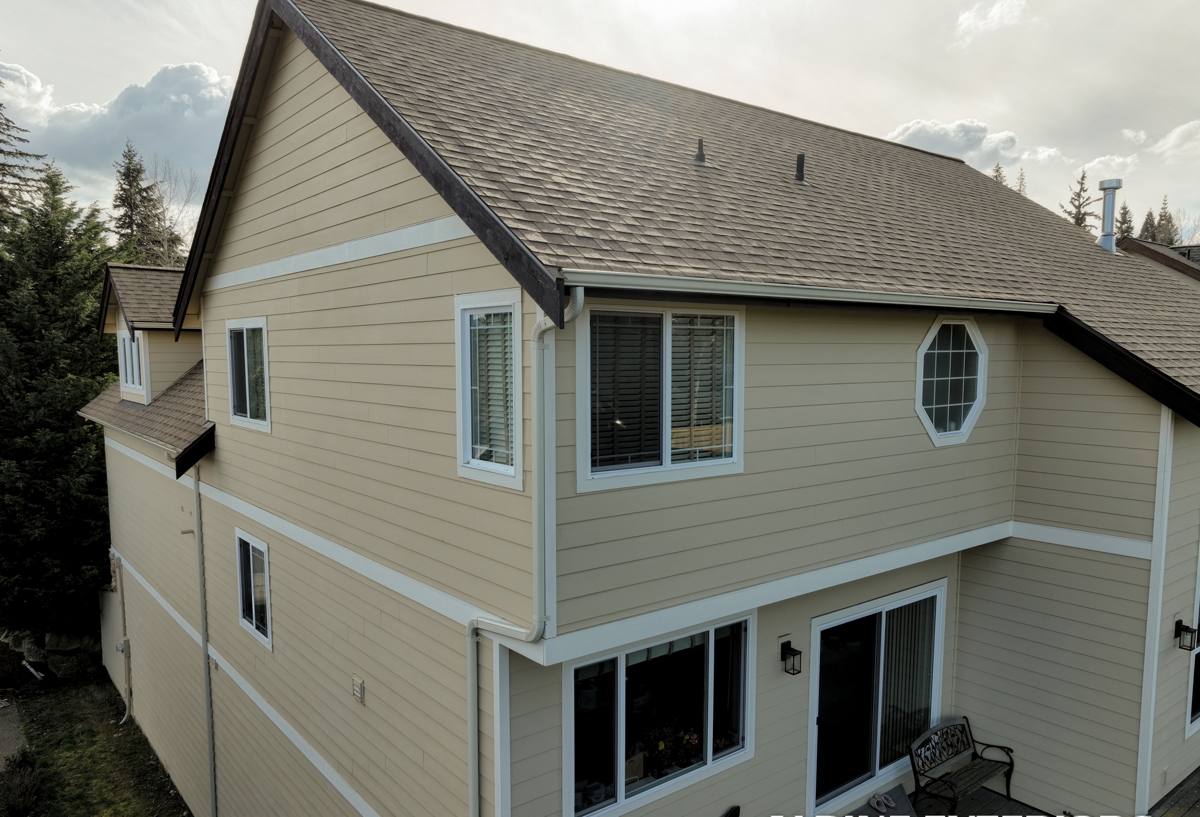
What Lyman's Weather Actually Does to a Roof
Rain Volume and Duration
It's not just how much rain falls — it's how long a roof stays wet. Skagit County gets long stretches of low-intensity rain and drizzle, sometimes for days at a stretch, rather than short heavy downpours. That means shingles, flashing, and underlayment stay saturated far longer than in climates with quick storms and long dry spells in between. Any weak point — a nail popped slightly proud, a valley with marginal flashing, a vent boot with a hairline crack — has more time to let water in before things dry out again.
Moss and Organic Growth
Shaded roof sections, north-facing slopes, and areas near trees are prone to moss colonization here for much of the year. Moss isn't just cosmetic. It holds moisture against the shingle surface, works its way under shingle tabs as it grows, and can lift edges enough to let wind-driven rain underneath. Left unaddressed for a few seasons, moss growth shortens shingle life significantly.
Salt Air and Metal Fatigue
Lyman is inland enough that salt exposure is lighter than at the immediate coast, but Skagit County as a whole still sees salt-laden air moving through on storm systems. Over years, that accelerates corrosion on unprotected metal flashing, nail heads, and vent components. It's a slower effect than moss or standing water, but it's part of why we don't treat every roofing detail as interchangeable with what a supplier in a drier region might spec.
What a Correct Asphalt Shingle Job Looks Like Here
Asphalt shingles remain one of the most practical roofing choices for this region — affordable, widely available, and, when installed correctly, genuinely durable in wet climates. "Installed correctly" is doing a lot of work in that sentence, though. For Lyman-area homes, that means:
- A high-quality synthetic underlayment as the actual waterproofing layer, not just a formality under the shingles — this is what keeps you dry if wind ever drives rain up under a tab.
- Self-adhering ice-and-water membrane at eaves, valleys, and any low-slope transitions, since these are where standing water and ice dams (on colder years) do the most damage.
- Balanced attic ventilation — intake at the eaves, exhaust at the ridge — so moisture-laden air isn't trapped against the roof deck, which is a major driver of both moss growth and premature deck rot in this climate.
- Corrosion-resistant flashing at every roof-wall intersection, chimney, and skylight, sized and formed for the actual roof geometry rather than a one-size patch.
- Proper nailing pattern and fastener count per the manufacturer's high-wind and warranty specifications — this is one of the most commonly shortcut steps and one of the most consequential.
- Shingle selection matched to sun and moss exposure on that specific roof, factoring in which slopes stay shaded and damp longest.
Shingle Options and How They Perform Locally
Not all asphalt shingles are the same product wearing different colors. For a roof that has to deal with sustained moisture and moss pressure, the differences below matter more here than they would in a drier climate.
| Shingle Type | Typical Lifespan Here | Moss/Algae Resistance | Best Use Case |
|---|---|---|---|
| 3-Tab (economy) | 15–20 years | Standard — no built-in resistance | Budget-driven projects, secondary structures |
| Architectural / Dimensional | 25–30 years | Better shed profile; often available with algae-resistant granules | Most primary homes in this climate |
| Algae-Resistant (AR) Architectural | 25–30 years | Copper-infused granules actively resist algae/moss staining and growth | Shaded roofs, tree-heavy lots, north-facing slopes |
| Premium/Designer | 30+ years | Usually includes AR granules and heavier mat construction | Steep-slope, high-visibility roofs where longevity and appearance both matter |
For most Lyman-area homes, we steer people toward an algae-resistant architectural shingle. The upfront cost difference over standard architectural shingles is modest, and given how much moss pressure this area sees, it's one of the better dollar-for-dollar decisions a homeowner can make on a re-roof.
Why We're Careful About Certain Roof Systems in This Climate
We get asked occasionally about low-slope or unconventional roofing approaches for additions or outbuildings. Our standard is to match the system to how well it sheds water and resists moss over time in sustained-moisture conditions — some assemblies require more precise, ongoing maintenance than most homeowners realistically keep up with here, and we'd rather steer a homeowner toward something lower-maintenance from the start than sell a system that looks fine on day one and becomes a headache by year five.
Our Process for a Lyman Roofing Project
- On-site inspection. We look at the existing roof deck, current ventilation setup, moss and moisture patterns, and any problem areas — valleys, chimneys, skylights — before we recommend anything.
- Written estimate with real specifics. Shingle line, underlayment type, ventilation plan, and flashing scope — not just a lump-sum number.
- Deck inspection during tear-off. We don't know the full condition of the plywood or planking underneath until the old roofing is off. If we find soft or rotted decking, we flag it and replace only what needs replacing.
- Full underlayment and flashing install per the climate-specific approach above, not a stripped-down version.
- Shingle installation to manufacturer nailing and exposure specs, with attention to how each slope on that particular roof will drain and dry.
- Final walkthrough so you understand what was done, what the ventilation setup is, and what basic upkeep (like moss treatment) will keep the roof performing as designed.
Roof Maintenance Checklist for Lyman Homeowners
A properly installed asphalt shingle roof in this climate still benefits from basic seasonal attention. This is what we recommend to homeowners after every install:
- Have moss growth treated or removed at the first sign of it — don't wait for a visibly thick mat to form.
- Keep gutters clear, especially going into fall, so water isn't backing up under the eave edge.
- Trim back overhanging branches to reduce shade and debris buildup on north-facing slopes.
- Have flashing around chimneys, skylights, and roof-wall intersections visually checked every couple of years.
- Confirm attic ventilation isn't blocked by insulation or debris — poor airflow accelerates both moss growth and deck deterioration.
- After any major windstorm, do a quick visual check (from the ground, or have us look) for lifted or missing shingles.
Why Local Roofing Experience Matters for Lyman Specifically
Lyman isn't a big town, and it doesn't get treated as a market unto itself by every contractor that works Skagit County. But its position along the river valley, its tree cover, and its distance from the coast versus places like Anacortes or La Conner all shape what a roof needs here — different sun exposure patterns, different moss timing, different wind behavior than a wide-open lot out toward the flats. A crew that already works this specific area knows which roof slopes tend to hold moisture longest, which valley details commonly fail on older homes nearby, and how to spec a job that will actually hold up rather than one that looks right on paper.
That local pattern recognition is worth more than it sounds like on a spec sheet. It's the difference between a roof that gets re-flagged for moss problems in year four and one that runs its full expected lifespan with routine, predictable upkeep.
Get a Straight Answer on Your Roof
If you're weighing a repair versus a full replacement, or just want an honest read on how much life is left in your current roof, we're happy to take a look. We'll walk the roof, tell you what we actually see, and put together a clear, no-pressure estimate — no scare tactics, no upsell on things your roof doesn't need. Reach out using the form below to schedule a free estimate for your Lyman-area home.