 Burlington
 Why La Conner Homes Need a Different Approach to Siding
La Conner sits where the Swinomish Channel meets Skagit Bay, and that location shapes everything about how siding performs here. Homes close to the water deal with a steady drift of salt air that ordinary paint and wood siding struggle to shrug off year after year. Add Skagit County's long wet season, near-constant marine moisture, and the shaded, slow-drying north walls common on older La Conner lots, and you have a climate that punishes any siding product not built for it. We install fiber cement siding on homes throughout the Burlington and La Conner area, and the jobs we get called back to fix are almost always the same story: a product that looked fine on install day and started failing within a few wet seasons because it wasn't matched to this environment.
Fiber cement siding, done correctly, is one of the few exterior products that holds up to salt exposure, repeated soaking, and the moss and algae growth that thrives in Skagit County's shade and humidity. But "fiber cement" is not one product — the material, the finish, and the installation details all matter, and getting any of them wrong shows up fast in a coastal microclimate like La Conner's.
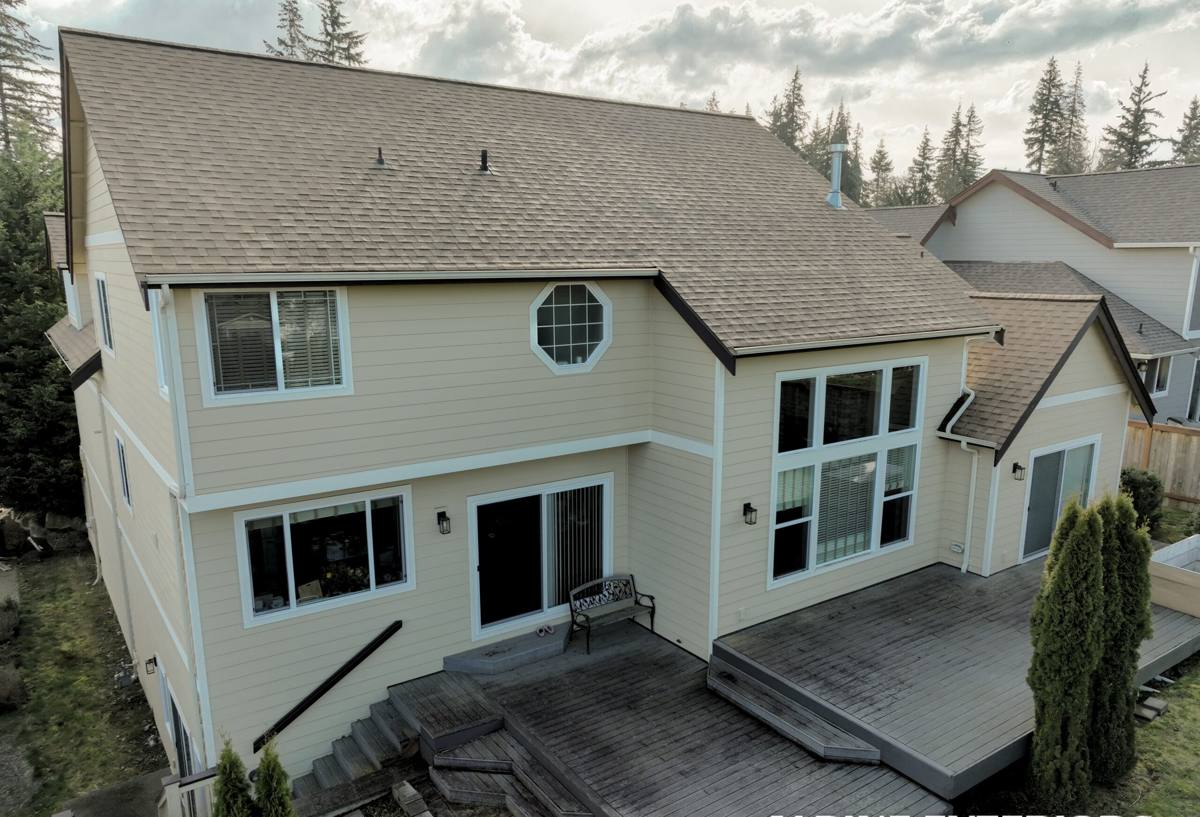
What Salt Air and Driving Rain Actually Do to Siding
Salt Air
Airborne salt is corrosive to fasteners and abrasive to finishes. On wood and engineered wood siding, salt-laden moisture accelerates paint breakdown, so a home that would need repainting every 7-8 years further inland might need it every 4-5 years within a mile or two of the channel. On metal trim and fasteners, salt exposure speeds up rust and staining if the wrong hardware is used.
Driving Rain
La Conner's exposure to wind off the water means rain doesn't just fall straight down — it drives sideways into wall assemblies, wall penetrations, and any gap in flashing or caulking. Siding that isn't installed with a proper water-resistive barrier, correct flashing at windows and doors, and the right clearances at grade will let that driving rain find its way behind the cladding, where it does damage you can't see until it's expensive.
Moss and Algae Season
Shaded walls, gutters that hold moisture, and Skagit County's long stretch of overcast, damp months create ideal conditions for moss and algae growth on north- and east-facing elevations. Porous or absorbent siding materials hold that moisture and feed the growth; siding with a factory-baked finish sheds it far more easily and cleans up without stripping the surface.
Why Fiber Cement Fits This Climate
Fiber cement is a mix of Portland cement, sand, and cellulose fibers, cured into a dense, dimensionally stable board. Unlike wood or wood-composite siding, it doesn't swell, rot, or delaminate when it gets wet, and it isn't a food source for the moss, algae, and insects that a marine climate encourages. It's also non-combustible, which matters on properties near dry brush or with wood-heavy neighboring structures.
We install James Hardie fiber cement exclusively. Hardie manufactures specific product lines engineered for different climate zones — including HZ5 formulations built for wetter, harsher conditions like western Washington's — and backs the material with a factory-applied ColorPlus finish that's baked on rather than field-painted. That finish is the biggest single factor in how well siding resists fading and dirt/algae buildup in a climate like La Conner's, and it's a meaningful upgrade over primed board that gets painted on site.
Why We Don't Install Everything on the Market
We get asked fairly often about vinyl, LP SmartSide, cedar, and other fiber cement brands. Each has a place in the industry, and we're not going to tell you they're junk — that's not honest and it's not our call to make about a whole category of product. What we will say is why we chose to standardize on one system rather than carry several:
- Vinyl expands and contracts with temperature and can crack or blow off in wind-driven storms; it also isn't a great match for a climate where driving rain regularly tests every seam.
- Primed wood and cedar require ongoing maintenance — repainting, caulking, and moisture monitoring — that gets harder to keep up with in a climate this wet, and failures (rot, insect damage) are often hidden until they're advanced.
- LP SmartSide and other engineered wood products use a resin-treated wood strand core that performs well in many climates but is more sensitive to sustained moisture exposure at cut edges and butt joints than cement-based siding — a real consideration this close to the water.
- Other fiber cement brands exist, but we've found Hardie's climate-specific engineering, factory finish consistency, and installation documentation to be the most reliable fit for what Skagit County throws at a house.
Standardizing on one product also means our crews install it constantly — they know its fastening patterns, clearances, and flashing details cold, instead of switching methods from job to job.
What a Correct Fiber Cement Installation Involves
The material is only half the equation. Most siding failures we're called to look at in this area trace back to installation shortcuts, not the product itself. A correct install for a La Conner home includes:
- A continuous water-resistive barrier behind the siding, lapped correctly so water sheds outward at every seam
- Proper flashing at every window, door, and roof-to-wall intersection — the most common failure point in driving-rain climates
- Correct fastener spacing and type, including corrosion-resistant fasteners appropriate for salt-air exposure
- Minimum clearance from grade, decks, and roof lines so siding never sits in standing moisture
- Properly caulked and back-primed cut edges, since an exposed cut edge is where moisture intrusion typically starts
- Ventilation behind the cladding where the wall assembly calls for it, so incidental moisture can dry out instead of getting trapped
Skip any one of these and you can end up with premature paint failure, staining, or moisture damage behind the siding — even with a top-tier material installed over it.
Our Process for a La Conner Project
- On-site assessment. We look at your home's exposure — how close to the water, how much shade, current condition of the walls and trim — before recommending a product line or approach.
- Removal and inspection. Once old siding is off, we check sheathing and framing for hidden moisture damage, which is common on homes that have had wood or composite siding in this climate for years.
- Repair before covering. Any compromised sheathing or framing gets addressed before new siding goes on — covering up a moisture problem just hides it.
- Water barrier and flashing installation. This is the step that determines how the wall performs in driving rain, and it's not visible once siding is up, so we don't rush it.
- Hardie siding installation to manufacturer spec, with attention to fastening, clearances, and cut-edge treatment.
- Final walkthrough covering trim, caulking, and touch-up before we call the job done.
Cost Factors for La Conner Fiber Cement Projects
Every home is different, but the factors that most commonly move the price on a La Conner job are below. We don't post fixed pricing because siding scope varies too much home to home — but this gives you a sense of what drives the estimate.
| Factor | Why It Matters |
|---|---|
| Home size and wall complexity | More corners, gables, and dormers mean more cutting, flashing, and labor time |
| Current siding removal | Tear-off and disposal of existing material adds time versus a bare wall |
| Sheathing/framing repair | Hidden moisture damage found during removal has to be fixed before new siding goes on |
| Product line and profile | Lap, shingle, and panel profiles, plus HZ5 versus standard formulations, price differently |
| Trim and accessory scope | Corner boards, window trim, and fascia work add to material and labor |
| Access and site conditions | Waterfront lots, tight setbacks, or limited equipment access can affect labor time |
Why Local Experience Matters in La Conner
A crew that mostly works drier, inland climates doesn't always default to the flashing details, fastener choices, and clearances that a marine environment demands — not because they're careless, but because it isn't what they run into every day. Working across Burlington and the surrounding Skagit County towns, including La Conner, means we see the same salt-air staining, moss buildup, and driving-rain failure points repeatedly, and we build our installation checklist around them rather than treating them as exceptions.
We also know which elevations on a typical La Conner home tend to hold moisture longest and need the most attention during install, and which details are worth the extra time even when they're not strictly required by code.
Maintaining Fiber Cement Siding in This Climate
Fiber cement is low-maintenance, not no-maintenance. In a climate like this, a homeowner gets the most out of the material by:
- Rinsing siding periodically to remove salt residue and prevent algae/moss buildup, especially on shaded walls
- Keeping gutters clear so overflow doesn't run down the siding face
- Keeping vegetation trimmed back from walls to allow airflow and drying
- Watching caulked joints at trim and penetrations and having them refreshed if they crack or pull away
- Repainting on the schedule appropriate to the finish — ColorPlus factory finish extends this interval well beyond field-painted siding
If you're weighing siding options for a home in or near La Conner, we're glad to walk the property with you, point out what your specific exposure demands, and give you a straightforward, no-pressure estimate — just fill out the form below.