 Burlington
 Big Lake's Climate Is Tougher on Siding Than It Looks
Big Lake sits in a pocket of Skagit County that looks calm on a summer afternoon and feels completely different in November. Homes ringing the lake sit under heavy tree cover for most of the year, which means less direct sun, more standing moisture on exterior walls, and shaded siding runs that simply don't dry out as fast as a wall facing open sky. Add in driving rain off Puget Sound, wind that funnels moisture-laden air inland through the Skagit lowlands, and a moss season that can stretch from fall through spring, and you've got a climate that punishes any siding product with a weak point at the seams, fasteners, or bottom edge.
This isn't a knock on Big Lake — it's a genuinely nice place to live, with the shade and water that make it desirable also being exactly what makes exterior materials work harder. Siding here needs to shed water fast, resist sustained dampness without swelling or rotting, and hold its finish through repeated wet-dry cycles without cracking, peeling, or feeding mold and algae growth. That's the standard we install to on every Big Lake job, and it's why we don't offer anything but James Hardie fiber cement.
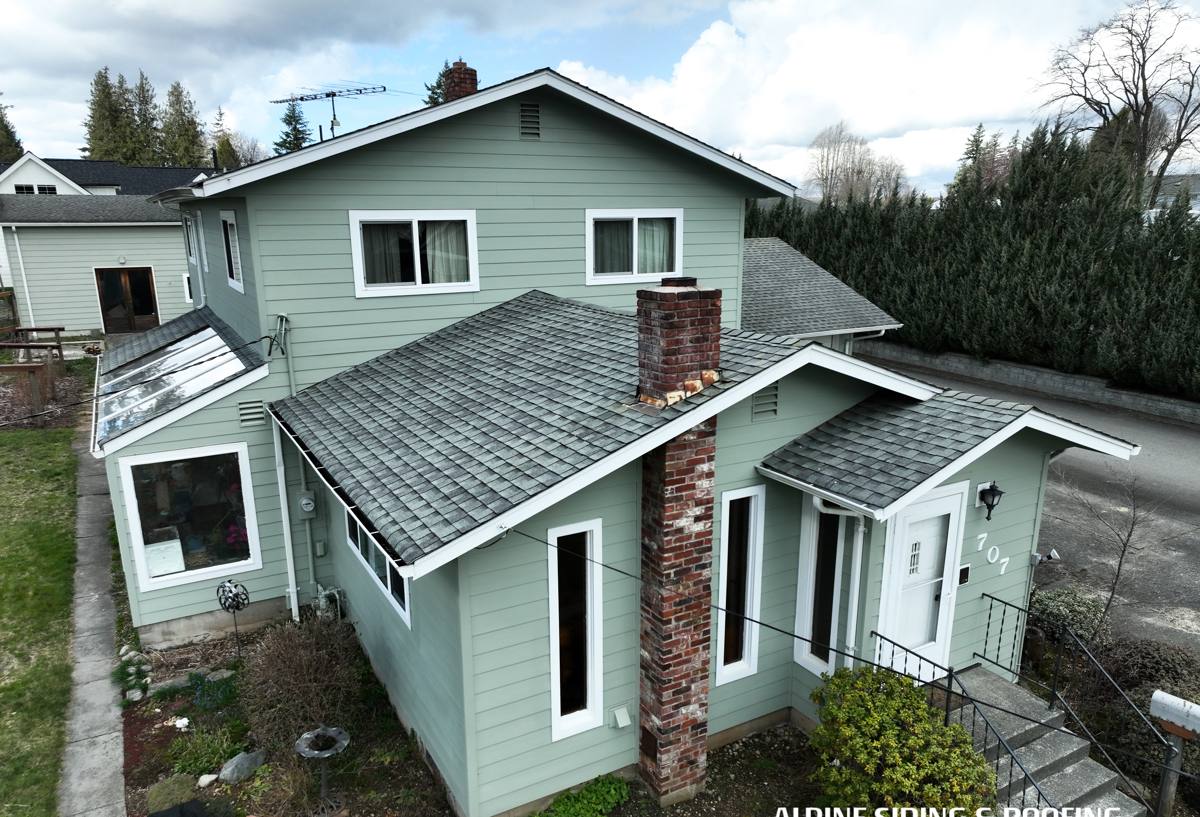
Why James Hardie Fiber Cement Holds Up in This Climate
James Hardie siding is fiber cement — a mix of cement, sand, and cellulose fiber pressed and cured into planks and panels. It doesn't absorb water the way wood-based products do, and it doesn't expand and contract with temperature swings the way vinyl does. For a shaded, damp lot near Big Lake, that matters more than color or texture options.
Built for the Pacific Northwest Specifically
Hardie engineers its products by climate zone, and the Skagit County area falls into the HZ5 zone — Hardie's designation for regions with sustained moisture exposure. HZ5 formulations are engineered with that moisture load in mind, which is a meaningfully different product than a generic fiber cement board designed for a dry climate.
ColorPlus Finish Matters More Under Trees
Hardie's ColorPlus Technology is a factory-applied, baked-on finish rather than site-applied paint. In a shaded, humid environment, field-applied paint is fighting an uphill battle — it's drying slower, curing less completely, and more likely to trap moisture underneath. A factory finish cured under controlled conditions holds its color and its bond to the substrate far more consistently, which shows up as fewer touch-ups and a longer stretch before repainting is even a conversation.
What a Correct Installation Actually Involves
Fiber cement siding is only as good as the installation behind it. Most of the complaints we hear about siding failure — cracking, staining, soft spots, paint peeling at the seams — trace back to installation shortcuts, not the material itself. On a Big Lake home, where the siding is dealing with more sustained moisture than a sunnier lot would see, those shortcuts show up faster.
Flashing and Water Management
Every window, door, and horizontal trim transition needs proper flashing and a drainage plane behind the siding — a rain screen or weather-resistant barrier that lets any moisture that gets past the surface find its way back out instead of sitting against the sheathing. On a shaded, tree-covered lot, this is not optional detail work; it's the difference between siding that lasts and a wall that rots from the inside out while looking fine from the street.
Fastening, Gaps, and Clearances
Hardie specifies exact nail placement, gap spacing between panels, and clearance from grade, roofing, and decking. Panels installed too tight against each other or fastened incorrectly can't move the way they're engineered to, which leads to buckling or cracked caulk lines. Ground clearance matters even more near a lake, where soil holds moisture longer after a storm.
Caulking and Sealant Details
Every joint needs the right sealant, applied correctly, at every seam and penetration — hose bibs, light fixtures, vents. A missed or thin caulk joint is a small thing that becomes a big thing after a winter of driving rain and a spring of moss buildup trapping moisture against it.
How Hardie Compares to the Alternatives in This Climate
We get asked why we don't offer vinyl, LP SmartSide, or cedar as options. Each of those products has legitimate uses elsewhere — but for a shaded, moisture-heavy lot like Big Lake, the trade-offs stack up against them.
| Factor | James Hardie Fiber Cement | Vinyl | LP SmartSide (engineered wood) | Cedar |
|---|---|---|---|---|
| Moisture behavior | Doesn't absorb water; won't rot or swell | Doesn't absorb, but seams and J-channels trap moisture | Wood-based; vulnerable at cut edges and seams if moisture gets in | Absorbs moisture; needs consistent maintenance to prevent rot |
| Moss and algae resistance | Non-organic surface, factory finish resists growth | Can host moss/algae in shaded, damp conditions | Wood fiber surface can feed organic growth if finish fails | Natural wood readily hosts moss in shade |
| Finish longevity | Factory-baked ColorPlus finish, long fade/chip resistance | Color molded through material but can chalk and fade | Factory-primed; still needs field topcoat and maintenance | Requires refinishing every few years |
| Fire resistance | Non-combustible | Combustible, can melt/deform near heat | Combustible | Combustible |
| Typical lifespan when correctly installed | Decades, with strong transferable warranty | Long-lived but prone to warping/cracking over time | Shorter if moisture management fails | Shorter without diligent upkeep |
None of this means the alternatives are junk products — it means that for the specific conditions around Big Lake, we've made a professional call to install only the material that gives homeowners the fewest ways for moisture to win.
Our Process, Start to Finish
Assessment and Measurement
We start by walking the exterior, noting shaded and exposed elevations separately, checking existing moisture damage, ventilation, and where water currently sheds off the roof onto walls. Big Lake homes often have different exposure needs from one side of the house to the other, and that shapes the flashing and drainage plan.
Tear-Off and Prep
Old siding comes off, sheathing gets inspected for hidden rot or soft spots (common on shaded walls that have been trapping moisture for years), and any damaged sheathing is repaired before a single new panel goes up. A weather-resistant barrier and rain screen go on next, set up to actually drain rather than just get covered over.
Installation
Panels and trim go up to Hardie's fastening and gap specifications, with flashing detailed at every window, door, and horizontal break. This is where the difference between a correct install and a fast one is decided — and it's not visible from the curb once the job is done.
Final Walkthrough
We walk the finished exterior with the homeowner, checking seams, caulk lines, and trim details, and go over what basic upkeep looks like going forward.
What It Costs — and What Actually Drives the Price
We don't post fake per-square-foot numbers because the honest answer is "it depends," but here's what actually moves the price on a Big Lake project:
| Cost Factor | Why It Matters |
|---|---|
| Tear-off vs. new construction | Removing and disposing of old siding, plus repairing any hidden sheathing damage, adds labor beyond the siding itself |
| Home size and wall complexity | More corners, dormers, and trim transitions mean more cutting, flashing, and labor hours per square foot |
| Siding profile and plank size | Lap siding, panel systems, and shingle-style products all install differently and price differently |
| Access and lot conditions | Shaded, sloped, or tree-crowded lots common around the lake can slow staging and require more careful protection of landscaping |
| Trim, soffit, and fascia scope | Full exterior packages (trim, soffit, fascia) cost more than siding alone but close off more of the moisture entry points that cause problems later |
We'll walk your specific home and give you a real number based on what's actually there — not a rough guess based on square footage alone.
Keeping Big Lake Siding Looking Right Year After Year
Correctly installed Hardie siding is low-maintenance, not no-maintenance. A little seasonal attention goes a long way in this climate:
- Rinse shaded walls and north-facing elevations once or twice a year to clear moss spores before they take hold — a garden hose is usually enough, no pressure washer needed
- Keep gutters clear so water sheds away from siding instead of running down the wall face
- Trim back branches and shrubs that keep siding shaded and damp longer than necessary
- Check caulk lines at trim and window edges every year or two and touch up any that have cracked or pulled away
- Address any soft spots, staining, or bubbling paint promptly rather than waiting — small issues are cheap to fix, hidden moisture problems aren't
Why a Crew That Already Works Big Lake Matters
Siding installation isn't identical from one lot to the next. A crew that already works this area understands how shade patterns move across a lakeside lot through the day, how much longer a north-facing wall stays wet after a storm compared to one that catches afternoon sun, and how the local permitting and inspection process works in Skagit County. That local familiarity shows up in fewer surprises mid-job and a finished install that's actually built for the wall it's on, not a generic textbook wall.
It also means we're not disappearing after the invoice clears. A local crew has a reputation in the community to protect and is around the following winter if a question comes up.
Get a Straight Answer for Your Home
If you're weighing a siding replacement on a Big Lake home, we're happy to take a look, tell you honestly what your exterior needs, and give you a clear estimate — no pressure, no inflated scare tactics about your current siding. Fill out the form below and we'll set up a time to walk the property.