 Burlington
 Building Decks for an Island Climate, Not a Catalog Climate
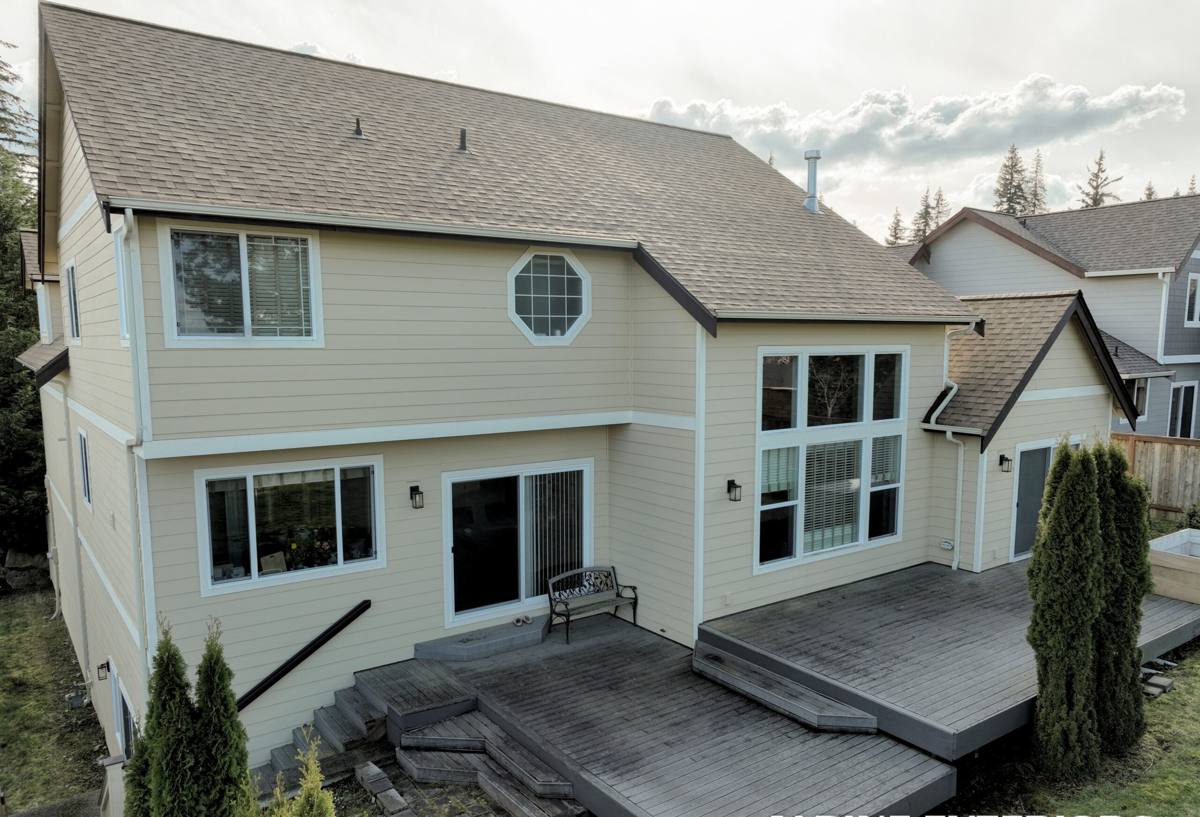
A deck on Guemes Island lives a different life than one built a few miles inland. It sits closer to open water, takes wind and salt spray straight off the Sound, and spends a good part of the year under a marine layer that never fully dries out. Add in the shade from mature evergreens on many island lots, and you get a surface that stays damp longer than almost anywhere else in Skagit County. None of that means a deck can't last for decades out here — it means the build has to account for conditions a generic deck spec was never written for.
We work throughout the Burlington and greater Skagit County area, and Guemes Island projects get planned with the ferry schedule, the exposure, and the moisture load in mind from day one. This page covers what actually matters for a deck built to hold up on the island — not a general "how decks work" overview.
What Salt Air, Rain, and Moss Actually Do to a Deck
Salt air and corrosion
Airborne salt doesn't just affect decks on the immediate waterfront — it travels on wind across the whole island and settles on any exposed metal. Standard fasteners and hardware that would be fine in a drier, inland yard can start showing rust and pitting within a few seasons out here. Once a fastener corrodes, it loses grip strength long before it looks obviously bad, which is why fastener choice matters more on Guemes Island than almost any other single decision.
Driving rain and moisture load
Storms coming off the water tend to drive rain sideways, not straight down. That means water finds its way into joints, ledger connections, and post bases that a purely vertical rain would never reach. A deck built to a minimum code standard for a dry climate often has gaps in flashing and drainage that only become a problem once wind-driven rain is part of the equation.
Moss and algae growth
Shade, humidity, and long stretches without direct sun are a perfect combination for moss and algae. On decking surfaces this isn't just cosmetic — moss holds moisture against the boards, and on wood it accelerates rot at the exact spots where boards contact joists and each other. On composite decking, algae growth in low-sun, poorly ventilated areas is one of the most common complaints homeowners have, and it's almost always tied to how the deck was designed and framed, not just the material.
Material Choices That Hold Up on the Island
There's no single "best" decking material for every Guemes Island home — the right call depends on sun exposure, budget, and how much upkeep you actually want to do. Here's how the common options compare under this specific climate:
| Material | Salt air / corrosion resistance | Moss and algae behavior | Maintenance |
|---|---|---|---|
| Pressure-treated wood | Good if fasteners are upgraded; wood itself handles moisture reasonably well when sealed | Prone to moss in shaded, damp spots unless kept sealed and cleaned | Highest — needs regular sealing/staining and cleaning |
| Cedar | Naturally rot-resistant but softer; still needs corrosion-rated hardware | Similar moss risk to treated wood in shade | High — periodic oiling or sealing to maintain appearance |
| Capped composite | Excellent — synthetic core and cap don't corrode | Algae can grow on the surface in shaded, low-airflow areas; cleans off easier than wood | Low — occasional washing |
| PVC decking | Excellent — fully synthetic, no organic material to feed rot | Same surface algae risk as composite in shade; smooth surfaces rinse cleaner | Low — occasional washing |
We'll walk through these trade-offs with you honestly rather than steering everyone toward the highest-margin product. A well-sealed wood deck on a sunnier, more open part of a Guemes Island lot can perform just fine; a heavily shaded, wind-exposed spot is usually a better case for composite or PVC.
Fasteners, Framing, and Footings Built for the Exposure
This is where most of the long-term performance of a deck actually gets decided, and it's mostly invisible once the project is done.
- Fasteners and hardware: we use stainless steel or heavy-coated, corrosion-rated fasteners and structural connectors rather than standard galvanized hardware, especially for anything close to the water side of the island.
- Post bases and footings: footings are sized and set to handle both the wind loads this exposure sees and the wetter, sometimes softer soil conditions common on parts of the island.
- Joist spacing and airflow: we frame with enough clearance and spacing underneath the deck for air to actually move, which is one of the biggest factors in how fast moss and algae take hold on the underside and low-sun edges.
- Beam and post material: pressure-treated or engineered lumber rated for ground contact and exposure, not standard framing lumber, wherever the structure is close to grade or moisture.
Drainage and Ledger Board Details That Prevent Rot
The ledger board — where the deck attaches to the house — is the single most common failure point on any deck, anywhere, and driving rain makes it worse. Proper flashing behind and over the ledger, with a drainage gap so water can't sit trapped against the siding or rim joist, is not optional in this climate. We also grade and slope decking surfaces slightly so water sheds off rather than pooling, and we keep board gaps consistent so water and debris can pass through instead of collecting.
On the ground level, we think about where water goes after it leaves the deck. A deck that drains water straight into a foundation planting bed or against a crawlspace vent is just relocating a moisture problem, not solving it.
Our Process for Guemes Island Deck Projects
Site visit and planning
We look at sun exposure, wind direction, existing drainage patterns, and access to the build site before we design anything. A deck plan that ignores which direction the weather comes from on your particular lot is guessing, not planning.
Ferry and logistics scheduling
Guemes Island is ferry-access only from Anacortes, so we plan material deliveries and crew days around the ferry schedule up front rather than discovering the logistics mid-project. That means fewer surprise delays and a more predictable timeline for you.
Permitting
Deck projects on the island typically fall under Skagit County permitting requirements. We handle the permit process as part of the project so you're not left figuring out county requirements on your own.
Build and walkthrough
We build to the framing and material standards above, then walk the finished deck with you — covering how to maintain it and what to watch for given your specific lot's sun and wind exposure.
Maintenance Checklist for Island Decks
Whatever material you choose, a little seasonal attention goes a long way in this climate. Here's what we recommend homeowners on Guemes Island stay on top of:
- Sweep debris and standing organic matter (leaves, needles) off the deck regularly — it's the main food source for moss and algae.
- Rinse or lightly scrub shaded areas at least once or twice a year, even on low-maintenance composite or PVC decking.
- Check fasteners and visible hardware annually for early signs of rust or loosening.
- Inspect the ledger board area and any flashing for staining or soft spots, especially after a hard winter storm season.
- Keep gutters and downspouts near the deck clear so runoff isn't dumping extra water onto or under the deck.
- Re-seal or re-stain wood decking on the schedule recommended for the product — don't wait until it's visibly gray or worn.
Why Hiring a Crew That Already Works Guemes Island Matters
A contractor who's never priced a ferry-dependent job before will either underbid the logistics and run into delays, or pad the bid heavily to cover their uncertainty. We already know how to schedule materials and crew time around the ferry, we already build with corrosion-rated hardware as a default rather than an upcharge, and we already frame for the wind and moisture exposure specific to the island rather than a generic mainland spec. That experience shows up in fewer surprises during the project and in how the deck performs five and ten years down the road, not just on the day it's finished.
We also know that "waterfront-adjacent" doesn't mean "waterfront" — plenty of Guemes Island lots are set back from the shoreline but still get the same wind, salt air, and moss pressure. We build to that reality for every deck on the island, not just the ones with a water view.
Get a Straightforward Estimate
If you're planning a new deck or replacing one that's showing its age on Guemes Island, we're happy to take a look and walk you through honest options for your site, sun exposure, and budget. Use the form below to request a free, no-pressure estimate.