 Burlington
 Composite Decking Built for Bow's Coastal Conditions
Bow sits close enough to Samish Bay and Padilla Bay that salt-laden air is a constant, not an occasional visitor. Add Skagit County's long wet season and the shade cover that comes with the area's fir and cedar tree lines, and you've got a recipe that wears out an ordinary deck fast. Composite decking earns its keep here because it doesn't absorb moisture the way wood does, doesn't need annual staining, and holds up to the combination of salt exposure and near-constant dampness better than most alternatives — but only when it's installed with that environment in mind. A composite deck put together the same way you'd build one in a dry inland climate will still trap moisture, grow moss, and loosen hardware within a few seasons.
This page covers what a composite deck actually needs to hold up in Bow specifically — not composite decking in general — and how we approach the build so it performs for the long haul.
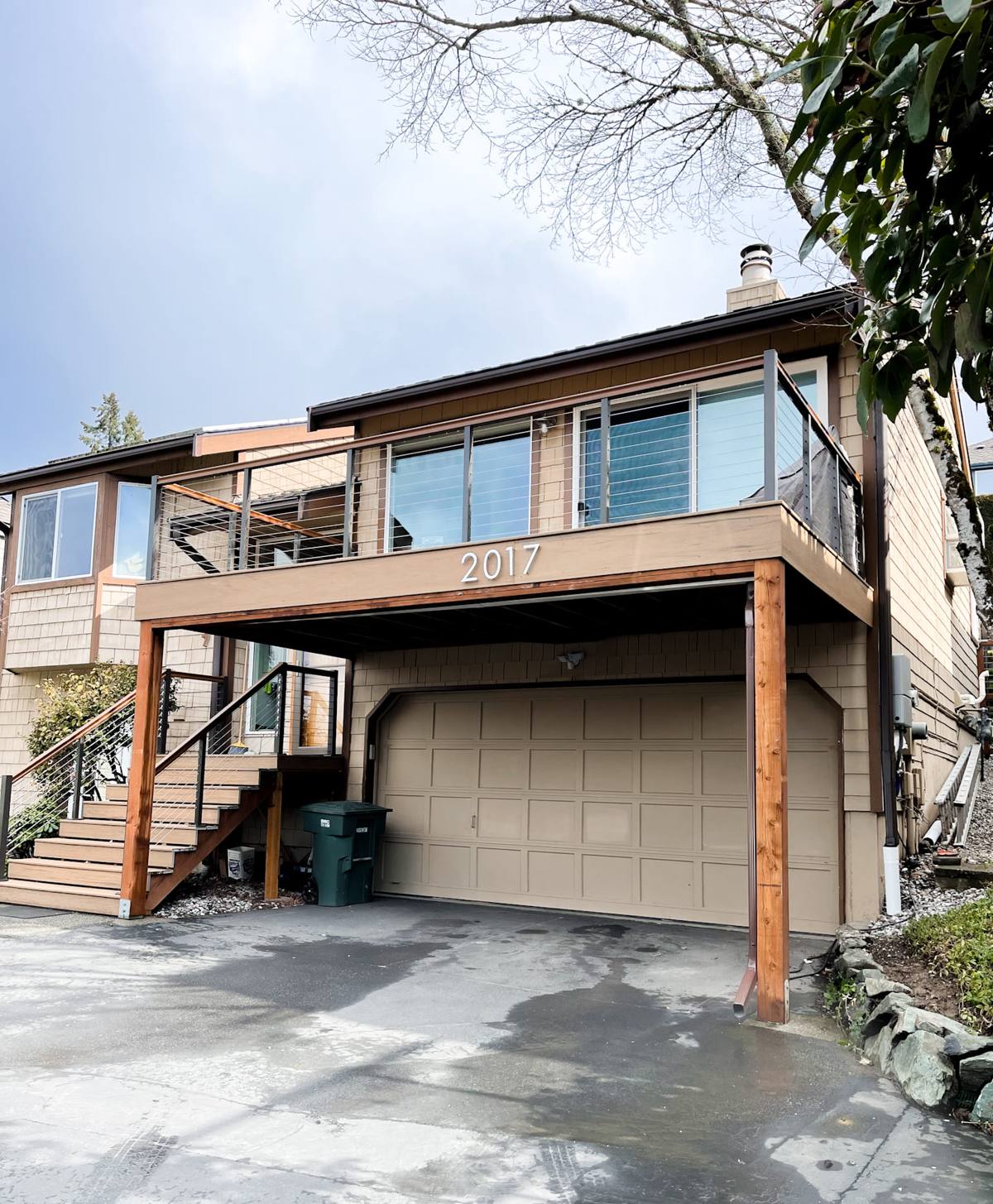
What Salt Air, Driving Rain, and Moss Actually Do to a Deck
Salt Air and Hardware
Salt-laden air accelerates corrosion on anything metal — fasteners, joist hangers, railing brackets, and structural screws. On a lot of decks we're called to repair, the boards themselves are fine but the fasteners underneath have corroded to the point of failure. That's a hardware and substructure problem, not a decking material problem, and it's the first thing we account for on any Bow project.
Driving Rain and Water Path
Wind-driven rain off the bay doesn't fall straight down — it gets pushed sideways under railings, into ledger connections, and along the underside of boards. If a deck's water path isn't planned out (flashing at the house connection, proper board spacing, drainage below the frame), water finds the one spot that wasn't protected and sits there.
Moss and Shade
Skagit County's moss season runs long, and Bow's tree cover and marine humidity make it worse. Moss doesn't just look bad on decking — it holds moisture against the board surface, can make composite boards slick underfoot, and works its way into gaps between boards and around fasteners where it's harder to reach. A deck built with tight airflow underneath and the wrong board spacing will grow moss faster and hold it longer than one built with drainage and ventilation in mind.
What a Correct Composite Deck Build Involves
Composite boards are only as good as what's underneath and around them. The parts of the job that don't show once it's finished are the parts that determine whether the deck is still solid in ten years.
Substructure
- Pressure-treated or composite-compatible framing sized correctly for the span and load
- Joist tape over every joist top to keep fasteners from sitting in standing moisture
- Corrosion-resistant, coated or stainless fasteners rated for coastal exposure
- Footings set below frost depth and sized for Bow's often-saturated ground conditions
Flashing and Ledger Connection
Where the deck attaches to the house is the single most common failure point we see on older decks in this area. Proper flashing — installed so water sheds away from the house rather than behind the ledger board — matters more here than in drier climates because of how much wind-driven rain the structure has to shed over a season.
Board Spacing and Airflow
Gapping between boards needs to account for composite's expansion and contraction with temperature and moisture, but it also needs to let water and debris pass through rather than pool. Underneath, the frame needs enough clearance and airflow to dry out between rain events instead of staying damp continuously through the winter.
Hidden Fastener Systems
Most composite decking today uses a hidden fastener clip system rather than face-screwing through the board. Done correctly, this keeps the board surface free of screw holes that would otherwise become another spot for water and moss to collect.
Composite Decking Options
Not all composite boards behave the same way in a marine climate, and the differences matter more here than they would somewhere dry and sunny. The main distinction is whether the board is fully capped (a protective polymer shell around the entire board) or capped only on the top and sides.
| Feature | Fully Capped Composite | Capped-Top / Uncapped Composite |
|---|---|---|
| Moisture resistance | Best — sealed on all sides, including cut ends when properly capped | Good on top surface; cut ends and underside more exposed |
| Moss and mildew resistance | Higher — smoother, sealed surface sheds moisture faster | Moderate — more surface texture can hold moisture longer |
| Upfront cost | Higher | Lower to moderate |
| Fit for Bow's climate | Well suited to sustained salt air and rain exposure | Workable, but needs more attention to drainage and maintenance |
We'll walk through the specific product lines and warranty terms during your estimate rather than push one option — the right choice depends on your budget, how exposed the deck is to weather, and how the deck is used.
Our Process From Estimate to Finished Deck
1. On-Site Walkthrough
We look at sun and wind exposure, existing drainage, the condition of any structure being replaced, and how the deck ties into the house. In Bow, we're also checking tree cover and how much moss exposure the location is realistically going to get.
2. Structural Plan
We size the frame, footings, and hardware for the actual span and load, not a generic template. If your lot has soft or consistently wet ground — common in parts of Skagit County — footing depth and drainage get extra attention.
3. Permitting
Deck projects in unincorporated Skagit County areas like Bow typically require a permit depending on size and height. We handle that process as part of the job so it's not left to you to sort out.
4. Build
Framing, flashing, joist tape, decking, and railing go in with hardware and details specified for coastal exposure, not standard-issue fasteners that will corrode early.
5. Walkthrough and Close-Out
We go over the finished deck with you, including what routine maintenance actually looks like for your specific board choice and site conditions.
Cost Factors for a Bow Composite Deck
Composite decking costs more upfront than pressure-treated wood, but the maintenance savings and lifespan usually make up the difference over time. What actually moves the price on a given job comes down to a handful of factors:
| Factor | Why It Affects Cost |
|---|---|
| Board tier (capped vs. capped-top) | Fully capped boards cost more per square foot but need less long-term upkeep in salt air |
| Substructure condition | Replacing rotted or corroded framing adds cost but is not optional if it's compromised |
| Site access | Some Bow properties have longer driveways or tighter access that affects material staging and labor time |
| Footing and ground conditions | Saturated or soft soil may require deeper or additional footings |
| Railing system | Composite or metal railing systems vary widely in price and corrosion resistance |
| Deck size and layout | Stairs, multiple levels, and custom shapes add labor beyond straightforward square footage |
Maintenance in a Moss-Prone, Salt-Air Environment
Composite decking is low-maintenance compared to wood, but "low" isn't "none" — especially in Bow's climate. A little seasonal attention keeps moss from getting a foothold and keeps hardware from becoming a problem before it's visible.
- Rinse the deck surface a few times a year to clear salt residue, pollen, and organic debris before it breaks down into a moss-friendly film
- Sweep leaves and needles out of board gaps regularly, especially under tree cover — trapped debris holds moisture against the board
- Clean with a soft-bristle brush and a composite-safe cleaner rather than a pressure washer on high pressure, which can damage the cap surface
- Check railing posts and stair connections annually for any looseness, which can signal fastener corrosion underneath
- Keep gutters and downspouts near the deck clear so runoff isn't dumping extra water onto or under the structure
- Trim back overhanging branches where practical to cut down on both moss growth and debris buildup
Why a Crew That Already Works in Bow Matters
A lot of what makes a composite deck last in this area isn't in the product spec sheet — it's in details like which fastener coatings actually hold up to the salt air off the bay, how much drainage a substructure needs given how wet the ground gets here, and what Skagit County's permitting process actually requires for a project this size. A crew that's built decks throughout Burlington and the surrounding communities, including Bow, has already worked through those specifics rather than learning them on your project.
We're also familiar with the practical side — road access, delivery logistics for a rural or waterside lot, and scheduling around the wetter months so the build isn't fighting the weather the whole way through.
If you're considering a composite deck for your home in Bow, we're happy to come take a look and walk you through what your specific site needs — no pressure, no obligation. Use the form below to request a free estimate.